


Last week, I sat down with residents of the industrial town of Wisconsin Rapids who are working to prevent a data center in the middle of their city. This week, I went to Port Washington, where a data center is already under construction. I spent time with the neighbors and residents closest to the site. They are angry, heartbroken, and not backing down.
You may have seen headlines about Port Washington if you’ve been following the fight against data centers; friends and colleagues of mine with no connection to Wisconsin have heard about arrests at city council meetings, an attempted recall, and the landslide passing of a tax benefit referendum drafted in response to the data center.
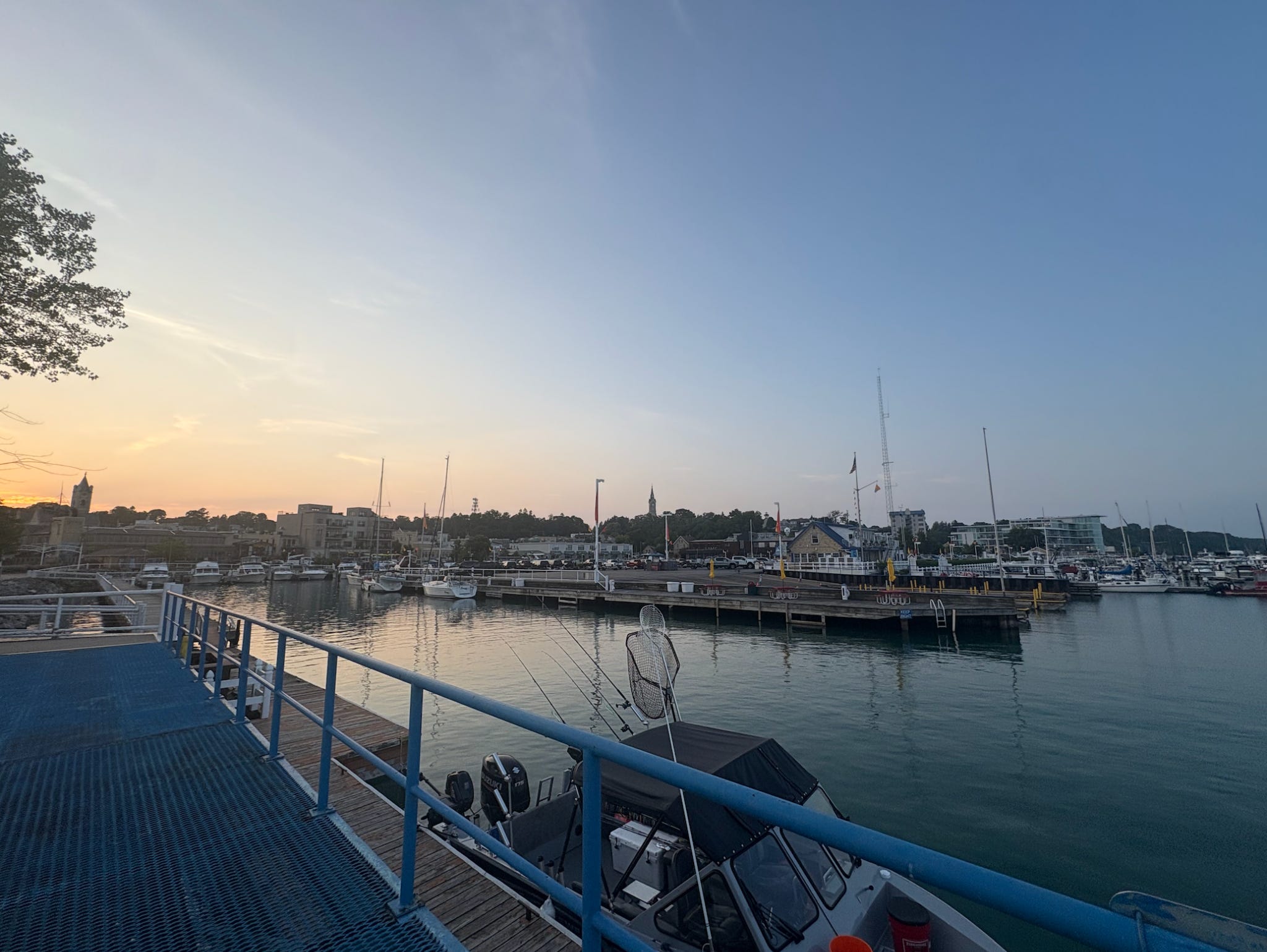
Port Washington, Wisconsin is beautiful. On the shore of Lake Michigan, half an hour north of Milwaukee, a fishing town with a historic marina, and in the summers, it’s lush, vibrant, and a major hub for bird watching. It’s been compared to small town New England.
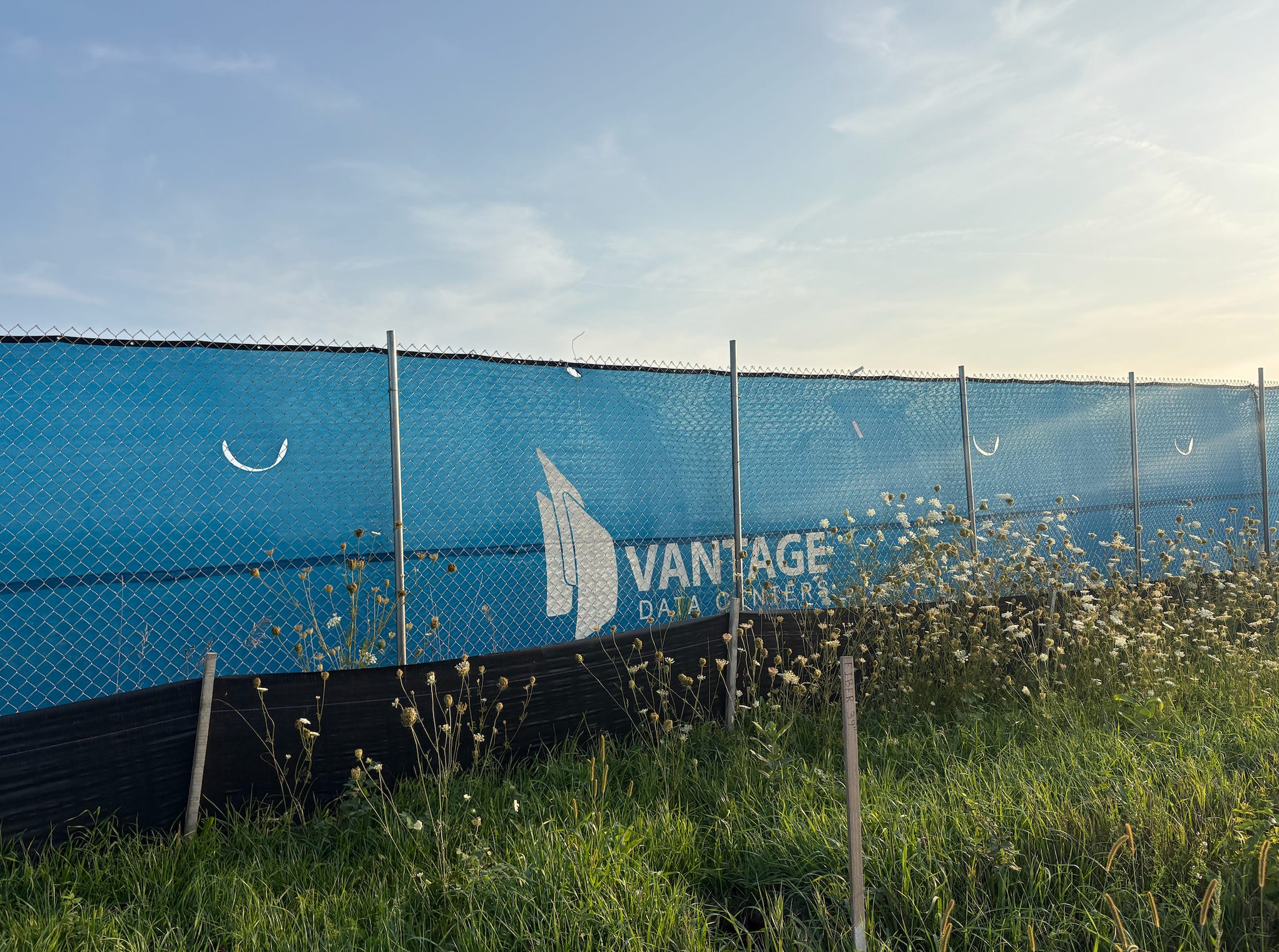
I drove right along the under-construction data center, all three-square-miles of it, on my way to meet the neighbors and organizers. It’s contained in blue privacy fencing with “Vantage Data Centers” branded every so often. I was meeting some members of Great Lakes Neighbors United, a group started by local residents that’s been one of the major voices of opposition to its development.
The neighborhood really is right next to the site. I walked up to the door of the address I’d been given via email; there was a note taped to it saying to walk right in and leave your shoes on, with a smiley face. The whole kitchen counter was a buffet. A couple of UW-Milwaukee journalism students were already chatting with some of the neighbors at the kitchen table. They all smiled, welcomed me, and encouraged me to take some food.
I found Amanda — the homeowner, I eventually learned — sitting on a couch on the back porch overlooking a lush garden. We immediately started chatting about our shared love of hiking and the beauty of Wisconsin’s nature in the summertime. It’s the reason she chose to move and buy a home here in retirement, all the way from San Antonio.
Conversations edited for length and clarity.
Amanda: We always thought this was a special place that time just forgot about. And I’m just so afraid. These people are just not prepared for what’s going to happen. And it’s unfair — they didn’t ask for it. They didn’t. This is nothing they had any say over. It was literally shoved down their throats.
We would go and we would yell at the mayor. I kept on saying, ‘Slow down, slow down. Take your time. You’re not thinking this through.’ And the reason I can say this is because I’m from San Antonio, Texas, and I lived next to three data centers for the last ten years. So I knew what was coming, and I knew how they did it.
That’s what was so hard about watching this come in. And seeing these people, a lot of these people have been here all their lives. It’s all they’ve ever known. And to see what’s going to be the change in culture, the change in everything. They don’t know what’s coming.
Tracy and Jeff joined us on the porch couch next. Tracy is a mother and mental health advocate whose family has been in Port Washington for three generations. Jeff moved to Port from Milwaukee in retirement; he shows up with a “No Data Center” button pinned to his ballcap. Both live in town, a couple miles from the data center, but have family in close proximity to the site. They, and Amanda, are members of Great Lakes Neighbors United.
Tracy: [GNLU] was started last year here. It’s basically a group to help those around the data center. I mean, it first started here, and now we’re branched out to help other data centers, other people who don’t know what to do about a data center coming to their town. We’re just trying to help spread the word of what could happen.
Native Wisconsinite Charlie Berens, a well-known journalist and comedian who has been leading and assisting with anti-data-center advocacy around the state, wore a Green Bay Packers tie in a video about Port Washington approving the massive data center in August of 2025. It now has over two and a half million views, and was how some Port residents learned what was imminent.
Tracy: So last year, after I heard of the Charlie Berens video, I left the council meeting when they were still doing the public speeches. And I was walking home out of frustration. I’m just thinking, what are we gonna do? This could be detrimental for the environment. I had lots of questions going through my mind trying to think, what happens if this? What happens if that?
So I went on Facebook to see, is there any group that’s talking about what to do about a data center, saying no to this data center that’s coming to Port Washington or anywhere? And I couldn’t find anything.
So I created a group, shared it saying, ‘Hey, for those who went to the council meeting, I created this so that we can share helpful information on what to do, what not to do.’ And then from there, I got a few people, and I asked, ‘Hey, can I please get some help with monitoring the group?’ Because I have a full time job taking care of my kids. And from there a few people volunteered to help. One of them was actually a school classmate, and she’s the one that started Great Lakes Neighbors United.
In a state and locale that places so much value on nature and the environment, residents were appalled to learn no environmental impact report had been conducted. The state’s Department of Natural Resources has faced existential budget cuts in the last two decades — devastating for a state with a storied history of environmentalism.
Jeff: That’s the whole problem here to me, is the [DNR] cuts. Tony is taking care of the whole Ozaukee County.
JJ: One guy?
Jeff: One guy. That’s Tony. Tony’s the man. And if that’s happening here though, I mean, imagine some other areas.
JJ: Wisconsin Rapids can’t get ahold of a representative. They just get sent back information sheets.
Jeff: There you go. And probably because their rep is, who knows, in Iron county or something, 150 miles away from them. So. I guess we’re lucky we got Tony.
Cuts to the DNR made it easier for an environmental impact report to be overlooked. The group found out via Freedom of Information Act requests, however, that Vantage was directly involved in the omission.
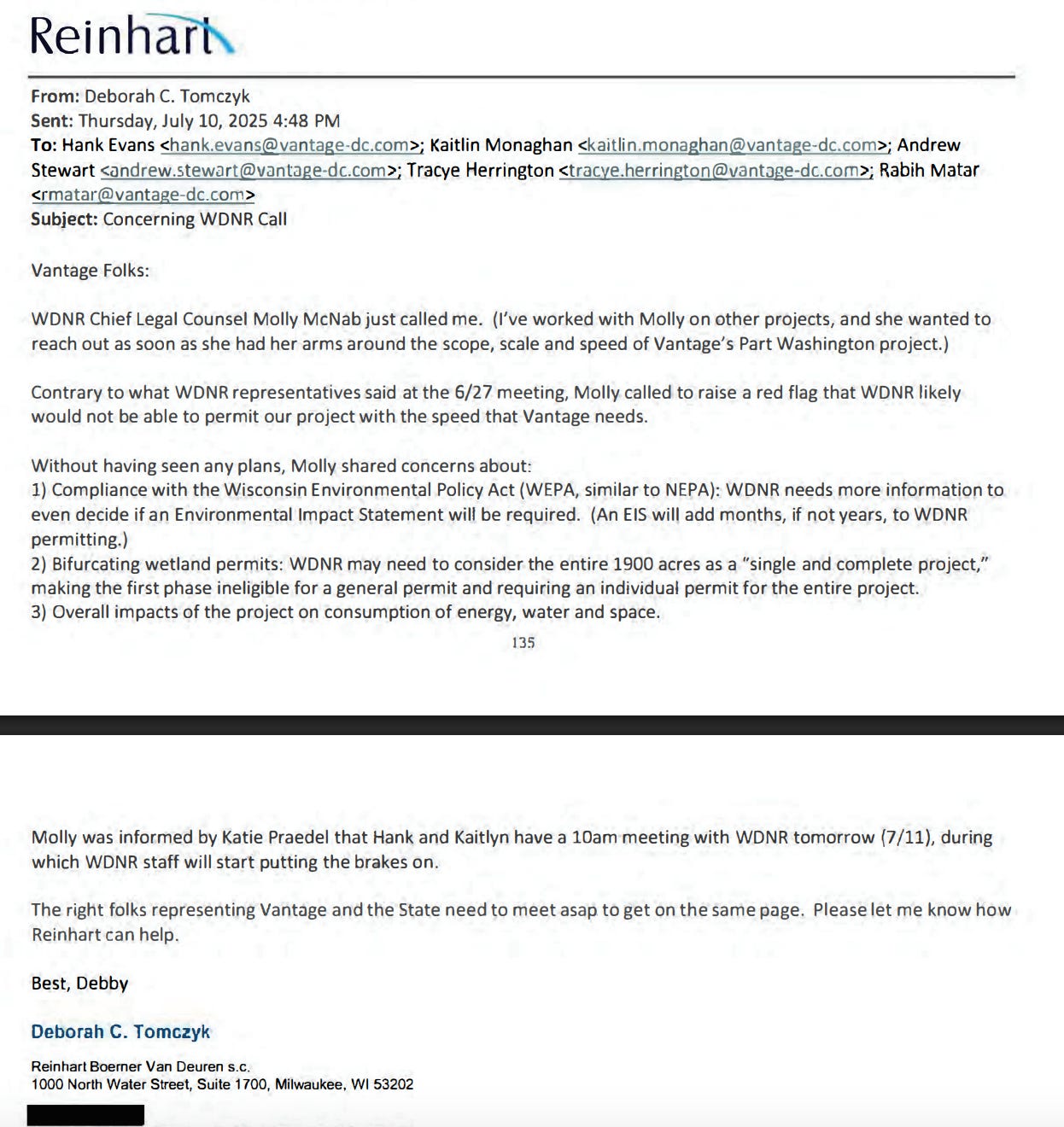
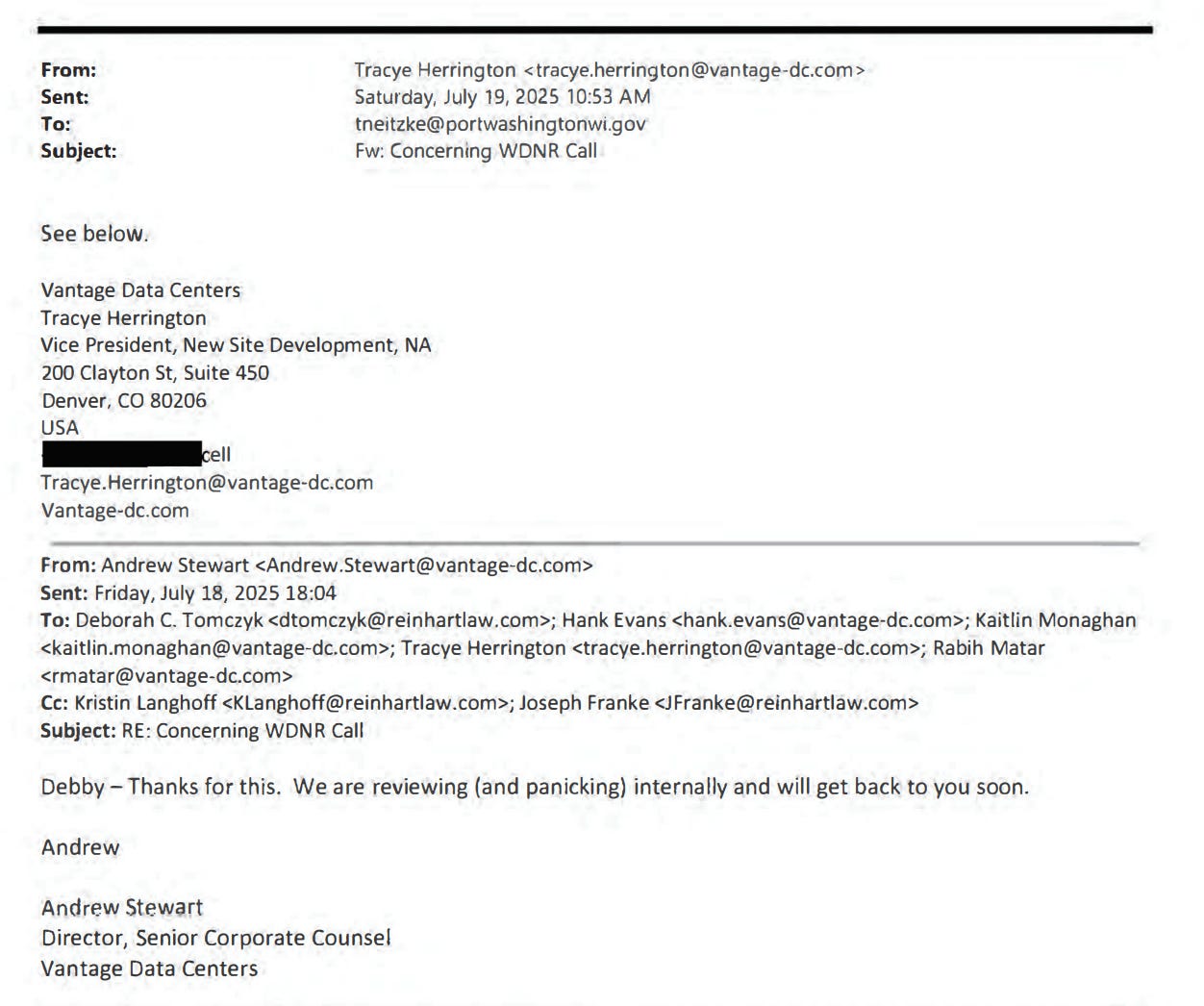
Amanda: Come to find out — we did a FOIA on them, we actually got records on it — Vantage was really upset. They’re like, ‘If we have to do an environmental impact study, this project will not go forward.’ And the mayor said, and I can show you the emails, the mayor said, ‘Let me make some calls.’ And two weeks later, they’re like, ‘Clear.’
No environmental impact study was done. He went to Governor Evers. Governor Evers greenlit it. Which is a shame. I wish I could suck back that vote that I voted for him because he was always Mr. Conservation.
Tracy: There was something that Vantage needed them to look over. I think it was the generators, the emergency backup generators that they were supposed to approve of. But they basically let it slide because, if they approved it, it would have killed the project.
Jeff: Yeah. They didn’t do the environmental impact statement. I have concerns about the contaminants. And maybe not me, but are we going to have the worry in 15 years for — I have grandkids a mile away from it.
Amanda: We’re on a bluff. I mean, you’re 80 feet above the lake right now. Bluffs are notoriously unstable. They have a tendency to slide down and take houses with them. There’s an association of engineers that assesses your bluff for integrity. That was never done. You know, I mean, your bluff should have integrity. I told Heidi, when all the vibration was going — She lives on top of the bluff. And I’m like, ‘I need you to go to bed at night with a life jacket and a crash helmet, because you’re gonna end up in the lake,’ you know. That’s the worst thing you can do to a bluff. And not one study was done.
Heidi is another neighbor in the subdivision, and also has deep Wisconsin roots. She and Amanda have kept a close eye on the site as Vantage moved in. It’s hard not to, frankly. There’s one road in and out, and it goes past the data center.
Heidi: I don’t know if you drove around it yet or up to it, but you’ll see blue plastic that goes around it. It says ‘Vantage.’ That thing is three miles square. That’s huge. They put up the, you know, the plastic, and they started just raping the land.
Amanda was driving her car down, and she saw a pile of dead deer. And they must have just— They didn’t care. We’re all big conservationists, you know, and environmentalists. They must not have cared anything about the wildlife within the walls of that fencing that they put up. And I’m sure those deer were so terrified when they started all this heavy equipment. They’re probably running in there, breaking their necks, breaking their legs. They had stacked up dead deer. And she was going to take a picture, and this security guard caught her. He came, and goes, ‘Put that phone down.’ She said, ‘I can take a picture.’ Is she a fighter or what?
Yeah. She said, ‘This is a city street. I can stand in the street and take pictures.’ He said, ‘I’m gonna take your phone and smash it.’ So that’s the kind of thing that was from day one. That’s the kind of thing we put up with.
It doesn’t stop them from taking any opportunity to walk or ride bikes along those roads. They jokingly call it their “spy ride.” If they notice any updates or new information, they let each other know. They certainly won’t be intimidated.
Amanda: It was like dawn, it was a Sunday. And I’m like, I’m gonna see. So I took my lawnmower, and I have a pretty beefy lawnmower. And it’s got a flag that says ‘bite me’ on it. I’m like, you know what, I’m gonna see what the reaction time is. I’m gonna see what would happen. So I went up to the road, and I waited until there was no traffic whatsoever, and I just gunned it. Two and a half minutes. I had four of them on me, asking me what I was doing. And I said, ‘I’m gonna mow.’ And he goes, ‘where?’ I’m like, ‘I don’t have to tell you where I’m mowing. I’m just mowing.’ And he goes, ‘Give me some ID.’ I’m like, ‘I’m on a mower. Where am I gonna put an ID?’
It should be noted: this was Vantage’s private security, not local police. She did not legally have to show them ID. It’s unclear if they were legally allowed to ask her for one.
Christine, who had invited me to speak with them, joined us in the yard next. She was born and raised in neighboring Washington County, and is almost finished earning her PhD in social anthropology.
I’d seen the disturbing videos of arrests at Port’s city council meeting the year prior. Christine was one of them. While recounting it, she and the others kept laughing in disbelief.
Christine: When I was arrested and dragged out of the common council meeting, the mayor was then interviewed because they were asking him about it. He said, like, ‘Well, you know, she’s an outside agitator.’ And then they said, ‘The women who were arrested? So they didn’t come from the city of Port Washington?’ And he had to say yes.
Tracy: They all came from the city of Port Washington.
JJ: So that was you!?
They laughed again.
Christine: Oh yeah.
Tracy: You’re famous.
JJ: Were you charged with something?
Christine: Disorderly conduct. Yes. They appointed a special prosecutor, first of all. And then they tried to give us a deal, saying, ‘Oh, we’ll knock it down to loud and unruly noise.’ And it’s like a discount on the fine of, like, 50 bucks.
More laughter.
Tracy: She said ‘Recall’ three times as she was going back to her seat.
Christine: And people were clapping.
Tracy: People were clapping. So it was just her voice over the clapping and stuff.
Christine: And like I said, not unusual compared to any of the behavior in the past.
Tracy: What was unusual was the officer, the. The sergeant at the time — now he’s retired — he quietly went to Christine to say, ‘I need you to leave’. And it’s like, you’re doing this as someone else is now speaking.
Amanda: If anybody should have been arrested, it should have been me and that neighbor, because we attacked Teddy [the mayor, Ted Neitzke IV]. We were screaming at Teddy, and it was— It was really fun. It was really kind of fun.
They had a lot to say about the mayor. In several different conversations, longtime residents told me it was common knowledge that he’d been a bully in high school. He won because he ran unopposed. They said he’s been frequently taunting and condescending to residents opposing the data center. They referenced reporting I’d been following myself this month, Jasmine Sun’s data center work in the midwest, during which she met and drove around with Port Washington’s mayor. She described how he compared himself to Theodore Roosevelt, blamed Charlie Berens, journalists, and “outside agitators” for the opposition, and how he proudly told her there’s nothing he would have done differently in communicating with residents about the center.
Tracy brought up that quote from the mayor, to a chorus on the porch of “How cold can you be?” and “Heart wrenching.”
Tracy: Yes, I saw that. And I used that against the mayor at the last council meeting because it’s like, how could you be so heartless to not even take into consideration what’s going on? Like, I’ve heard so many people complaining about how this is destroying their lives.
Advocating against the data center — even just advocating for more information and transparency regarding it — is affecting their lives, too. One member has had cupcakes thrown at her house. A member of the GNLU who is a naturalized US citizen has recently begun receiving odd paperwork from the Census demanding an immediate response and threatening vague consequences if not. Several members have received odd anonymous letters.
Tracy: I won’t even go into details about this letter, but it was so morbid that I took it to the police. And I looked up the address of where it came from. It’s an abandoned building from Illinois. And I’m like, what in the world’s going on? That’s why I put up the security camera, because I fear for my children’s safety. I fear for my safety. And it’s never been like that for Port. It’s like, you could just keep your door open. No one’s gonna barge in. You could keep your doors unlocked for your cars. Now? No.
There have been other people within Great Lakes Neighbors United that have spoken out, that have gotten some iffy letters and they’re not signed from a person or organization, it’s basically from the same address that I got. Yeah, we don’t know who it is.
I mean, I’m not gonna stop what I think or what I’m for. But those fears are out there nowadays. Definitely.
They’re also highly aware of how this data center could be used. OpenAI and Oracle intend to move in once it’s built. Nobody can give them clear answers on what will be stored, produced, or developed there, but neighbors notice the intense security and surveillance already.
Amanda: AI in itself, I mean, without having your community destroyed, just the fear of what are they gonna do with this. When you came here and you crossed that road, I don’t know if you noticed or not, but you went through seven Flock cameras. When you leave, you’ll see them. There’s seven Flock cameras on the corner. There’s only one way out of this subdivision. So every time we leave, they know exactly what our patterns are. They know. If a friend of mine comes over and gets in my car, the Flock camera reads your license plate, and they can ping their phone to find out who I’m riding with, just from their cell phone.
I mean, this is the way surveillance is. And we’re in the baby stages of it. Why do they need so much surveillance? Why do they need to know everything that we’re doing, every place that I’m going, what my schedule is?
Yeah, I have a lot of questions, and I’m so afraid that I wasn’t really concerned until Anthropic was dropped and they picked up Oracle, that they’re going to militarize Oracle. This is the largest data center going. They’re really investing a lot into this one, especially with security. Is this going to be another military installation? Is this going to be there — are we building the end of the world?
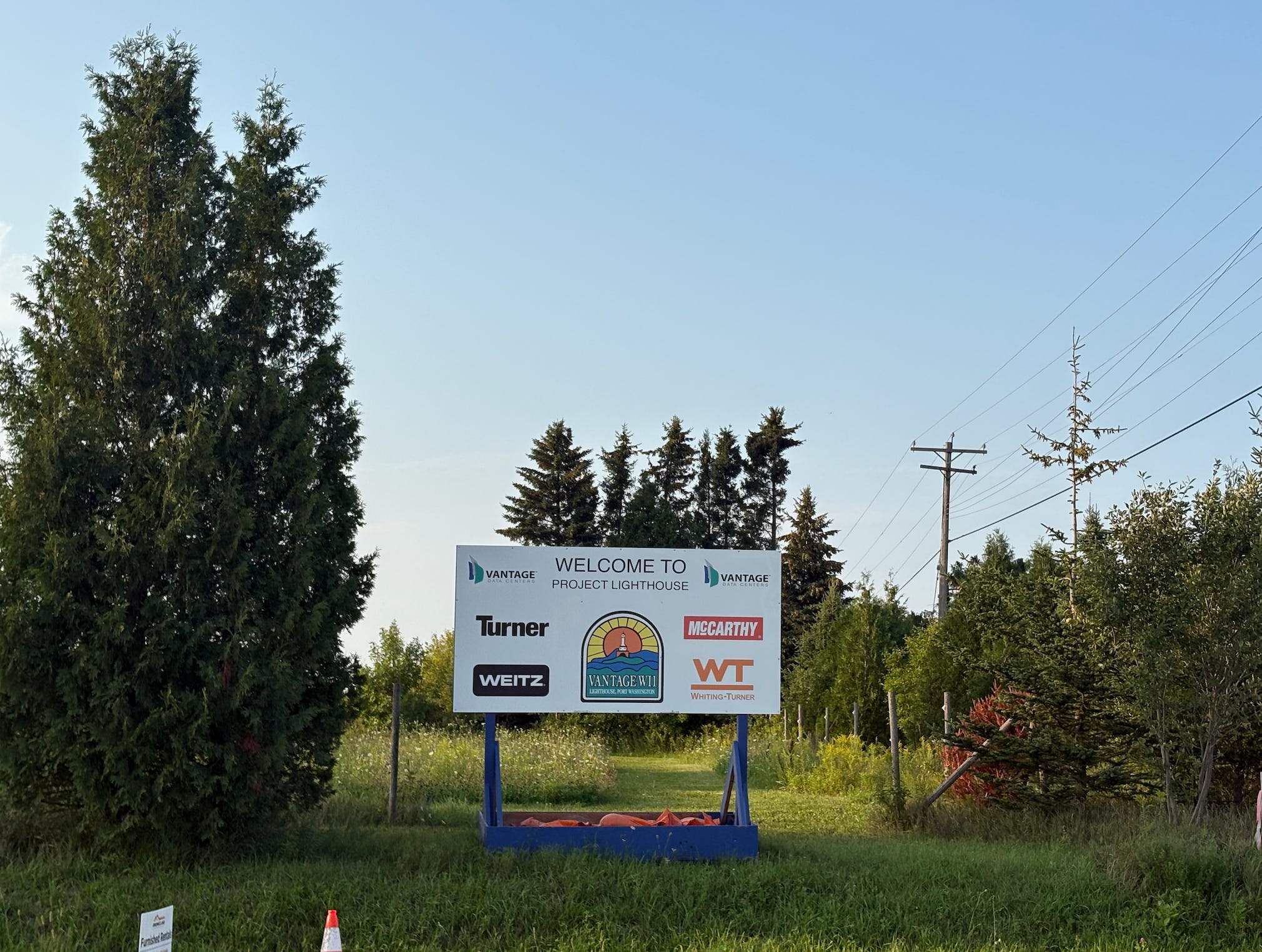
Moving away isn’t an option. Residents didn’t know it was coming until it was too late. Their property values have plummeted. They’re trapped.
Amanda: I had a realtor come last week to talk to me, and he pretty much said if I want to sell the house, I have to [lose] 150,000 to 300,000 because nobody will live next to a data center. No one. So we lost that much value on our house already. I tried to sell it last year before shovels even went in the ground. Then as soon as I disclosed it with the data center, I had two full price offers torn up right in front of me.
I cannot sell this house. And what’s worse is the realtor told me not only can I not sell this house, but I also can’t go look at other houses because it’s contingency. And once they see the address and then I’m so close to the data center, they’re like, we’re not taking that. So I can’t even look at other houses.
Jeff: I can tell you, with my son being that close to it, he kept saying something was going on, but for a year ahead of time, nothing was brought out with what was actually going on. When the signing came, we were at all the monthly meetings.
I’m still against it. I’m still affected by the constant traffic today. You can drive through and you can see the dust in the air, and that’s minimal of what’s been going on. And that’s not even what’s coming.
Water contamination is a massive concern. In the neighborhood next to the data center, every house has its own well. Even more urgently, a walking distance away is Lake Michigan.
Currently, more than 30 million people get their drinking water from the Great Lakes. The five lakes are one massive interconnected watershed. They account for over 20% of the Earth’s accessible fresh water, and over 80% of North America’s. They are an indispensable ecosystem to the health and future of millions. The stakes of the health of that water are indescribable.
Vantage is already using Port Washington’s water in ways that are legally dubious. The neighborhood next to it is most immediately threatened. With no environmental impact report, there is not adequate information on the effect it will have on the Great Lakes.
Jeff: I’ll call it the far fetched hope that we could still stop the project. Hopefully they can’t get water, because now they want to use well water. And I mean, to me, that’s crazy to begin with, but crazier yet is that they’ve allowed them to use these wells all the way up to this point.
If that were you or I demolishing something to say, ‘We’re putting up a barn here,’ that well would have been capped and covered and sealed. Yep. No, not for Vantage. Vantage can.
Jeff: We’re battling with these wells right now. They need the water first, you know, or the approval, and they keep using it when they’re not supposed to.
Tracy: They have the water.
Amanda: They’ve been using it all along.
JJ: So what happens, they just get fined?
Jeff: No, you don’t hear of fines.
Tracy: They won’t get fined.
Jeff: Are you going to start having contaminants because you’re sucking the bottom of a well? I know when the water goes down, there is none.
There’s also the water usage that’s being used by a power plant, because they intake Lake Michigan’s water and run it through and use that for cooling. Now you heat up the bay, now it evaporates more. And that’s just a simple concept that I’m grasping. There’s other ways that it’s going down while they’re using it. So I mean, it’s not just the water they’re using there, it’s the water they’re also going to be using at the power plant.
Heidi: If you have never seen that, you don’t realize. It’s spewing out warm water. There’s warm water going out into Lake Michigan. We’re not the only city that does that. We’re just one of many. You know, Milwaukee, over in Michigan they’re doing it. So it’s not a small deal. It’s a huge deal.
Amanda: And then you’ve got ambient heat because a data center that big is gonna change the air temperature ambiently around it. It could be, it could be 2 to 3 degrees anywhere to 16 degrees. And that’ll change the whole ecosystem.
Port Washington is already a unique microclimate because of the atmospheric effects of the Great Lakes system. Residents dryly call the area the “Cancer Crescent.” Once again, they have no answers for how the data center, its water usage, or the inevitable new power sources required to power it will affect the safety of the air and atmosphere.
Christine: The air quality is a huge question that people have.
Tracy: Ozaukee county already has bad air quality as is.
Christine: Yeah. It does not meet the federal standards for ozone.
Amanda: You know, maritime winds, they always prevail from the north. And then most of our winds always come from the west. If you watch the weather at all in the summertime from Milwaukee to Sheboygan, they’ll always be ozone alerts for the area. We call it the Cancer Crescent, which is, you know, a bad name, but it’s because the ozone always pools. They built a data center right in the middle of where this air does this. So not only do we have air that’s not going to dissipate, it’s going to literally stagnate right over us. So whatever pollution we get from that thing, if they do have to run gas turbines, which is what they’re threatening to do, it’s amplified. It’s going to be. I mean, there is no control. We did not have an environmental impact study done.
Christine: Actually yesterday marked a year, August 19th, when the developers’ agreement was signed. It was Aug. 19, 2025, and a couple of us went to the common council meeting. It was full of people from the surrounding counties who were finding out just then that they were going to be affected by power lines coming through their properties. And that was the same day that our developers’ agreement was signed.
So, like, all of our attention in the city of Port Washington was on the data center site itself, you know, where we were focused on that. But then it’s like, well, wait, yeah, how is this thing going to be powered?
Now it’s looking like the transmission lines are becoming increasingly delayed. But they don’t even know if they have transmission lines ready. We don’t actually know where they would plug into, like, the energy source. You’ve got this transmission line to nowhere, basically. That’s why we’re really concerned about on-site power generation being an option, because that’s what Vantage has used. In Sterling, Virginia, they found a loophole with which they could run generators 24/7. And those were diesel generators. But we’re also very concerned about the methane gas turbines. Like what’s happened in Memphis with Elon Musk.
The data center isn’t in the city of Port Washington itself, but in the township slightly to the north. That’s made avenues for official opposition even more complicated.
Amanda: We actually are outside agitators. We live the closest to it and we’re, we don’t live in the city of Port. We live in the town of Port. And that data center took up two thirds of our town. So we’re the little sliver that’s left. We’re kind of gerrymandered, so we don’t get any tax breaks. We don’t get any tax incentives. We can’t vote. We can’t vote against the mayor, we can’t vote for the mayor, we can’t do anything. And we’re suffering the worst from it.
And my biggest thing is, we’re an experiment. We’re guinea pigs. It’s like, can you live with this thing?
Christine: My sister ran into the guy who was heading up security when they first started, like in January. Her friend got to talking with this guy, and he’s like, ‘Well, you know, locals. They always put up a fight in the beginning, but then, you know, they just get used to it. They’ll quit their complaining.’
So that’s the mentality. ‘These locals who are in the way.’ Yeah, we’re in the way.
Everyone, from those who moved to the area in the last decade to those whose families have lived there for generations, told me the process of bringing in Vantage has changed Port Washington’s culture for the colder and more impersonal. It’s a good time to insert that on the homepage of Vantage’s website, they tout their slogan: “Where innovation, sustainability and respect for communities are built in from the start.”
Tracy: Growing up, it was a quaint little town, city. Very pleasant, very, very friendly. Like your Southern small town where everyone’s waving to you. And now with the data center in, it feels like there’s so much tension that it’s losing it. Because of all the stress that the data center’s brought, it’s changing the culture. It’s really changing the culture. It’s like it’s lost its charm. It’s lost. It’s like almost friendliness, almost.
Right now, I’m advocating for mental health because I’ve seen people getting stressed, people losing sleep, and when I’m talking to them, I let them just let their frustration go because it’s like, don’t bottle it in right now to the point that someone breaks around here. I mean, it could be a crisis for their family, or it could be a crisis, let’s say they do something stupid within the city at some event, school, whatever, there could be a shooting, there could be a death. There’s that kind of fear of what could happen if mental health is not taken into consideration. So that’s why for the past couple months I’ve been going to the board meetings to advocate for the city to provide mental health to residents. Because I can tell you mental health is not cheap to get.
Jeff: Animosity throughout the entire city of Port. When I was canvassing, we all got along, we had block parties where we loved one another. Now, you can’t talk to half of the people and they don’t talk to you because of this issue.
Cassie Steiner, a senior campaign coordinator with the Sierra Club’s Wisconsin Chapter, told me they are already seeing more and more American climate refugees, and that many from regions affected by droughts, hurricanes, tsunamis, and tornadoes are already looking to the Great Lakes region as a climate safe haven.
The incentivization and deregulation of data centers in the region will have a detrimental effect on its environment, incomparable to its previous industrialization. The scale of electricity data centers use is magnitudes larger than a standard factory or mill.
Steiner told me a recent study warned the water in the Great Lakes is not renewable in the way water resources usually are. “If there’s enough water withdrawn from that watershed, and it’s being put back elsewhere, or evaporated up and raining down elsewhere, that changes the characteristics of the water, how much there is, what level of pollution there might be,” she said. “I think we take clean water for granted at some points. It’s a huge concern here. And that water is part of why data centers are looking at the Midwest.”
Amanda: I’m really disappointed in Wisconsin. I just didn’t. I never thought they would do this because they were such stewards of the land and they were, they took care of the land. I mean, this land fed them. I mean, they understood how it worked.
I’m a big hiker. One of the things that I always noticed about Wisconsin was that they don’t litter. There was never any litter. I mean, I could be like 50 miles, you know, in, and there’s never, not even a cigarette butt. These people were good stewards, you know, and to see this just ripped away from them for an unknown entity that we’re not even sure what it’s for or what it’s going to do, it’s hard.
Christine: For those of us who moved here specifically because of the environment, we didn’t move here because we love a data center. To the contrary. Had we known that this would be coming, I never would have considered — I mean, I grew up around here, so I know of plenty of other places that would have been great. I invested the past five years in this community, and living here, and thinking this will be a place to put down roots.
I constantly feel in my life now, this is the second time we’ve, my partner and I, have owned a home. The first time being in Florida, when we were flooded out because of overdevelopment due to impervious surfaces that pushed water down. We sold and left because of the climate issue there. And I would very much consider myself a climate refugee.
Coming back to Wisconsin, you know, I was like, yep, I grew up there. Don’t worry. Things move slowly. People are considerate, and deliberative, you know.
And then this. Are you kidding me? Like, it’s just like you, Amanda, you left Texas. You were being surrounded by data centers. And it’s like you come up here. Again, it’s like, are you kidding me? My adult life is constantly being uprooted by a natural disaster due to climate issues, you know, overdevelopment, lack of planning. It’s becoming really exhausting.
Amanda: ‘Unfortunate’ has become the word that triggers us because everything — ‘It’s really unfortunate that we couldn’t buy your house because you live next to a data center.’ ‘It’s unfortunate that we have to lose a hundred thousand or two or three hundred thousand if you want to leave.’ Unfortunate is always the first word they use.
And it’s, it triggers me. I said, you know, it’s not unfortunate that we chose to live here and have land and houses that we knew what we were buying. All of a sudden to be ripped away and our future is gone, and we don’t know what we have anymore, because it was stolen from us. Our future has been stolen.
Though the data center is under construction, and some residents resigned to it, the group told me they aren’t giving up yet. The Sierra Club has an outstanding lawsuit against Vantage.
Christine: I think you can’t allow them to colonize your mind with their mantras that this is a done deal. Otherwise, you’ve already lost and there’s no point.
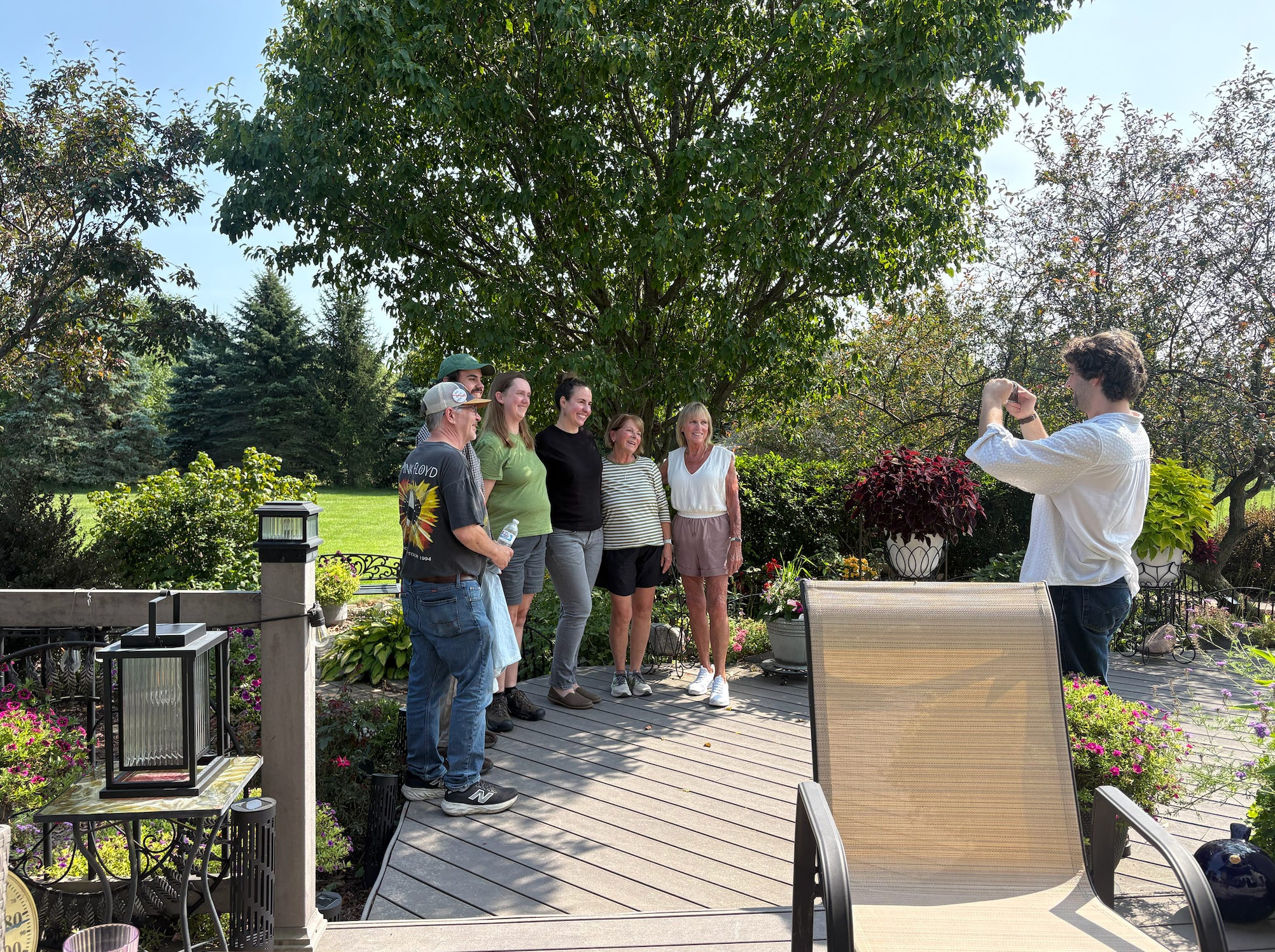
I spent the better part of six hours at Amanda’s house. She, and everyone I spoke with, were instinctively warm, even through anger and devastation. There was continuous laughter; they told me they had to be able to laugh. They made Terminator references, joking that some saw them as the real-life Sarah Connor. A five-month-old floppy puppy named Sunshine romped into the yard from next door, looking for Amanda’s dog to play with. A sweet elderly couple who live on the street stopped in to say hello on their way to play cards in town. I have no doubt the culture of Port Washington has changed — the footage of residents being dragged from city council meetings really is sobering — but the culture they described as indispensable still prevails here, not even a half mile from the Vantage project.
And only as I was getting ready to leave, holding the sandwiches she’d insisted I take and with an invitation to return, did Amanda turn to me and ask, “By the way, who are you?”
This was devastating to read. I spent hundreds of hours in Port W and Ozaukee County on the Rails to Trails project trails…SO MANY migratory bird species, not to mention the endangered Monarch butterfly migration along the lakeshore. Shame on Evers and the men who did this.
This is what plutocracy looks like.
In 2024, most voters in Port Washington voted for Donald Trump*, an obvious plutocrat. However, it isn't clear they'd be better off if Kamala Harris had become president, Harris being, like Tony Evers, a "centrist" Democrat; as Gil Durán said recently, "[T]he only people as addicted to billionaire money in American politics as the Republicans are the Democrats."** Absent a revolution - either a "political revolution" sensu Bernie Sanders or otherwise - I expect outrages such as the ones described in this piece will continue and worsen.
"They had a lot to say about the mayor. In several different conversations, longtime residents told me it was common knowledge that he'd been a bully in high school.": And presumably, nothing was done about him, because "boys will be boys" or some such idiocy. Such people rarely improve with age. A society tolerates them at its peril.
By the way, I lived in Wisconsin for two-and-a-half years during the aughts, and my partner grew up there (near Osseo). It is indeed a naturally beautiful state. It's also a state with a long history of political schizophrenia, being, for example, the home of both Robert La Follete and Joseph McCarthy.
*https://www.zipdatamaps.com/election-atlas/city/wi/port-washington/map-of-2024-presidential-election-results-by-voting-precinct
**https://www.theguardian.com/lifeandstyle/2026/aug/05/journalist-taking-on-tech-fascists-silicon-valley