

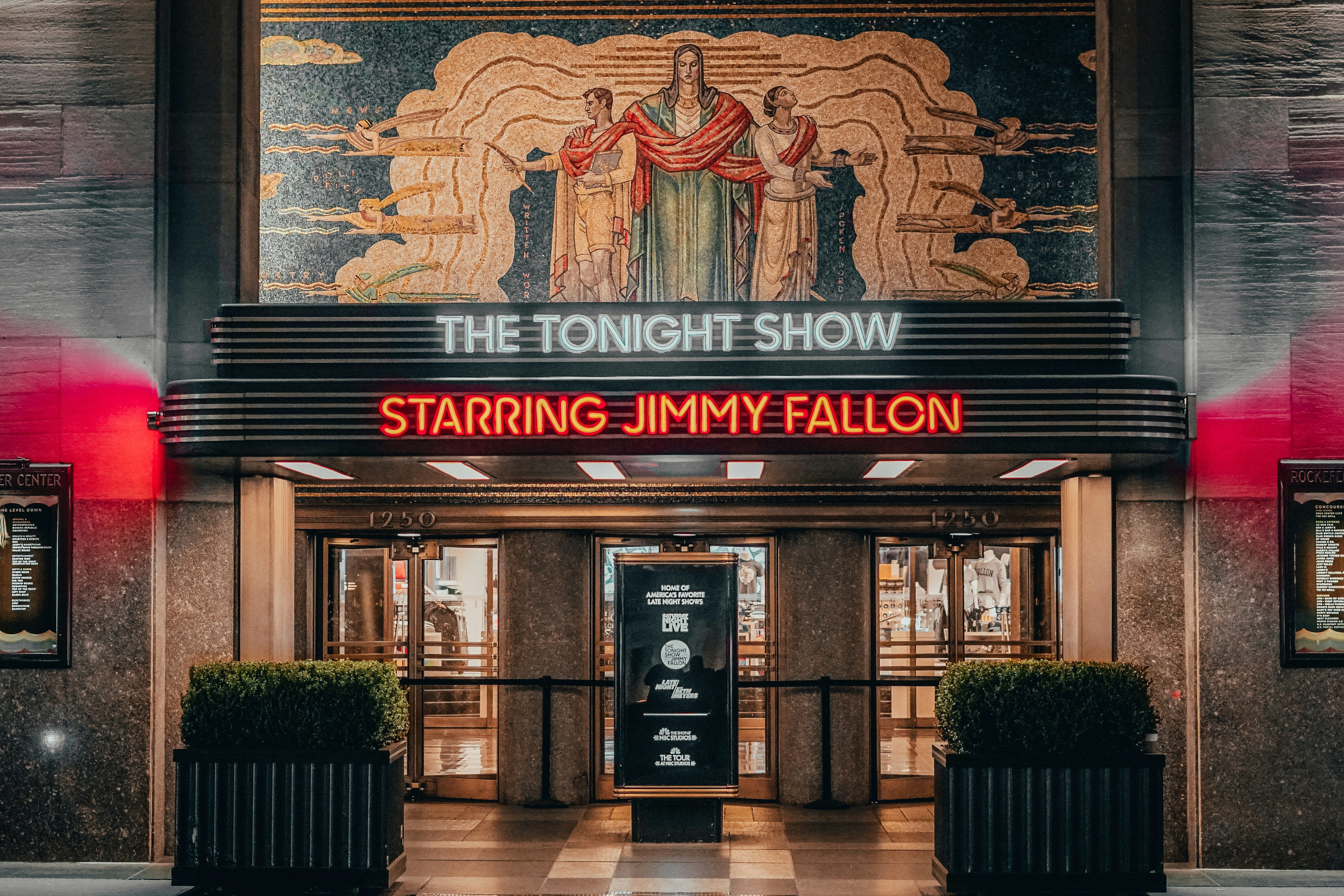
On December 8, OpenAI CEO Sam Altman was a guest on The Tonight Show Starring Jimmy Fallon.
Fallon’s routine is to play up his cluelessness, nervously laugh, and lob softballs at his guests (usually charismatic actors and musicians) until they produce viral soundbites that help them promote movies or albums. Fallon has intentionally carved out a niche as the “apolitical” late-night guy. His competitors—Stephen Colbert, Jimmy Kimmel, and Seth Meyers—aren’t the second-coming of Edward R. Murrow, but they’re loosely associated with the liberal resistance.
I assume that’s why OpenAI’s communications team picked Fallon, a sycophantic AI chatbot in the flesh, to co-host what was supposed to be a ChatGPT infomercial. OpenAI presumably doesn’t want the notoriously awkward Altman to navigate even one borderline tricky question. Additionally, they don’t want to imperil their cushy relationship with President Trump; were Altman to sit down with Kimmel, for instance, it’s easy to see how a single, benign slight from the late-night host could trigger the president and diminish his affection for Silicon Valley.
In theory, Altman’s appearance on Fallon should have been a net-neutral endeavor at worst. Maybe boring, maybe awkward, but free advertising nevertheless. Instead, OpenAI’s media strategy backfired. The odd timing of Altman’s late-night debut, and the back-and-forth he had with Fallon, left me feeling even more bearish about OpenAI’s viability.
Firstly, the timing: it reeks of desperation. There were plenty of moments over the last three years when ChatGPT was still the subject of genuine curiosity, and Altman could have used the talk show circuit to his advantage. OpenAI wasn’t always associated with unpopular data centers and nervous rumblings about whether the AI industry might cause the economy to tank. People were intrigued at the idea of an AI chatbot enhancing the ways they search the internet and do their jobs. OpenAI hadn’t been sued for copyright infringement and other allegations. And crucially, other tech companies were trying to catch up to OpenAI, not the other way around.
We’re in a whole new world now. A week before Altman went on Fallon, he circulated a memo to employees declaring that OpenAI was in a “code red” situation. The company needed to improve ChatGPT, which by many metrics has fallen behind Google’s Gemini AI model. The memo suggested temporarily moving away from “advertising, AI agents for health and shopping, and a personal assistant called Pulse,” according to the Wall Street Journal. Altman was sending a straightforward message: no outside noise, no distractions, no ancillary goals. Regain your footing. Focus on the core product.
So why did Altman immediately disregard his own edict and attempt to tout the ChatGPT product on national television? Why book a late night appearance amidst a reshuffling of resources, while frantically trying to match Google’s AI offerings?
The lack of logic here, and the poor understanding of earned media, would concern me if I were an OpenAI investor. (Luckily, I am not.) The interview itself was a dumpster fire, too.
The edited Altman segment was ultimately only eight minutes long. It inspired a viral clip, albeit not a beneficial one. Altman marveled about how ChatGPT had reassured him that it’s normal for his six-month-old son to not be crawling yet. That sort of reassurance is already readily available to parents via an ancient form of technology called “talking to other human beings.” And, of course, parents figured out how to raise children well before the creation of AI chatbots.
Altman’s reflections about parenthood broke containment, and were roundly ridiculed on social media. The rest of the interview was similarly painful. At the very start, Fallon brought up how ChatGPT is celebrating three years of existence. If you’ve ever been in the audience of a talk show, you know how frequently you’re implored to clap and cheer. It’s the currency you exchange for a free ticket. And yet, when Fallon paused for an applause break, no one clapped.
Fallon then asked a question that was bafflingly surface-level, even for him: “What is ChatGPT?” It was apparent from the get-go that Fallon has not dabbled with AI tools even a little bit. His other questions included, “What are the pros of ChatGPT?” as well as “What are the cons of ChatGPT?” Two alien species interacting for the first time would have more chemistry than Fallon and Altman.
Towards the end of the interview, Fallon posed a question that actually piqued my interest: “What’s the biggest thing you see happening [with] ChatGPT in the next five years?”
Altman has previously made bold proclamations that in the future, “AI will seep into all areas of the economy and society,” and artificial general intelligence (AGI) “will be the biggest lever ever on human willfulness.” In September, he told Politico, “by 2030, if we don’t have models that are extraordinarily capable and do things that we ourselves cannot do, I’d be very surprised.”
But in response to Jimmy Fallon—a man who makes a living doing soy face at whatever his guests choose to hype up, no matter how mundane—Altman concerningly chose to demur. “Five years is a long time,” Altman said. “Next year, I hope we’ll start to see these models really make small-but-important, new scientific discoveries.” Perhaps realizing he needed to salvage the segment and snatch an unimpeachable applause line, Altman ended with a generalized, lofty-ish goal: “And in five years, I hope they’re curing diseases,” he added. Light applause ensued!
As of Sunday evening, the Altman segment has roughly 100,000 YouTube views, which pales in comparison to many of Fallon’s other recent guests. Almost all of the top comments on the Altman video are negative, and it has more than twice as many thumbs-down reactions and thumbs-up reactions.
The relative lack of interest in Altman as an emergent public figure, and the deeply critical reaction to his interview from those who are paying attention, is a very, very bad sign. A “code red” situation, one might say.
Here’s what else we’re reading this week:
Following up on my reporting from last week about California politicians’ muted response to Netflix’s attempted acquisition of Warner Bros.: gubernatorial candidate Tom Steyer announced his opposition to both merger proposals. He put out a strong statement!
I also got a statement from the office of California Attorney General Rob Bonta: “The California Department of Justice believes further consolidation in markets that are central to American economic life—whether in the financial, airline, grocery, or broadcasting and entertainment markets—does not serve the American economy, consumers, or competition well. We are committed to protecting consumers and California’s economy from consolidation we find unlawful. Beyond this, to protect their integrity, we’re unable to comment on, even to confirm or deny, any potential or ongoing investigations.”
I wish I was joking, but xAI and the El Salvadoran government—led by dictator and Trump ally Nayib Bukele—struck a deal to “bring personalized Grok tutoring to every public-school student in the country.” There are a litany of unresolved issues around AI tutors in the classroom: are the AI tutors providing accurate information? Should children and teenagers be relying on AI tools to complete assignments and learn? Are teachers and schools maintaining safeguards to prevent cheating or access to inappropriate content? And most importantly, if you’re going to insist on AI integration, does it have to be Grok?
The Phoenix New Times has an entertaining dispatch from Chandler, Arizona, where earlier this week the city council voted down construction of a data center by a unanimous 7-0 vote. The data center seemed like it was on track for approval until none other than Kyrsten Sinema, the much-reviled former senator, started making noise as a lobbyist for the project. That got the attention of Chandler residents, which in turn spooked the city council, and the rest was history. The moral of the story: If you’re going to hire a lobbyist to shill for an unpopular project, don’t pick a discarded politician whose approval ratings were so bad that they didn’t even bother running for re-election.
"Fallon, a sycophantic AI chatbot in the flesh"... nicely put...
That Chandler story is crazy. That is a town of conflicting personalities, I guess maybe not so surprising they vetoed it in the end.