


Jeff Bezos is not much for the limelight. Over the last few years, the world’s second-wealthiest man has stuck to the same script: a couple of print interviews, a panel appearance or two, and a few televised sit-downs with journalists who will humor his Goofy hyuck-hyucking. He’ll also occasionally step out with his wife, Lauren Sanchez, so they can make the Met Gala even more obnoxious, or so that he can debut an outfit best described as “62-year-old man tries cocaine for the first time while sitting on a vinyl couch at a Miami nightclub yelling ‘WHAT? I CAN’T HEAR YOU.’”
Because Bezos rarely shares his thoughts with the general public, it’s easy to track the substance of his remarks and get a sense of what he wants to convey to plebeians like you and me. In doing so, I’ve made an unnerving discovery: Bezos has developed a stump speech. What I’m less sure about is whether the stump speech is really just the result of him (or his PR team) being bad at coming up with talking points, or whether he has burgeoning political aspirations.
So far this year, Bezos has granted three televised interviews—two big ones and a bite-sized one that got less attention—and he spoke at a panel in Paris. In May, he chatted with CNBC’s Andrew Ross Sorkin at Rocket Park, which is Blue Origin’s factory in Florida. (Blue Origin is Bezos’s space tech company.) Bezos made headlines by stating that the bottom-half of American earners shouldn’t pay federal income taxes; he also claimed that it wouldn’t do much of anything for lower-income Americans if he were taxed more. CNBC got a nice tour of the Blue Origins manufacturing hub. A week later, one of the company’s rockets blew up.
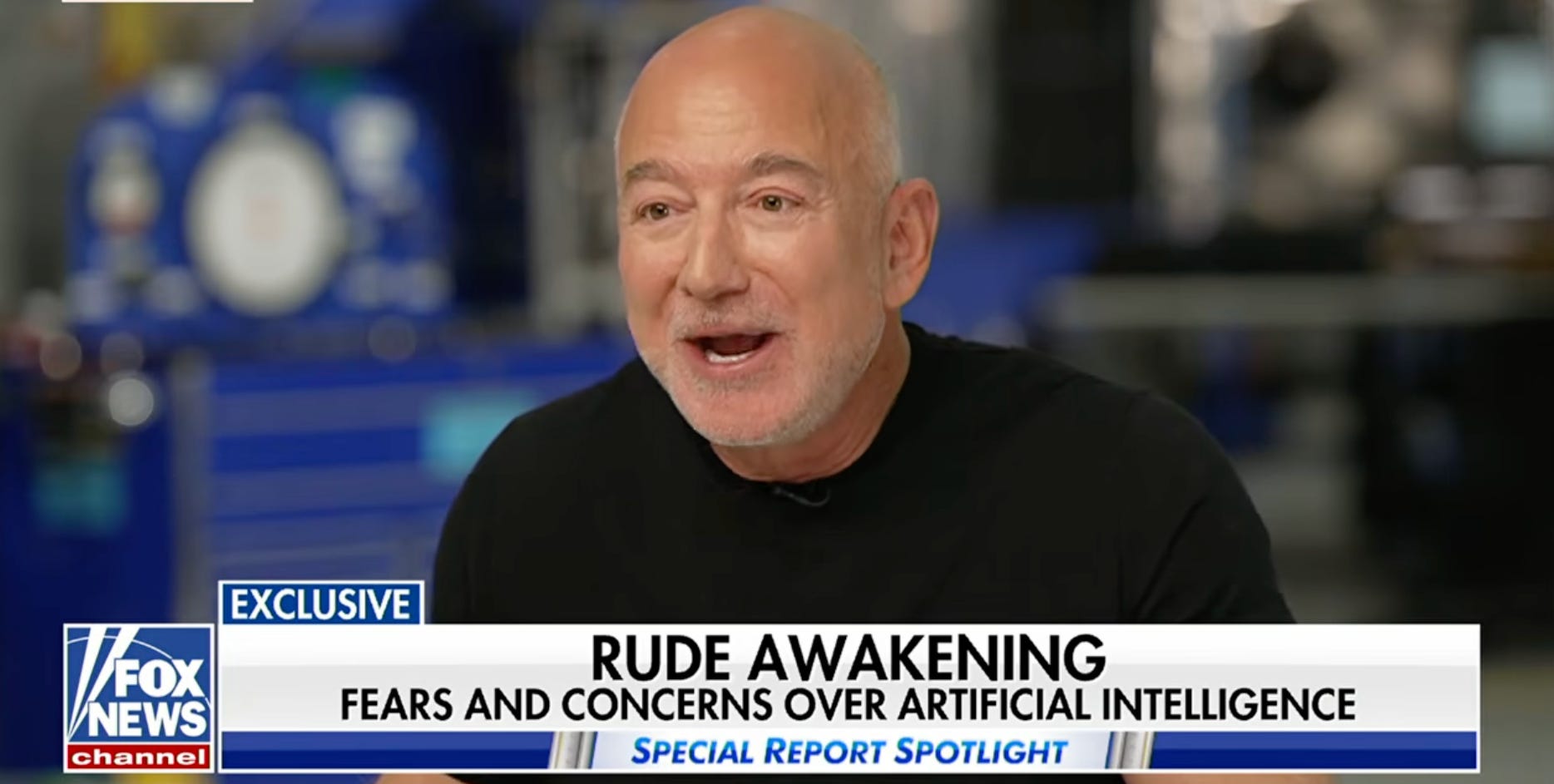
On June 11, still mourning the damage to his rocket launchpad, Bezos agreed to another CNBC interview that was ostensibly focused on his mysterious AI startup called Prometheus. On June 17, Bezos was a featured panelist at the 10th annual VivaTech conference in Paris; he chit-chatted about space and rocket ships and AI. And then on Wednesday, Bezos sat down for an interview with Fox News journalist Bret Baier.
Once again, the setting was Blue Origin’s Florida factory space. Baier and Bezos engaged in a battle of veneers, not wits. Baier ogled at Blue Origin’s resilience in the afterglow of its nuclear-grade explosion. Bezos proclaimed that he’ll launch a rocket again by the end of the year, that he wants to start doing 50 launches a year, and then eventually a launch every day, and eventually every hour, and eventually every minute. “That’s where I lose the team,” he hyuck-hyucked. This is all in service of extracting resources from the moon and establishing a lunar base, by the way. He’s put $28 billion of his own money into Blue Origin, a company he hopes to take public in the future. And he supports President Trump’s AI rebrand to “superintelligence,” or SI. “I do like SI, because artificial is not a very flattering thing,” he said. (Trump has since posted that anyone who refers to AI as AI, and not SI, is “THE ENEMY.”)
The rest of the Fox News interview was a retread of his commentary on CNBC and his panel in Paris. Which is what I’m trying to wrap my head around.
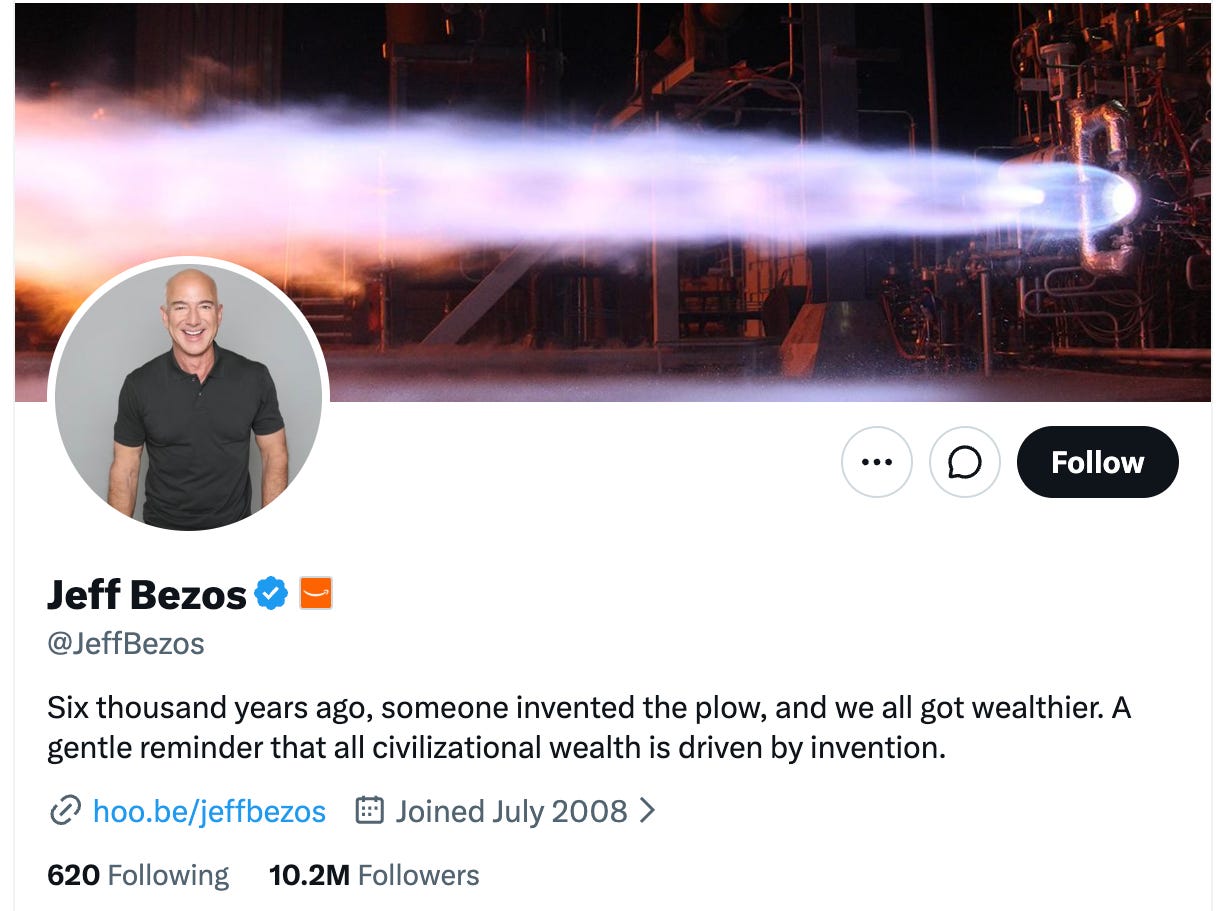
Earlier this year, Bezos—not an active social media user—changed his X bio to: “Six thousand years ago, someone invented the plow, and we all got wealthier. A gentle reminder that all civilizational wealth is driven by invention.” A LinkedIn-ism for our time and an implicit defense of his 12-figure net worth. Bezos proceeded to bring up the invention of the plow during both of his recent interviews with CNBC, when he was a panelist at VivaTech, and on Fox News, too.
“All civilizational wealth comes from invention,” he told Baier. “Six-thousand years ago, someone invented the plow. And then the steam engine. We all got wealthier. And that cycle has continued.”
Bezos seems to be issuing a preemptive defense of Prometheus, a nebulous AI startup that he doesn’t yet know how to articulate. The best he could muster to Baier is that through Prometheus, he wants to “make [AI] tools so easy to use that anyone will be able to be an engineer.”
When Baier pressed for more information about Prometheus’s first product offering, Bezos—who previously created an online bookstore—laid out a hellscape where every American tries to commercialize their worst “Shark Tank” pipe dream: “Probably everybody watching this show right now, at some point in your life you’ve had an idea for a product or service. You woke up one morning and had some idea for a product or service, but it never left your head. You never actually built it. The reason you didn’t build it is because it’s too hard. It’s too much work… What we want to do is make the distance between the idea and the actual manufacturing so much shorter, so much simpler.”
Here was Bezos’s sales pitch in Paris: “I promise you every single person in this audience has had an idea for a new business or a new product or a new device that they wish they could manufacture, and it just stayed in your head, it went nowhere,” he said. “The reason it went nowhere is because it was too hard to do and it wasn’t worth it.”
Businesses like Prometheus will “drive huge productivity in the economy,” Bezos told Fox News. “Double-digit productivity gains.” What will that do to our workforce, you might wonder? Bezos—whose old company Amazon laid off 30,000 corporate roles over the past year—says don’t even sweat it. AI will create a labor shortage. An empowering labor shortage. “You’re not going to need to have a two-earner household,” he told Fox (and also CNBC in both May and June). “Some people will decide, you know, I can support my family by working three days a week. That’s what productivity in the economy means.”
Bezos asserted to CNBC, VivaTech, and Fox News that he strongly disagrees with the “smart people” (he used the same phrase each time as an olive branch, I guess) who think there will be job losses caused by AI. Bezos’s techno-optimism obviously serves his own interests. So does his view that “government regulation can be very useful if it’s done in a light way and it’s done in a smart way,” as he phrased it to Baier.
He warned that “sometimes regulation goes wrong—especially when people are scared, reacting emotionally, and so on—and they want to regulate the underlying thing instead of the applications of the thing.” The example he gave is that you “do not want to regulate knives, you want to regulate murder.” Interesting point of comparison. Knives can kill people, but they usually cannot inflict harm on large swaths of people, as is the fear with malicious AI uses. A more interesting point of comparison, if Bezos really wants to go there, are guns, which can inflict harm on large swaths of people and are the subject of constant regulatory debates.
The last chunk of Baier’s questions for Bezos were explicitly political. Baier brought up Sen. Bernie Sanders’ criticisms of billionaires, to which Bezos cued up a response about how he’s not a villain. And also how the guy who invented Raising Cane’s isn’t a villain.
“We live in an environment where some people have been taught—I think incorrectly—this whole oppressor, oppressed framework,” Bezos said. “You can be a billionaire if you start a hamburger stand, you have 10 people and it works really well. You open a second one, you open a third one, now you’re employing 30 people, then you open 10 more, and so on. Pretty soon, you have a thousand hamburger restaurants and you are a billionaire. This is a real story by the way, just with chicken tenders. It’s Raising Cane’s.”
Wow. That 2000s-era FWD: FWD: RE: INSPIRING chain letter sounds oddly familiar. I heard him say it almost verbatim to Sorkin: “Let’s say you start a burger joint and you have 10 employees and you make a little bit of money,” Bezos hypothesized in May. “These are the most delicious burgers in the world. People love your burgers. So then you open a second outlet. And now you’re making a little bit more money, and you have 20 employees. And you open a third outlet. By that time you’ve opened 1,000 outlets, you are a billionaire. By the way, this is a real-life story.”
Bezos was willing to concede to Baier that “we do have real affordability problems” and it’s too expensive for young people to rent or buy a home. Certain politicians, however, are too focused on blaming “greedy landlords,” who aren’t actually the bad guys. “Housing is a simple supply-and-demand situation, it’s econ 101,” said Bezos, emulating the most annoying hardcore YIMBY on your timeline. “If you put in place government programs that subsidize demand and constrain supply, you’re going to get high prices.” I will avoid pasting more blocks of text, so just take my word for it: Bezos eerily repeated the same housing grievances to Sorkin.
Bezos’s closing message for the midterms is not an outright endorsement of Republicans, but it’s pretty close. It’s certainly a request for conservatives to be nice to him and other politically engaged oligarchs: “When you’re in the polling booth,” he said to Fox News viewers, “think about this. If there’s a politician who’s picking villains and pointing fingers, that probably means they don’t have a solution. If they had a solution, instead of blaming somebody, they would be working on the solution.”
It’s not like Bezos was ever a bleeding-heart liberal in the past. (Nor do I consider billionaire Democratic Party donors to be much better than their counterparts.) But Bezos’s moves the last few years—dissassembling The Washington Post and turning its opinion section into a “Wealth of Nations” knockoff, pulling back from Amazon, embracing Trump, investing tens of billions into lunar exploration and AI in ways that remain difficult to discern—suggest a radicalized turn.
Maybe Bezos is repeating himself in his sporadic interviews because, despite shedding his previous body suit, he’s still the same awkward guy from the ‘90s. I tend to believe, though, that hoarding more than $300 billion and having easy access to the president of the United States changes a man for the worse. So… presidential candidate Jeff Bezos? No, not right now. But Bezos strategically supplementing his techno-feudalism with an overtly political message does strike me as a worrisome development. If he isn’t able to launch rockets into space, I fear he’ll turn his attention back to earth.