


The Washington Post laid off more than 300 of its 800 journalists on Wednesday. The newspaper’s sports section is dead. So is the books section. The international desk was stripped for parts. The video department is reportedly down to a handful of people.
Reporters at the Post knew the cuts were coming, despite every journalist’s least favorite journalist Dylan Byers claiming a scorching-hot scoop on the matter. West Coasters were up at 5 a.m. in anticipation of a layoffs announcement, which was delivered by executive editor Matt Murray rather than publisher Will Lewis, presumably because Jeff Bezos’s “Toady of the Day” wheel landed on Murray’s name. (Lewis is apparently busy taking in American-style footy.)


Murray’s feedback to employees was standard fare: it’s a tough time in the media business, we need to adjust to a changing world, we’re committed to good journalism, blah blah blah. It is a tough time in the media business, and the Post isn’t profitable. The culprits, however, are Murray, Lewis, and Bezos, not rank-and-file journalists.
Lewis has treated the Post like a startup accelerator, reportedly investing resources and time into useless Grammarly clones, a decision that is dumbfounding enough to suggest he may not be capable of spelling out the acronym for “AI.” Even Murray struggled to convincingly defend his c-suite companion, telling CNN that some of Lewis’s product ideas are “experimental,” and he “can’t say it’s all worked, but also, having an experimental mindset is part of what we needed.”
Bezos, meanwhile, barred the Post from endorsing Kamala Harris prior to the 2024 presidential election, which led to the cancellation of hundreds of thousands of subscriptions. Then in February 2025, Bezos overhauled the Post’s opinion section so that everything is conservative and boring, in the stylings of Ross Douthat on Ambien.
Over the last few days, there’s been lots of reporting (deservedly so) about the elimination of the Post’s sports and books sections, but I was curious to learn more about how the tech section was affected by Wednesday’s layoffs. After all, the most Murray could muster on the subject during his CNN interview was, and I am not kidding: “Technology remains important to us.”
I spoke to some of the Post journalists who were laid off, and from what I’ve gathered, the tech section was decimated. It was slashed by more than half, from 20-something to 10ish people (I was given best estimates by a number of sources). There are now only a handful of employees left at the San Francisco office. The unconfirmed rumor is that office space will be shut down sooner than later.
The tech team layoffs were described to me on multiple occasions as “vibes-based” and sloppy. Most of the laid-off tech journalists were women. There’s no longer an Amazon beat reporter, or tech/internet culture reporters. The “Help Desk,” a consumer-oriented section, lost all of its contributors. “There was an investment in service journalism over the last few years,” one source who was part of the layoffs told me. “To watch it just get wiped out so quickly is both sad and confusing.”
The sources I spoke with pushed back on the oft-repeated assumption that Bezos himself is personally dictating coverage or killing stories. That’s clearly true of the opinion section, but not elsewhere. In fact, Murray and other managing editors actively crave high-profile investigations and accountability journalism, even sometimes at Bezos’s expense. The tech reporters who are still employed by the Post have written plenty of pieces that would qualify as de facto critiques of Big Tech.
There has, however, been a subtle shift in what is considered a “neutral” framing in Post articles, including the tech section. Consider these anecdotes, which were relayed to me:
A planned update to a service piece about phone security was squashed, because the article subject could be seen as “activism.”
A journalist was told that a draft of theirs needed to present the other side of AI—why it’s good, actually.
A journalist was told that they were verging into advocacy because their draft noted that the Tea app’s data leak put women in danger.
There’s an anxiety about coming across as too “liberal,” is how the top-line editing mood was described to me. The conservative-minded tone-policing coincides with Murray’s ascension—he’s a Wall Street Journal alum who’s led the Post since June 2024—and Bezos’s even more recent MAGA overtures. Interestingly enough, after Murray announced the layoffs, one of his media tour stops was with Fox News. “We’re a business,” he flatly stated during the interview, later referring to Bezos as a “pretty generous benefactor over the years.”
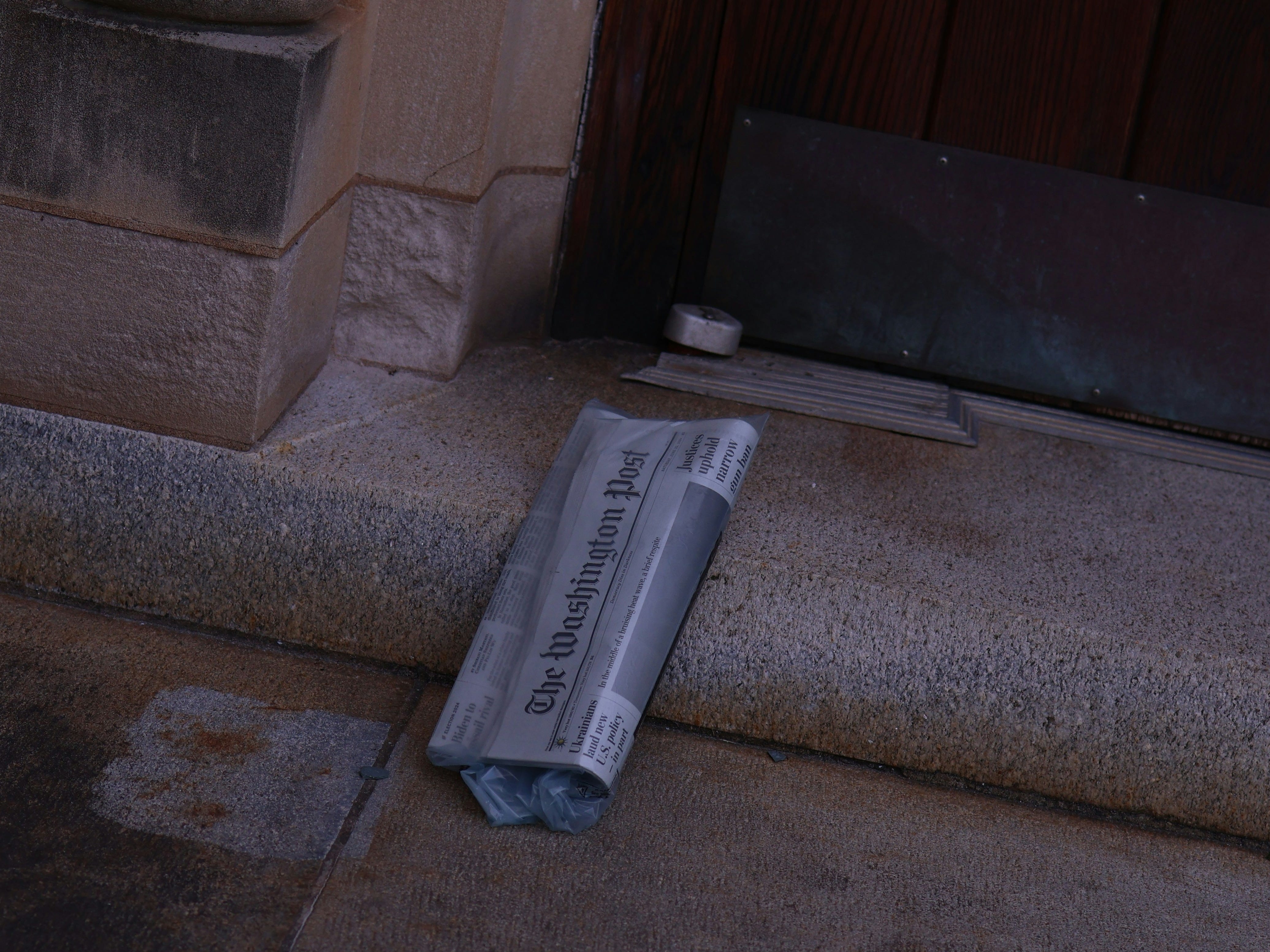
It goes without saying that Murray and Lewis will never, ever blame their boss for anything, even though Bezos cozying up to President Trump is easily the number one reason the Post has hemorrhaged subscribers. Nor can Murray acknowledge that Bezos has a large enough net worth to personally cover shortfalls at the paper until he is at least 2,500 years old, which I am guessing is slightly longer than he expects to live, even accounting for what I’m sure is a fascinating biohacking routine.
In 2013, when Bezos bought the Post for $250 million, there were immediately (fair!) questions about his motivations. I’m against any billionaire buying a news outlet, and I certainly wasn’t of the mind that Bezos was set to become a “generous benefactor,” as Murray is calling him nowadays. I also wasn’t convinced that Bezos was planning on personally quashing negative coverage about his valuable companies. I think that’s giving him too much credit, actually. In reality, he was a bored oligarch who liked the idea of purchasing and owning a prestigious newspaper, because it afforded him some positive PR from liberal-minded readers. It was 2013! Barack Obama was president; billionaires and Silicon Valley elites were generally aligned with Democrats. Hell, even during Trump’s first term, Bezos was happy to lean into “democracy dies in darkness,” taking multiple victory laps about how the Post was turning a profit.
But Bezos never actually cared about the Post. It was a side project for a fickle media baron who has other priorities, like sending his wife to fake space for 11 minutes and funding a “documentary” about Melania Trump, one of the least interesting people to have ever existed. With a revenge-driven Trump back in office, Bezos has clearly come to view his ultimately minuscule investment in the Post as a nuisance, not a PR boost, so he’s pivoted to a moonshot plan: getting conservatives to read the newspaper en masse.
I do believe the paper’s remaining journalists—including those on the tech team—will try to produce quality work in spite of ideologically-driven nitpicking and a drastically reduced staff. Many of those journalists will burn out and leave. Either Murray or Lewis (I’d lean Lewis) will eventually become the fall guy for this era of ineptitude. Another right-leaning bigwig will come in to speak for Bezos. Lots of journalists on the outside, myself included, will dunk on Lewis’s dismissal. Unfortunately, those dunks, as good as they will feel, will not halt the production of Melania II: The Remix, or change the fact that the Post is falling apart.
Here’s what else we’re reading this week:
Amazon, Alphabet, Meta, and Microsoft are forecasting a combined $650 billion in capital expenditures this year, according to Bloomberg. “Each of the companies’ estimates for this year is expected either near or [to] surpass their budgets for the past three years combined,” the report says. “They would set a high-water mark for capital spending by any single corporation in any one of the past 10 years.” Data centers, data centers, data centers.
A trio of Democratic Senators are raising alarm bells about the Big Tech trend of reverse acquihires, where large companies nab key talent from a startup, and also license their technology, but don’t acquire the startup outright. Ariella Steinhorn and I recently wrote an investigative feature for Hard Reset about one such reverse acquihire, and how a whistleblower’s complaint to the FTC has gone unheeded.
Senator Tim Scott is “praying” that a racist clip of the Obamas posted by President Trump is “fake.” I am not sure what Senator Scott means by this. It is true that the Obamas are not monkeys, as the racist clip suggests. That part is “fake.” However, the clip is not fake; the president posted it on the internet (and then deleted it).