

The jury assigned to the Musk v. Altman trial came to a verdict after just a few hours of deliberations on Monday. I wonder if it even took them that long, or if they stuck around for a little while in the jury room, like a student who doesn’t want to be first to turn in a test.
Elon Musk’s claims against OpenAI, Sam Altman, Greg Brockman, and Microsoft were barred by the statute of limitations, ruled the nine-member jury in Oakland, California. Basically, they decided that Musk took too long to file a lawsuit. Everything else is moot, though based on three weeks of testimony and evidence, I am doubtful Musk would’ve succeeded on the merits of his claims. (He and his attorneys are already promising to appeal.)

I was in the courtroom for a week, and listened to the live stream for most of the rest of the proceedings. At the onset, Musk’s argument was dubious, but not crazy. It seemed Judge Yvonne Gonzalez Rogers felt the same. Had the case gone Musk’s way via a jury decision, Gonzalez Rogers would’ve been responsible for assessing damages against OpenAI.
In Musk’s retelling, Altman and Brockman “looted” the nonprofit arm of OpenAI, but their theft wasn’t immediately obvious to him. He left the OpenAI board in 2018, and didn’t sue until 2024, when he definitively concluded that the organization he co-founded had abandoned its altruistic mission to advance AI safety and research. His specific claims were breach of charitable trust, unjust enrichment, and accusing Microsoft of aiding and abetting the breach of charitable trust. He sought hundreds of billions of dollars in damages, which he pledged would go back to the nonprofit.
Set aside the messenger, and you can see where Musk was coming from: It’s not like Altman and Brockman are angelic purveyors of truth. The discovery process in Musk v. Altman unveiled journal entries from Brockman, who, in the mid-2010s, daydreamed about being a billionaire while working at a nonprofit. Altman’s mendacious behavior is his defining trait. Just before trial started, Altman’s history of untruths was chronicled in a New Yorker investigation by Ronan Farrow, which Musk tried to use to his advantage by highlighting Farrow’s reporting on X. Most trash-talk and politics talk was barred by Gonzalez Rogers, and really, it was for the benefit of both sides: we all know Musk’s deal, Brockman is a MAGA super-donor, and Altman is a chameleon. The judge really wanted this to be a fair fight between tech’s least likable, most recognizable avatars.
There was only so much she could do. Brockman’s testimony was painful. “Between Brockman’s attitude… and the journal entries, I don’t think I’d trust him to watch my bag while I used the restroom,” The Verge’s Liz Lopatto wrote. During an uncomfortable portion of his cross-examination, Altman had no idea how to respond to questions about his finicky relationship with the truth: if he said he doesn’t lie about stuff, he’d be lying, but if he said he does lie about stuff, well… that’s not so great either. Altman’s uninspiring performance on the stand was overshadowed by sweaty texts and emails from his temporary firing in 2023; those messages were entered as exhibits and will live on in infamy. The testimony of Musk’s alleged partner Shivon Zilis was similarly entertaining and illuminating, but only as it pertained to their odd personal relationship.

Luckily for team OpenAI, none of the ancillary witnesses said anything revelatory about Altman and Brockman’s greed and untrustworthiness. And compared to Musk, the combination of Altman and Brockman managed to come across like two pleasant fellows getting yelled at by an industry peer—imagine Simon & Garfunkel on the receiving-end of an earful from Morrissey. On the stand, Musk was even more loathsome than whatever you’re imagining. He treated OpenAI’s attorneys like they had kidnapped him. This is not to say he should’ve befriended them—just that he didn’t bother with pleasantries, decorum, feigned introspection, or any interest in the outcome of the case. He was a wind-up toy with big googly eyes who could only blurt out reductive metaphors and idioms to explain why he was right and OpenAI was wrong.
Musk needed much more than that to prove that the statute of limitations shouldn’t be used against him. He needed to convince the jury that the lapse in time before he filed his lawsuit was legitimately the result of him being left in the dark; that OpenAI co-founders had schemed against him, booted him, pocketed his $38 million in early-stage investments, and looted their way to commercial success on his dime, without his knowledge.
Musk utterly failed to lay out how the co-founders’ aims were somehow hidden from him until 2024. If anything, the Musk v. Altman trial demonstrated the opposite. When Musk was still on the board of OpenAI, he proposed a controlling stake in a new, for-profit subsidiary. He eventually left in large part because his negotiations with other co-founders hit a dead-end. He can complain that their egos and motivations came into play, and I’d agree with him. But their egos and motivations don’t stack up to the way Musk and his underlings were talking about his own goals for OpenAI.
“Elon isn’t asking for absolutely eternal power, but he needs to be able to make critical and often counterintuitive company decisions when push comes to shove,” his right-hand man Sam Teller wrote to Altman in August 2017. “That’s the only non-negotiable for him. It is nothing personal—just something that will be true of every company he starts for the rest of his life.”
Six months later, having not been granted… I don’t know, somewhat-absolute eternal power? Musk took his ball and went home. He left OpenAI because he was frustrated and annoyed. Even then, witness testimony and exhibits showed that Altman wanted to keep Musk in the loop and in his good graces. He sent over a four-page term sheet about a capped, for-profit structure for Musk to consider. Musk admitted on the stand that he only scanned a little bit of it. On various occasions, Altman sought Musk’s advice about possible Microsoft investments. Once, Musk didn’t respond at all. Another time, he connected with Altman, but he doesn’t remember what they discussed.
Altman worked hard to get Musk on the phone, using Zilis as a conduit. In March 2019, for instance, Altman prodded Zilis about the best time to ring up her mercurial companion. Later, Zilis texted Altman, “I am so glad you hopped on the phone. Is so much nicer and you know I am always secretly cheering for you guys to remain close and friendly.”
Creepily enough, Musk had (verbatim) instructed Zilis to remain “close and friendly” with the OpenAI co-founders when he departed the organization a year prior. That’s what she did—from 2020 until 2023, she was even an OpenAI board member. Musk had the benefit of a potential mole, and it’s unclear how much he took advantage of his good fortune. He and Zilis shrugged at questions about whether they discussed the comings and goings at OpenAI in the early 2020s, when she was especially knowledgeable. No matter which way you slice it, Zilis’s presence at OpenAI is bad for Musk’s statute of limitations argument: he either didn’t care enough to ask her about what was going on at the organization, or he knew all about it, and still didn’t bring a lawsuit in a timely manner.
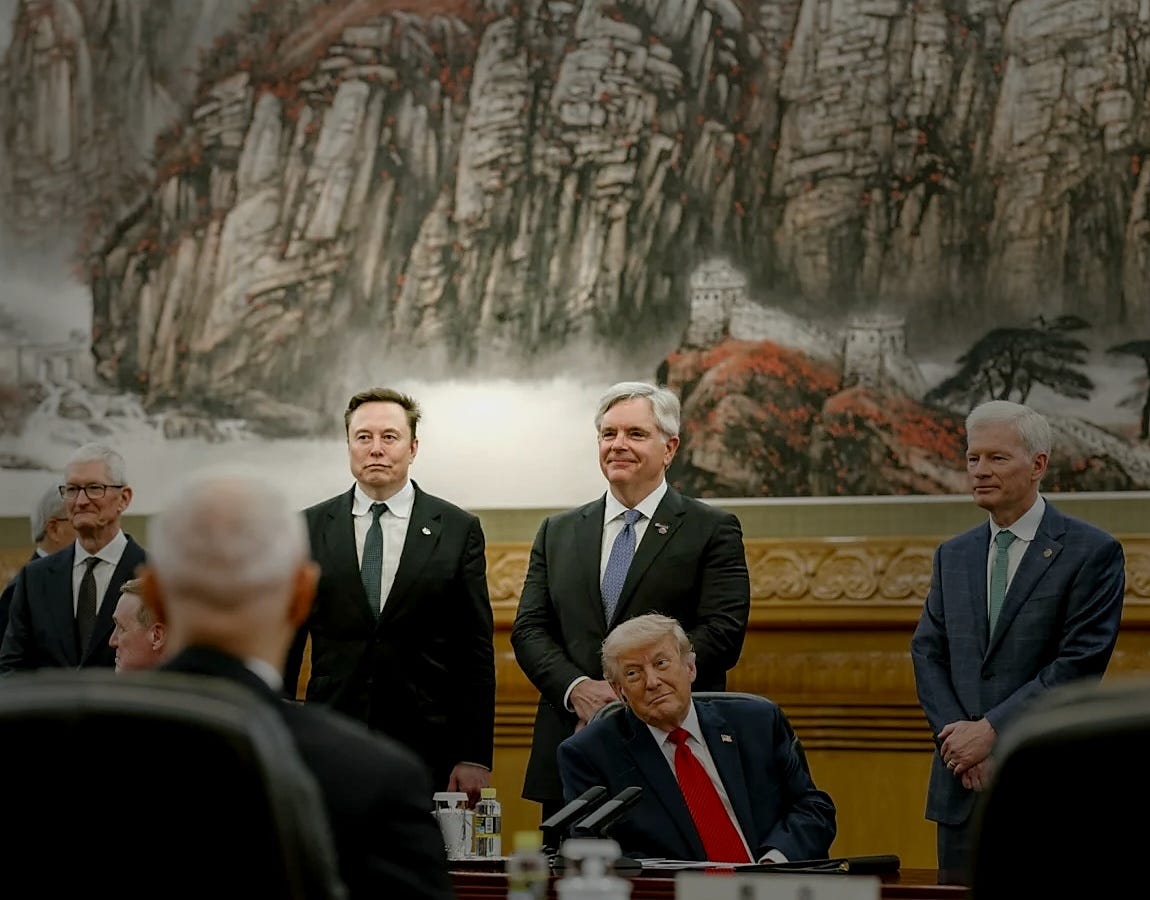
Altman and Brockman didn’t come to court every day, but they showed enough face to signal that they cared at least a little bit. Musk staggered through his testimony, and then went off to China with President Trump while the trial was still ongoing, despite being on “recall status” as someone who might be asked to take the stand again. Musk’s attorney had to apologize to the jury for his client’s absence, dubiously asserting, “This is something he is passionate about.”
While in China, Musk posed for epic selfies and made funny faces with Tim Cook. He’s been obsessively posting about Christopher Nolan’s upcoming film The Odyssey, and after he lost on Monday, he complained that the judge had erred. “...[T]he ruling by the terrible activist Oakland judge, who simply used the jury as a fig leaf, creates such a terrible precedent,” he wrote. “She just handed out a free license to loot charities if you can keep the looting quiet for a few years!”
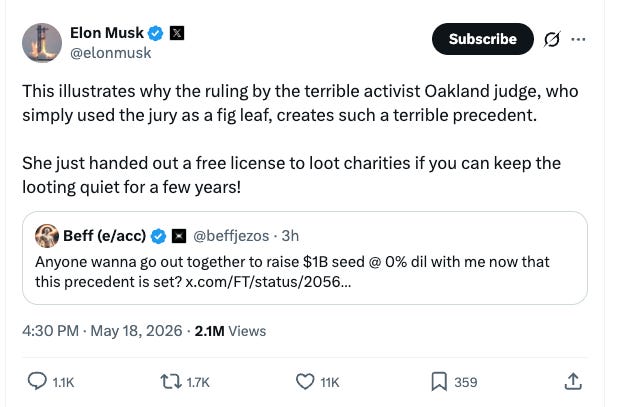
Except Gonzalez Rogers didn’t issue a ruling. The jury did. Musk would’ve known as much if he’d been paying attention to the court case that he brought and framed in existential terms. If there’s one takeaway from this trial, it’s that Musk hasn’t been paying attention to much of anything for close to a decade. He’s bopping around the globe, posting incessantly, absorbed by vapid grievances that change every few hours. It’s not Gonzalez Rogers’s fault—and it’s certainly not the jury’s fault—that they chose not to indulge him for once in his adult life.
Fantastic reporting, I’ve thoroughly enjoyed your coverage of the trial, thank you.
Elon Musk, despite all his claims of being a free-speech warrior in pursuit of the truth, has never let facts get in the way of a tantrum on X. Totally on brand.
Honestly, this was a case of ESH, and I wish the jury had returned a decision where both sides had to pay for wasting the court's time and resources on their petty billionaire grievances.