


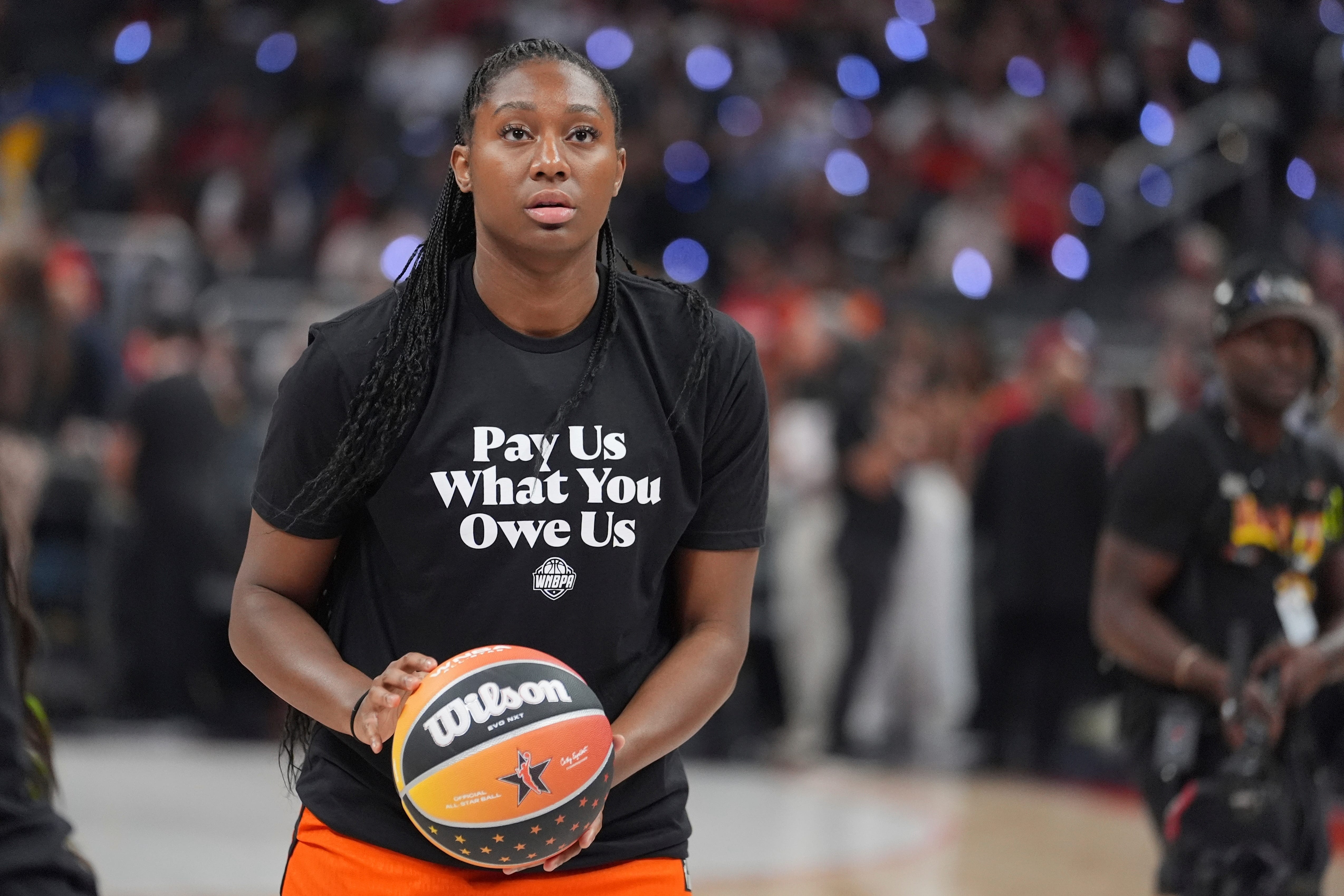
The WNBA’s recent collective bargaining agreement (CBA)—a contract between the league and its labor union (the WNBPA)—has been characterized as “historic.” ESPN wrote that the new CBA “permanently and positively changes the landscape” of women’s professional basketball. The players negotiated a massive pay raise commensurate with the WNBA’s rapid growth in popularity; benchwarmers, role players, and superstars are all making significantly more money than last season. The players’ union secured practice facility upgrades, more comprehensive team staffing requirements, much-improved travel accommodations, and stronger workplace protections for pregnant athletes, who can no longer be traded without their explicit consent.
In totality, the new CBA is a victory for the WNBPA, which staved off a last-minute lockout, and delivered on many of its members’ top demands. But these sorts of negotiations inevitably involve compromises and trade-offs, and as far as I can tell, the league gained the upper-hand in one crucial, underreported section of the agreement centering on wearables devices. The language in the “wearables” section of the WNBA’s CBA is interesting for what it hints at, for what it doesn’t say—and what it portends for other pro sports leagues that are heading back to the negotiating table in the next half-decade.
Setting the Stakes
A decade ago, just 13% of surveyed Americans owned a wearable—something like an Apple Watch, an Oura Ring, a WHOOP strap, or another health-monitoring device. Now, nearly half of Americans own at least one wearable, according to a recent survey. North American pro sports leagues have attempted to embrace the wearables craze, though their access has been limited by players’ unions.
Wearables present serious privacy issues for “Average Joe” consumers, who are entrusting tech companies to safely store and protect their biometric data. Imagine the stakes for a professional athlete, whose entire livelihood could be affected by a single biometric data point. To give one of many realistic hypotheticals: a basketball player has a terrible game, and the coach wonders if they showed up to the gym hungover. The coach has access to the player’s wearable data, and checks to see when they went to sleep, as well as what their heart rate looked like during the night. Should the player have been out partying before a game? No. Should the coach be able to surveil them? Definitely not.
It will not surprise you to learn that there’s an emergent gambling angle here: sports leagues would love to commercialize players’ biometric data, and sharp bettors would love access to data about, say, a hungover player. “We’re going to get to a spot where people are betting not just on the velocity of the puck that was shot by a player in the NHL playoffs, but on what the heart rate of a certain player is going to be running down the field,” said Helen “Nellie” Drew, the director of the University of Buffalo’s Center for the Advancement of Sport, and a professor of practice in sports law.
There are other practical considerations, too. What if wearable data reveals that a player isn’t as speedy as they were before, and a team uses that data against the player during contract negotiations? What if a wearable reveals a player is favoring their leg, or is at greater risk of injury? This information is potentially beneficial to a training staff and an athlete, so long as it’s disclosed and used in a responsible manner—a critical, mostly unresolved caveat. “Aging and injured players are the most at-risk” of wearable data being used against them, said Michael LeRoy, who researches sports labor laws and AI, and is a professor at the University of Illinois’s School of Labor and Employment Relations.
How the WNBA’s Wearables Agreement Stacks Up
Like the NBA and MLB—two leagues where the players tend to have more leverage than their counterparts in other pro sports—the WNBA and its players association have agreed to form a committee specifically tasked with reviewing and approving wearable devices. The committee will have two league representatives, two WNBPA representatives, and a neutral party appointed by both sides (five members total). The committee “will discuss, among other things, training for players and staff, data security, access and retention, use of derivative data, and emerging technologies,” the CBA reads.
That’s where the similarities between the WNBA, the NBA, and MLB come to an end. The NBA’s bargaining agreement includes the specific names of approved wearables. It’s unambiguous that unless the CBA is amended, wearables can’t be used during games. And it definitively states player data can’t be released to the public or used for commercial purposes. In other words, approved wearables are only for practices and training. A team that invokes biometric data during contract negotiations is subject to a $250,000 fine. (I will note that this is nowhere near sufficient, given the financial stakes between multimillionaire athletes and franchises valued in the billions, but it is something.)
MLB’s CBA does allow a selection of wearables to be worn during games, but on a voluntary basis. Biometric data is only shareable with a small cohort of coaches and staffers, and players can revoke access to the data without penalty. To date, the MLBPA has banned the commercialization of wearables data.
The WNBA, meanwhile, is allowing players to use “approved” wearables during games on a “voluntary” basis effective immediately, but it doesn’t identify what those wearables are, or who approved them. (The WNBA’s future-tense phrasing about a Wearables Committee strongly implies it’s not up-and-running yet.)
There are zero details about how the data from those wearables can be shared. Are coaches and staffers allowed to access it? Can players say no, or revoke access? The CBA doesn’t say. It does note that wearable data cannot be referenced during contract negotiations, but there are no safeguards or penalties mentioned. “The provisions that say the data cannot be used to negotiate contracts—I kind of chuckled at that,” Drew said. “Baloney.”
The WNBA’s CBA clarifies that “commercial use of the data collected from an approved Wearable… will require prior approval of the Players Association.” There’s an important clause at the end, though: the WNBPA’s approval “shall not be unreasonably withheld.”
Typically, that could be viewed as a standard hedge preventing the players’ association from stonewalling all wearables-related topics until the expiration of the current CBA. In this case, the WNBA has a trump card. Beginning in 2028, the league can require the usage of approved wearables. It’s not hard to see how the league might tighten the screws on its players come 2028: we’re mandating that you wear these devices, so why not commercialize your data with a group licensing agreement, something that at least entitles you to extra cash in exchange for your biometric data?
In fairness, the NFL already requires its athletes to use certain wearables. The NBA G League is trending in that direction too. And the NCAA is a totally unregulated mess; the best it’s offered are recommendations for how schools should (and shouldn’t) monitor college athletes. Viewed within that context, LeRoy doesn’t think the WNBPA should be in total panic mode. “I can say with confidence that what the WNBA is doing [with wearables] is not a novelty—it’s part of a growing trend,” he said. “I view this provision as an agreement to negotiate further… CBAs are like constitutions. They’re amended.”
But LeRoy conceded that it’s notable the WNBA hasn’t released any information about its “approved” wearables to date. In fact, the WNBA and WNBPA did not respond to my interview requests and a detailed list of questions I sent over, including:
The timeline for launching the “wearables committee.”
Which wearables are already approved, and who approved them.
The process that WNBA players must undergo to alert their team and/or the league that they are going to use an approved wearable.
Approximately how many players are using approved wearables.
If there are any penalties in place if a team is proven to have used biometric data against a player during contract negotiations.
What sort of biometric data the league wants to commercialize.
Why the league wants to require wearables during games beginning in 2028.
These are very basic, very straightforward inquiries. I can only assume the WNBA and WNBPA don’t have solid answers, and have decided to punt on a full-fledged wearables debate. “They were in a hurry to get the deal done,” Drew said. “Nobody wanted to see the season suffer, and so there was great pressure to conclude the negotiations with a win. This may have just been something that was left in the dust as they raced to the finish line.”
The problem—a problem that’s currently unique to WNBA players—is that the clock has already restarted on a potential point of tension with the league. Unless the wearables committee solves a bunch of fairly existential issues in short succession, this fight will start anew before (or during) the 2028 season. “I think that’s remarkably short-sighted,” Drew said of what appears to be a mutually half-baked approach to wearable tech.
A drama-free outcome, at least in the short-term, is that the WNBA and WNBPA sign off on a commercialization deal with a wearables partner or two (or three). The players choose to take the bag—an understandable choice in a vacuum, especially for a younger league where the salaries are just now hitting six- and seven-figures. But the longer-term implications of that arrangement are risky, to say the least, especially for a group of athletes still adjusting to an enormous spike in visibility.
“The idea that somebody gains more by handing over their personal data, I just question how that’s going to work,” LeRoy said. “I do not see this as an upside for any individual athlete. I see this as an inherently unfair mechanism for generating wealth and control for the league.”
seems very MAHA-coded with RFK's push for more people to wear wearables