

Hard Reset, in collaboration with Lush, hosted our first Safer Socials Connector event in the Bay last week. Yes, that Lush, with the bath bombs.
If you don’t know, as I didn’t: for over a decade Lush has been scrutinizing how it uses tech to engage with their employees and customers. The brand left most major social media platforms in 2021 after the Facebook Files confirmed that Meta had been aware of the negative and dangerous impacts of their products, including its role in stoking sociopolitical violence exacerbating the mental health crisis among teenagers. Lush developed a ‘digital divestment plan’ publicly, and encourages social media users to consider how the commodification of their attention and focus by Big Tech affects their mental health, relationships, and time.
A prevalent recurring theme was how the digitization of community will affect the generation below mine. For as much as we think about (and make fun of) Gen Z in association with online culture, we really were in-betweeners. The most formative years of our development were the most formative years of social media’s development. We grew up while it did, and while its parent companies figured out how to design interfaces that lit up the same part of our brains as hitting a slot machine.
Long story short, that wasn’t great for us. And Gen Z are adults now. The kids taking their turn with the most emotionally and socially vulnerable years of life are experiencing it through a fully formed social media landscape, and not only AI’s presence and normalization, but the nihilism and despair that seems to follow its development.
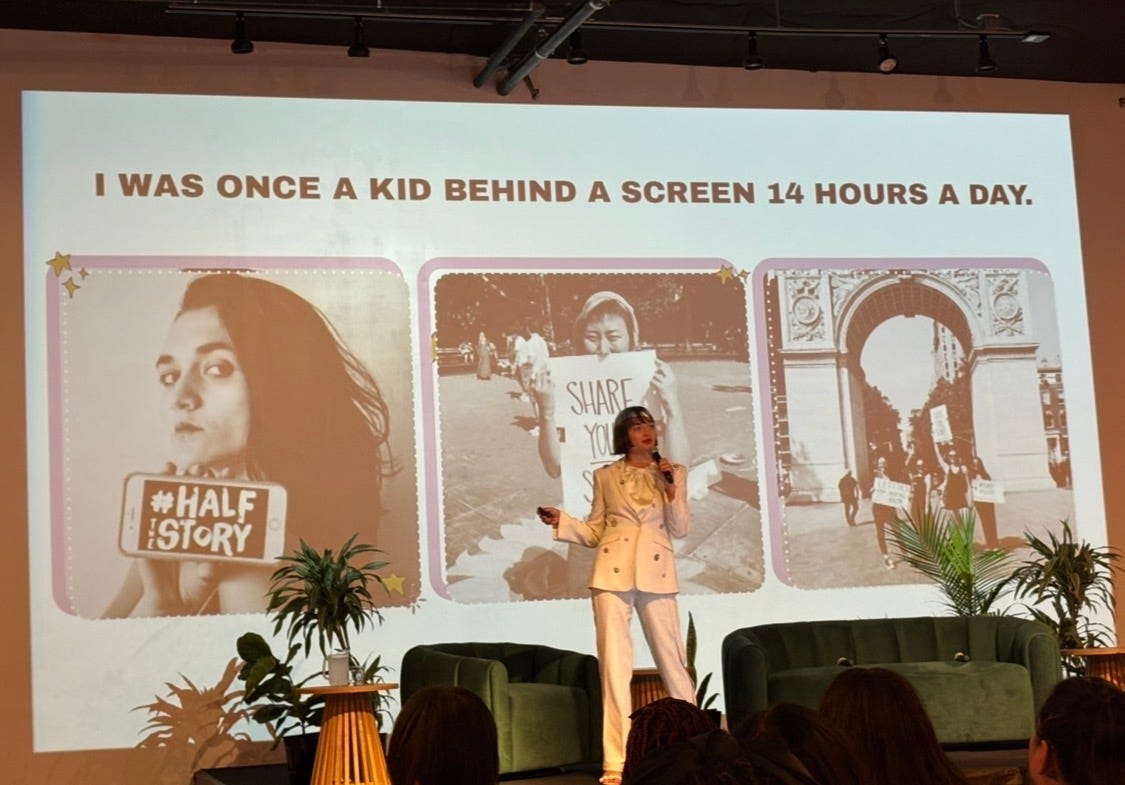
Larz May spoke about founding #HalfTheStory after experiencing social media addiction and a coinciding mental health crisis. She reached a point, as a college student, where her algorithm was feeding her instructional content for ending her life. That was over a decade ago, at the beginning of reckoning with the consequences of imitating perfection on social media, and May was a young adult experiencing how an algorithm can change a brain.
“Back then, it was that we were using funny filters, and avocado toast, and looking perfect on the Internet. I think we all remember those really cringy Instagram filters,” May said. “But now, the questions that we’re asking about technology are not just about, ‘what is the other half of the story behind the filter?’ AI is quite literally changing the future of humanity’s course.”
As May reiterated, this moment and the people centered in its consequences deserve more from us than fear. Action items that can be part of a solution can look like tech ed in schools (its necessity was compared to sex ed), getting young people and teenagers a seat at the policy-making table for tech regulation, and for all of us, relearning how to be bored; how to feel anything uncomfortable without sinking into doom and algorithms, especially as we all get push notifications flipping an hourglass on humanity. Fear has the potential for paralyzation, or for productivity.
“I’m afraid of a world where we have young people that are living in the doom loops of apathy to a place where they aren’t able to design and develop their own passions to figure out who they are,” May said. “Can we ensure that our children are going to be able to figure out who they are while living in a world where they’re spending 30 years of their life behind the screen? Because what happens if they go to college, and they graduate, and all the things they hung their identity around suddenly get replaced by AI?”
Another panelist, Nikki Iyer — co-chair of Design It For Us and a Berkeley undergrad student — shares my memories of feeling briefly empowered and excited to be the digitized generation. The democratized, global access to everything and everyone, at face value, made us the most connected generation in human history.
She shared that, as she grew up, that feeling of being a member of a moment receded to discontentment, and antithetically, loneliness. When your brain has been programmed from adolescence to expect immediate access to anything from your friends to a consistently dark news cycle, being alone in your brain feels like missing something shapeless and vital. It makes complete sense that anxiety, depression, and suicidal ideation have been statistically high in our age range.
“I grew up online, many of us all grew up online. And that means we know exactly what shouldn’t be happening to the next generation. You know the problems with technology because you’ve felt them many times. And I think one of the biggest issues with this problem is that so many of us become awake to it only because we experience the addiction ourselves,” Iyer said. “Big Tech has incentives to keep you online as long as they can, which you all know. It’s especially hard for young people, though, because the way that [tech companies] make their money is the more time spent, the more data they can collect, and the more targeted they can run their advertisements on you. That’s especially harmful when you’re young. You don’t have a strong sense of self and you’re much more likely to click on very profound things.”
Iyer no longer uses social media, and we talked about what she’s gained and lost through that choice. She’s gotten back countless hours of her own life she would have spent online. But your early twenties is an intensely social time of life, and in 2026, the means of gathering in person is organized online. Social media has become the infrastructure of our social lives, and was designed to make you feel like you’re missing out if you aren’t on it, or on it enough.
At least she and I remember how to leave, even if the process is more difficult and painful than it should have to be. There are versions of ourselves and our brains we’re motivated to find again, that existed before our attention was commodified and sold back to us. It feels like our responsibility to figure out how the next generation gets their chance to develop that baseline. The work is underway, thankfully, by a movement that includes Iyer and May.
The doom loop of unchecked AI development is overwhelming in adulthood; last week’s news cycle following the Anthropic whistleblower didn’t surprise me in the least, but I lost sleep and struggled to have unrelated conversations. If I put myself into my mind ten years ago, at thirteen — when the social media and technology landscape was prevalent in daily life, but not nearly as evolved and embedded into culture — and imagine seeing that headline, I get more emotional than is probably appropriate for Hard Reset.
These days, I need constant reminders that I’m not powerless, just to keep my sanity. I know I’m not alone in that feeling. Fear has the potential for paralysis, or for productivity. Choosing the latter has irrevocable power.