


In Atlanta, despite the societal backdrop of tech oligarchs and their shameless power grabs, the atmosphere was overwhelmingly optimistic.
At a conference for labor organizers and tech workers, a West African music and dance group beat the drums and danced ecstatically. Before each session, conference leads grounded us in history and understanding of southern culture, as well as with joyful song and dance. Facilitators of various sessions chanted, to get our attention and also to galvanize us.
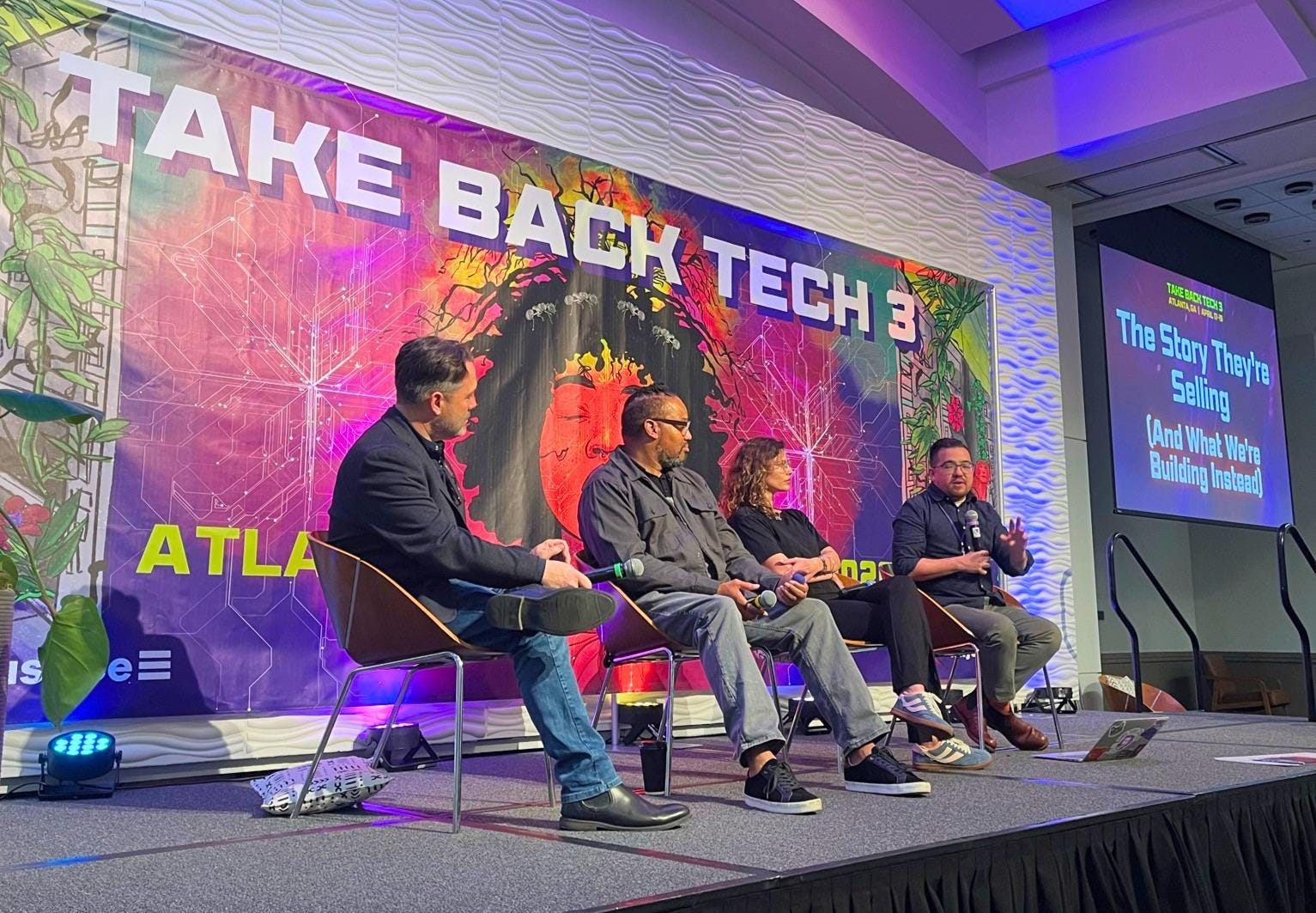
The Take Back Tech conference was conceived by non-profit Media Justice not to abolish or completely minimize tech from society, but to consider how the everyday person can reclaim beneficial elements of technology from oligarchy, the surveillance economy, and late-stage capitalism/capitalists.
I was there to speak about the consolidation of power in the hands of a few billionaire-run media companies. The panel was lively and interesting; we agreed that while AI is not necessarily inevitable in all realms of life, it is here and being used by the general public in a truly day-to-day way, and that in that context, we have to admit it may become the fabric of some people’s lives. As a result, our panel discussed, we may need to figure out how to temper the worst impulses of the algorithms and oligarchs, and educate the public about how these technologies are made.
Surveillance capitalism was also a huge topic of conversation, specifically how the federal government and ICE have been leveraging video technology to track the movement of immigrants, and the movement of women in the south who have had abortions. Called automatic license-plate recognition tools (ALPR), these technologies can manifest in fixed, mobile, portable, or flying cameras that capture, compare, store, and analyze images.
While pitched as a public safety imperative to some, they are unequivocally being used for malicious reasons. So from Massachusetts to Texas, local organizers and city council members described in detail their efforts to combat video surveillance companies, including Flock Safety and Axon. These companies, unknown to much of the voting public, have a back-end architecture that allows federal agents to access local information through formal, informal, and unauthorized pathways.
In one Texan town, organizers and activists enlisted libertarians concerned about privacy. This was an unlikely ally, but one that helped them build coalitions to make it politically unpopular for these companies to expand their presences or even renew their contracts.
I appreciated this thread, that connecting with unlikely allies and bringing in those who might disagree with parts of the movement was essential to the greater picture of change.
In one session, two debating teams were enlisted to take on two stances: one was tasked to affirm AI for the people, the other to criticize any presence of AI in society at all.

The “pro” team acknowledged the potential for abuse, but channeled the idea that information retrieval could be leveraged in a pure mathematical sense to identify online abuse of trans people, for instance–or even to help NASA discover more about the other planets. To the “anti” team, AI was inherently exploitative and colonialist, extracting water and minerals from indigenous communities for data centers, and cheapening labor through its marketing pitch that artificial “intelligence” could replace good work.
Both sides had valid statements and compelling arguments. But what I found especially interesting was that at the end of the debate, the moderator asked each team to reflect on their blind spots. Naturally, the “pro” team said that their support of even the “people’s” AI could be abused in the wrong hands, and that even good people can be exploitative if the systems are inherently so as well. But interestingly, the “anti” team was firm in their acknowledgement that it was lazy simply to critique AI without a critique of the critique. They admitted that some progressive movements can be too purist, to the point of alienating anyone who disagrees with them. There was a fundamental and universal understanding that, like the anti-surveillance teams who partnered with libertarians, there had to be a meeting of minds outside of traditional echo chambers.
I left Atlanta feeling hopeful as well, with both the acknowledgement that activists weren’t backing down, and also with the feeling that activists and organizers feel strongly that political progress may not be possible without two disparate groups coming together to solve things.
What else we’re paying attention to…
Meta is tracking employee keystrokes to train its AI.
Can AI agents run real world stores? One market in San Francisco is trying to find out.
A med student generated a “MAGA girl” with AI to grift men online.
Labor groups are pushing back on Trump’s AI plan. required casinos to give workers advanced notice before implementing new technologies.
State governments and Native American tribes have filed a flood of legal challenges to claim Kalshi is running an unlicensed gambling operation.
Missouri is outlawing the use of AI to create explicit sexual material of a person without their consent.
A North Carolina jury found that Uber is liable for the behavior of a driver who grabbed the inner thigh of a passenger and asked if he could “keep her” with him.