


Friends of mine in tech describe the Bay Area tech networking scene in a fascinating way. There’s the classic buttoned-up hotel ballroom mixers, and then there’s robot cage fighting and BioPunk raves.
I followed one suggestion Monday night to an Irish Pub in San Francisco’s Mission neighborhood. A beer garden with an insistent amount of posters for a Catherine O’Hara movie marathon was not the space I expected tech-focused business casual networking to thrive in, but it was packed over an hour before its start time.
The event brought in a somewhat even ratio of women to men, from some still in college to some nearing retirement age. The disarming setting and confident regulars made conversation easy and frequent. A representative of the organization hosting — The Founder’s Club — told me this tradition was formed in the UK, and now takes place monthly in major cities across the United States. They host regular meetings in Miami, Austin, Chicago, LA, Houston, and New York. They focus on AI, health and wellness, or women in tech. Their San Francisco events are catered to start-up founders.
I talked for a while with the founder of a seven-year-old company that designs reusable hardware for satellites and space missions. He was visiting the Bay from Argentina to attend events like this one. He told me fundraising has become very different than it was less than a decade ago; now, every potential investor asks where AI fits into the operation. His company builds physical computing systems, but his software engineers, as is now standard, check and fix code that AI writes rather than coding themselves.
He asked me in turn how AI has affected my world as a writer, and asked if I use it in my work. I told him that I never publish AI-generated writing, and the most its cultural prevalence has affected my work is having to scrutinize my love of em-dashes. He was surprised, and asked if I worry that my work is being used to train AI models (of course I am). That made me wonder how that concern translates to a company that designs physical hardware. AI has been trained well enough to write initial code for his company; does he worry it could absorb and dispel their proprietary information?
Not AI itself, he told me; he’s considered this frequently. Hackers have always been willing and capable to steal and sell information, and the advantage of AI makes that threat more acute. It’s made cybersecurity a greater focus than ever.
A couple from France, also visiting the Bay for meetings like this one, is seeking investors for research about mental health and anxiety in children. They hope to develop software that can help adolescents and their families understand triggers and patterns of their child’s anxiety. They told me raising money in France for this project has been difficult, where the medical research space tends to be insular. This was their first event in San Francisco, and they were excited to be in a space they described as more peer-focused than academically structured.
One of them gestured around the patio at the groups of people in engaged conversations, and observed, “There’s a founder’s mindset here.”
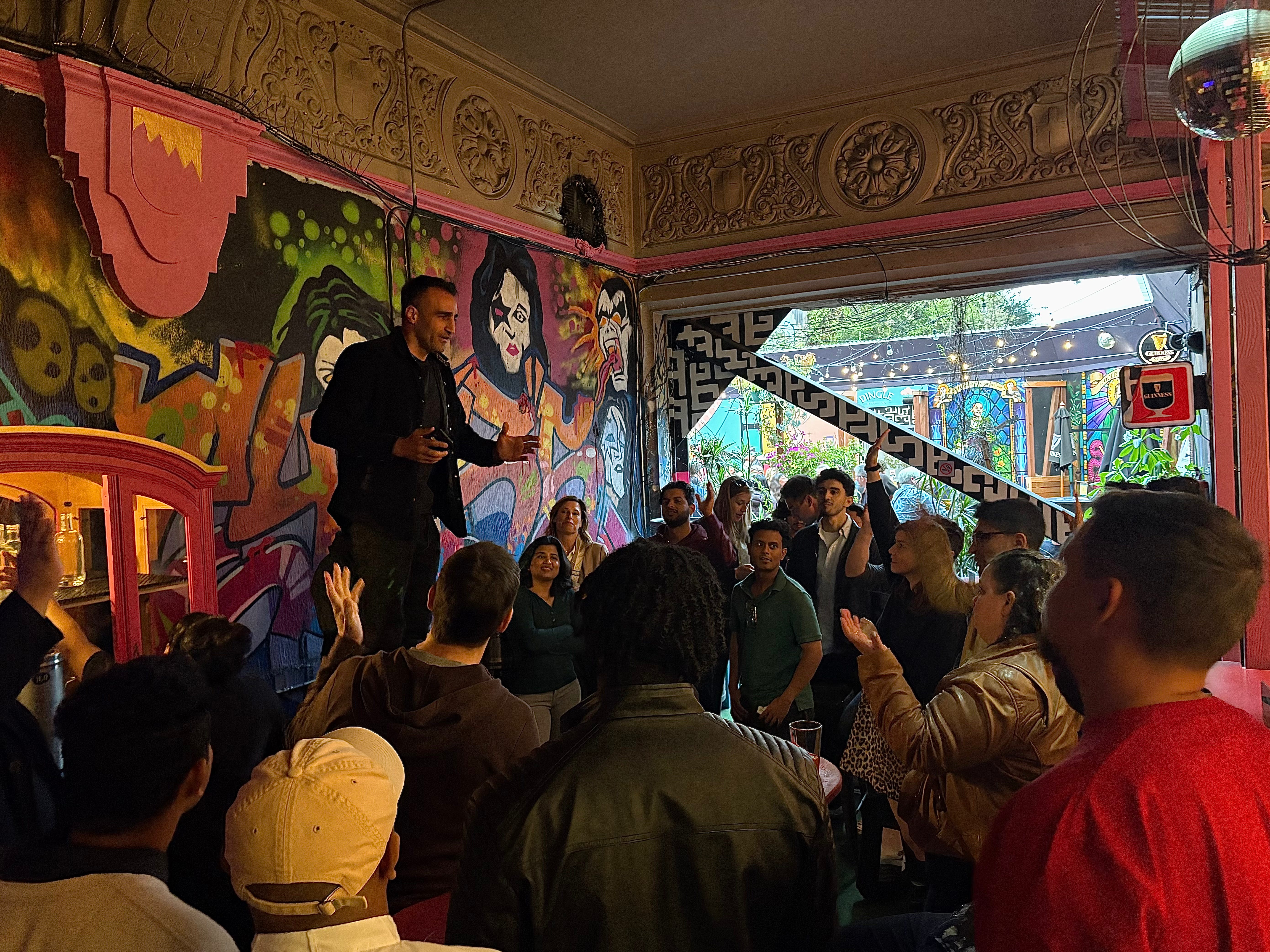
A young man with The Founder’s Club stood up on a bar stool — no microphone, just a projecting voice — and began to call names who had signed up to give their minute-long pitch to the room. An iPhone timer was started when the pitch did. Attendees gathered around whoever was speaking, some of whom also opted to stand on the stool. The group applauded when each pitch ended. They were supportive and responsive. Just as I was wondering how effective an event this may be, members of the crowd started calling out that they wanted to meet with the founders ending their spiels. I watched two young founders exchange information and plans to form a partnership as two start-ups competing with Stripe.
Sustainability was a notable throughline. A young man, from atop the bar stool, showed the room his company’s software tracking materials used in the fast fashion industry with the goal of incentivizing recycling and upcycling fabric. An Australian man told me about his company’s goal to invest in and advance infrastructure for electric, renewable aviation and marine technology. A young woman from Ethiopia told me about Kapsule’s work to expand the infrastructure for healthcare data across Africa.
I spoke with another of the event’s staffers as folks began to exchange LinkedIns and close their tabs. He said this format of informal bar networking draws new people every week and regulars who enjoy the social aspect, interesting conversation, and hearing new, young entrepreneurs speak.
He asked why I hadn’t pitched from the bar stool. I reminded him that I’m a reporter, not a founder.
“You should still get up next time,” he told me. “Everyone could use a good chance to practice their spiel.”