


Surveillance doesn’t typically have a sexy connotation to it. Most people don’t exactly love to be watched or stalked—or to have their private communications invaded for the sake of national security or public safety. Privacy was actually supposed to be sexy.
And yet these days, it’s not just an over-zealous government that’s watching us (though they are). It’s us watching each other. Recording each other. Watching ourselves. And even now filming ourselves being watched.
In the last few weeks, amid the launch of the Meta smartglasses, I’ve been struck by how culturally acceptable it’s become for us to contribute to our own surveillance—oftentimes without knowing exactly where and how our documentation and data is being stored, consumed, or analyzed. Because the recordings of us seem so inevitable—on city streets, in stadiums, at airports, on our phones—some have decided to embrace it to the full extent it can be embraced. Myself, in certain ways, included.
Last week, an English influencer and model posted an Instagram carousel of herself recorded through the lens of her home security camera. The fish eye angle of the photos makes us feel like we are watching her rather than seeing her (dubbed “surveillance chic” by a writer trying to make sense of this cultural phenomenon). Another influencer is using her building’s elevator security camera to document daily outfits; others posting Ring camera images say they are subversively winking to the surveillance state.
Workplace culture has accepted surveillance, too. Companies are adopting products that claim to track and hack productivity, while developing entire databases of workers’ digital behaviors. Job interviews are being recorded by both candidates and employers—and firing decisions are made based on the aforementioned recordings of people’s daily keyboard strokes. (This is not lost on the workers developing these surveillance products, given they are surveilled at the very jobs where they develop the surveillance products.)
Meanwhile, the companies that are surveilling us are trying as hard as they can to upend their own past historical identities as spy-like, opaque, sinister, in bed with some deep state. These days, they are trying to be something else altogether: cool. Cute, even.
Palantir, the company which helps ICE track the location of immigrants, launched a bright blue “chore coat,” emulating a “workman’s” coat that may affiliate Palantir with something more industrial, more down-to-earth. The Palantir employee who developed the coat actually describes himself as being responsible for “vibes,” and can be seen promoting the “elite” nature of his merch on X.
One woman, a tech worker, even advocated for the recording of others as a psychological imperative of some kind. She told the Wall Street Journal that she was “triggered” because someone asked her to stop recording them—also sharing that she has taken to recording job interviews and even first dates as part of her daily routine.
Online stalking is not new, and neither is the recording of people or online behavior analysis. But there is a fusion of forces today that feels unprecedented.
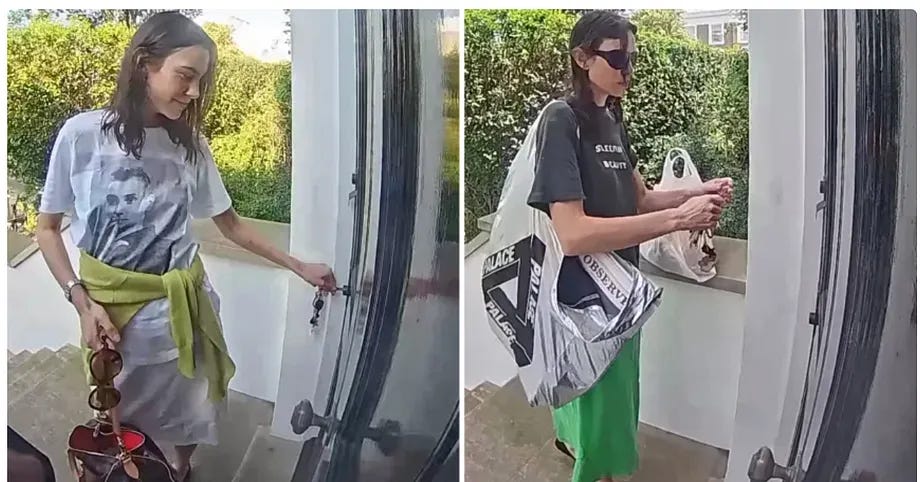
And that fusion is between the proliferation of surveillance cameras feeding our locations and actions into an increasingly authoritarian state—and a social and digital culture that is encouraging everyday citizens to document everything. It’s allowing us, paradoxically, to conflate cultural trends of expression with the acceptance of surveillance.
Because although elevator selfies can feel cute in the moment, the intentions of the technology underlying all the networks we feed are nebulous. We actually don’t know what is happening necessarily with our information snapped by cameras that are not ours. Is the goal for us to record every single interaction and movement of our day so we can better train AI or some future Metaverse (given the first one succeeded so spectacularly)? Is it to allow the government and advertisers to keep dossiers on our locations, sentiments, and personalities? Is it merely to show public company shareholders that they are innovating by developing gadgets that we may not actually need?
And even more questions abound about the future of consent. How will two-party consent laws apply when Meta glasses record someone who is inebriated and confessing something private during an intimate conversation? What will companies do when they possess footage of sexual interaction that was not meant to be recorded? What employees will have access to information that was not meant to be preserved or accessed for play-by-play documentation?
Candidly, it’s psychologically uncomfortable to ask these questions. And the companies know this. It’s awkward to ask why we (myself included!) are exposing ourselves to such a degree—or why we are documenting things that may have previously required a subpoena or sophisticated technology to access.
To be clear, I’m not saying that all documentation or expression for online consumption is bad. But I also think that in a world where surveillance no longer seems like a choice, perhaps surveilling ourselves and others more and more is an impulse to retain some semblance of control or agency over it all.
We’ll start to see the answers to the previous questions play out, sometimes in very creepy ways. The other week, Waymo called the police on two teenagers who were drinking and playing with a toy gun in one of their driverless vehicles. The teens were locked in the car, observed by a remote Waymo employee, until the police arrived. And last week, it was reported that a Milwaukee police officer searched the license plate number of someone he was dating over 200 times. He also searched for his partner’s ex.
These companies’ products feel so ingrained in our daily movements that they seem all but inevitable as part of our act of living and working. But ultimately, the idea that we’re taking back our personal agency by surveilling ourselves and others 24/7 is not true. The only agency we may be definitely contributing to at the end of the day is law enforcement.
What else we’re paying attention to…
A rural New York school district is deploying a humanoid teacher this fall—manufactured, bizarrely, by a crypto sex doll company.
The surge of AI in workplaces may be the catalyst that knowledge workers needed to unionize.
The CEOs of the two largest prediction markets appear to despise one another.
US Army employees are burning through their AI tokens.
The FIRE movement seemed to this journalist like a fringe movement of people who didn’t want to work. Turns out, it’s more of an intentional group that wants to reject hustle culture.
AI embellishes images of birds, leading to confusion among birdwatchers. On that point: AI is also duping homebuyers into thinking kitchens are renovated.
I was amused by this headline! Meta is testing an AI bedtime story app for people who have no imagination
OpenAI’s model escaped containment, hacking into the AI research platform Hugging Face in order to steal answers to a test they were being graded on.
this was a really interesting read! alexa chung’s post also made me think of the idea that women often feel like we should act pretty and feminine, as if we’re being watched, even when completely alone. except now, we are actually being watched and it’s not just some weird feeling and pressure to perform.
also the ai bedtime stories?! reminds me of julia’s job in 1984
surveillance culture is so layered, I've been thinking about it more from the angle of performance of self moving from online to offline because we live in fear of 'being caught in 4k' but this has given me more to consider around the wider (and more insidious) implications.