


“Steve isn’t that dumb.”
So said Mark Cuban, the former owner of the Dallas Mavericks and longtime co-host of the TV show “Shark Tank,” exactly one year ago. Cuban was defending Steve Ballmer, an early-days Microsoft executive who later served as the company’s CEO and has spent his golden years as the heavily involved owner of the Los Angeles Clippers.
At issue: last September, investigative journalist Pablo Torre reported that Clippers star Kawhi Leonard had signed a “no-show” endorsement deal with a now-defunct (and fraudulent!) company as a means of circumventing the NBA’s salary cap rules—and that the deal was funded by Ballmer.
Torre’s report kicked off a nonstop sports media news cycle, and was damning enough that the NBA hired a law firm to investigate the matter. The law firm and the NBA released their findings this week. The top-line result is that the Clippers “violated the circumvention rules in numerous independent ways.” And: Ballmer “knowingly sought to help Mr. Leonard obtain off-court income opportunities and, in at least one instance, engaged in a significant act of team facilitation. Mr. Ballmer also failed to create conditions under which his organization abided by the NBA’s circumvention rules.”
Among the many penalties levied by the NBA: Ballmer is suspended from all league activities for a year, and the franchise must forfeit five future draft picks (and $30 million).
The NBA’s salary cap purposely limits how much teams are able to pay players. It’s mostly a leverage point for cheap-o franchise owners, who generally do not want to pay players what they are actually “worth” relative to their marketing value. To his credit, Ballmer is not “cheap” when it comes to player contracts or building an arena. Since purchasing the Clippers in 2014, Ballmer has feverishly tried to turn around the fortunes of the oft-hapless sports franchise. He privately financed the Clippers’ $2 billion Intuit Dome, for instance, which opened in 2024. (He’s cheap in other rich-guy ways, including how he reportedly takes advantage of tax write-offs, but I digress.)
It helps that Ballmer is unbelievably wealthy even among his team owner peers. Forbes lists his net worth at $156.7 billion, which makes him the ninth-richest person on earth as of Thursday afternoon. A little (alleged) cap circumvention to secure the services of Leonard, one of the 75 greatest players in NBA history, would be a small price to pay. Unless, of course, Ballmer and/or the Clippers get caught.
Ballmer and/or the Clippers got caught. According to Torre’s reporting (much of which was substantiated by the NBA’s investigation), after Leonard signed with Los Angeles in 2019, his uncle slash agent Dennis Robertson tried to pocket tens of millions of dollars via shady “endorsement agreements” facilitated by the Clippers.
Ballmer pleaded his innocence over the course of the last year, and he found a credulous audience. Up until the release of the NBA’s independent investigation, countless pundits and reporters strayed outside of their usual coverage areas and butchered their analysis of Torre’s scoops. Unable to contextualize financial reporting, and seduced by what one can only reasonably deduce were Clippers sources eager to muddy the waters, these pundits and reporters repeatedly cited a lack of a “smoking gun.” This is rarely how reporting works. Investigative journalism is not the equivalent of a court of law, and it’s unusual for a story (or even a series of stories) to answer every single outstanding question a reader might raise.
Torre, though, came pretty darn close. As time went on, and Torre peeled back more layers of the onion, the same refrains grew louder and louder. The cynical take, which I was more sympathetic to, was that the NBA wouldn’t bring the hammer down on its richest owner even if he did everything he was accused of doing. But the other common take drove me nuts: that by virtue of his immense wealth and entrepreneurial spirit, Ballmer was too brilliant to rashly participate in (or even have knowledge of) a cap circumvention scheme. Cuban asserted as much multiple times. A sampling of other equally annoying (and wrong) assessments:
The Ringer’s Bill Simmons said, “This was so sloppy that it almost makes me think, I kind of just can’t believe—everything I know about Ballmer, how shrewd of a businessman he is, how thoughtful he is about everything… I just can’t believe he was this dumb. That’s kind of where I’ve landed. And maybe he was this dumb. But I can’t believe he was this dumb.” (Disclaimer: I was a Grantland intern and used to play pickup basketball with Simmons, who I did not know well but liked interpersonally.)
An anonymous front office executive told The Athletic’s Jason Lloyd, “Steve is really intelligent. I don’t believe he’s dumb enough to wire $50 million to a company, just to have that company turn around and give it to Kawhi. I don’t believe it.”
“It’s not something I would ever believe,” former Milwaukee Bucks owner Marc Lasry told CNBC. He added that Ballmer is “honorable” and a gentleman.
“The Clippers are not dumb to first of all, leave a messy paper trail that [would] basically ruin their franchise,” ESPN analyst Bobby Marks said last year. “We’ll wait and see what comes out of this investigation. I’m not anticipating anything. That’s not any disrespect to Pablo’s reporting. But I’ve been part of salary cap circumvention cases. The optics don’t look good, but it doesn’t meet the smell test as far as a team circumventing the salary cap.”
Other reporters, like Puck’s Chief Snark Critics Peter Hamby and Dylan Byers, de facto backed Ballmer by insinuating that Torre had somehow screwed up his investigation. Disgraced sportswriter Jay Mariotti suggested that Torre should “quit… until he decides if he ever can validate a story.” These reporters did not offer much in the way of evidence—just that the NBA seemed to be taking a while to wrap up its own investigation, and that some poorly-sourced stories published by ESPN made Ballmer look like he was in the clear.
They were badly mistaken. The full 35-page report from the NBA and the law firm it contracted is quite detailed; it includes key witnesses, text messages, and emails that go far beyond “bad optics,” as Marks put it last year. You could argue that it, too, does not have a “smoking gun,” but again: what does that really mean? Lengthy, written investigations require interested readers to use their brains and make connections. No reasonable person is going to read the NBA’s report and conclude that Torre, or the league, were picking on the wrong guy.
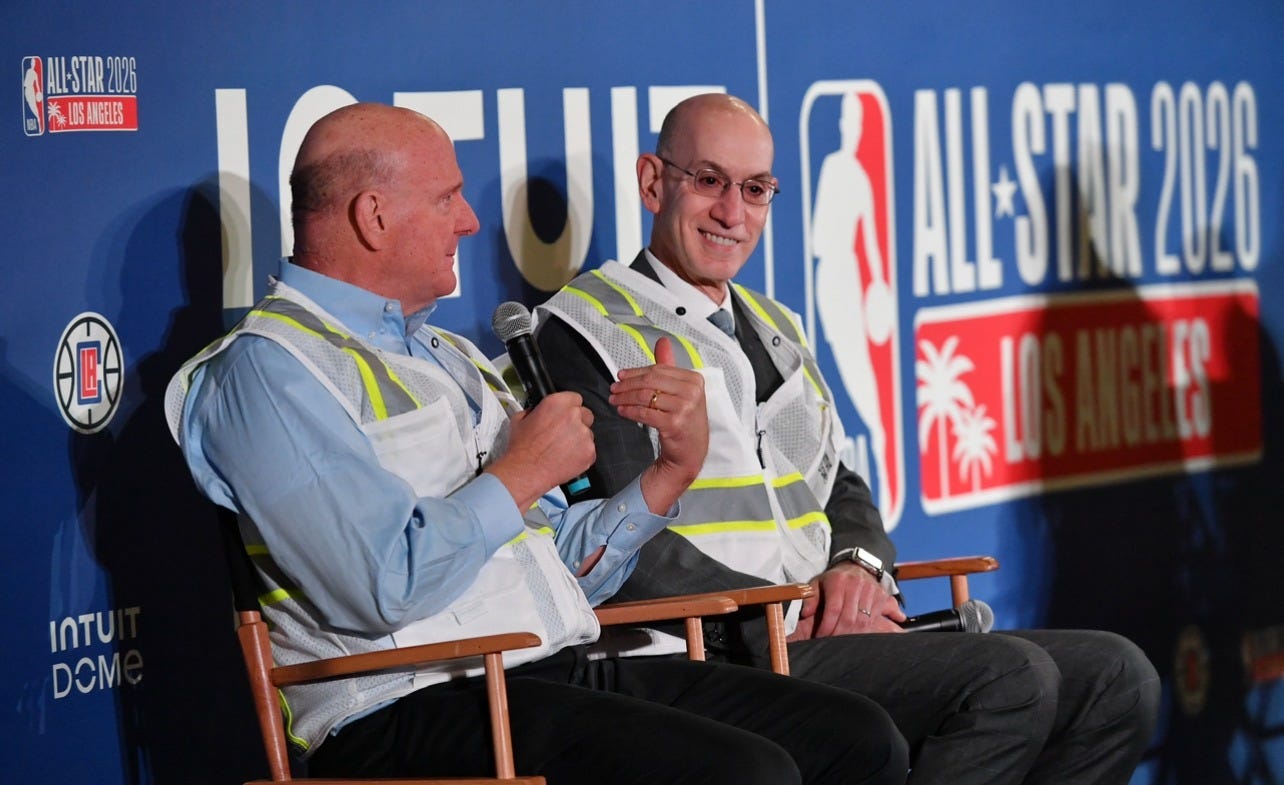
Ballmer is apparently “fuming” about the penalties enacted by the league. “I know Steve Ballmer a little bit, and I understand when you’re worth $150 billion and you’re angry—and he’s very clearly angry—you can’t advise him, you can’t talk to him,” said ESPN analyst Brian Windhorst. The Clippers released a disappointed statement with a typo in it, and also sent a litigious letter to NBA Commissioner Adam Silver. From what I’ve gathered, Ballmer and his basketball team don’t have many avenues to actually fight the penalties assessed against them, though I’m sure that won’t stop them from trying. As Windhorst noted, hell hath no fury like a tech oligarch who doesn’t get his way.
The thing is, Ballmer’s behavior got the Clippers into this mess. Following up a self-inflicted scandal with a prolonged temper tantrum will only make him look worse, so that’s exactly what I expect him to do. Unlike Cuban, I don’t know whether Ballmer is “dumb” or not. I do know this: Ballmer’s cartoonish ruthlessness is hardly uncommon among tech oligarchs—and it absolutely should not be mistaken for intelligence.
Here’s what else we’re reading this week:
For the second time in a year, a federal judge ruled that Google is running an illegal monopoly—and then declined to do much of anything about it. Judge Leonie M. Brinkema, who’s 82 years old and was appointed by President Bill Clinton, “ruled on Wednesday that Google must make changes to address its advertising technology monopoly but would not need to break up that business,” the New York Times reported.
Specific details about those “changes” are under seal for a few more weeks, but as The American Prospect’s David Dayen noted, Google doesn’t seem very concerned. Quite the opposite, in fact: “We’re very pleased the court rejected the DOJ’s proposal to break apart tools that help small businesses reach new customers and grow,” said Google’s vice president of regulatory affairs.
Last September, U.S. District Judge Amit Mehta—appointed by President Barack Obama—decided against breaking up Google, despite ruling that the tech conglomerate also had a monopoly over the online search market.
Uber laid off 10% of its staff on Wednesday, which reportedly amounts to roughly 3,300 people. Like Xbox’s mass layoffs announcement in July, Uber is relying on vague language about how it needs to “remove layers” of management for the long-term health of the business.
Uber is also immediately shutting down operations in Nigeria and Uganda. The ride-sharing company is apparently offering what it calls a “goodwill payment” to active drivers, though it’s unclear how much money that entails, and it’s hardly a consolation for people who made a living off the app. “I cannot accept it. What do they expect me and my family to do? How do they expect us to feed?” one Uber driver said to the outlet TechCabal.
Another week, another inexplicable Sam Altman quote. This one is from his recent interview with Time and Alex Heath: “I think everyone should have a personal robot,” Altman said. “I would love to have a personal robot that could do the tasks I don’t want to do. That’d be great.” In the same interview, Altman also unsubtly critiqued Meta’s pervert glasses. “I find it very uncomfortable to talk to people with a camera and a light,” he (correctly) stated, when asked about AI glasses more generally.
There’s a four-hour Elon Musk documentary in the works, according to a feature from The Hollywood Reporter. It’s directed by documentarian Alex Gibney, who was unable to secure access with Musk himself, but seems to have locked down interviews with dozens of other important characters in Musk’s orbit. “People assume because he’s very rich that he’s not crazy,” Gibney said of Musk. “But the terrifying thing might be that he’s crazy and he’s very rich and powerful. That’s the warning bell the film sounds.” Assuming there’s no chicanery, the documentary will reportedly be released on HBO during the first half of 2027.
Commerce Secretary Howard Lutnick is playing nice with Anthropic. Coincidentally, Anthropic co-founder Tom Brown had wonderful things to say about the Trump Administration on Wednesday. “I really love Trump’s post from earlier this week ... where he was pointing out that the data centers are just an enormous source of prosperity,” Brown said at a G20 panel.
"Steve isn't that dumb.": [Narrator voice:] Steve was, in fact, that dumb.
Has the chair-throwing incident of 2004 been memory-holed? Ballmer denied it, of course, but this latest episode is suggestive of how much credit we should give his denial.
Mistaking swagger for talent and low cunning or sheer luck for high intelligence is a characteristic folly of this society. The encomiums for Ballmer are cases in point.
Likewise the reverence for Elon Musk.