


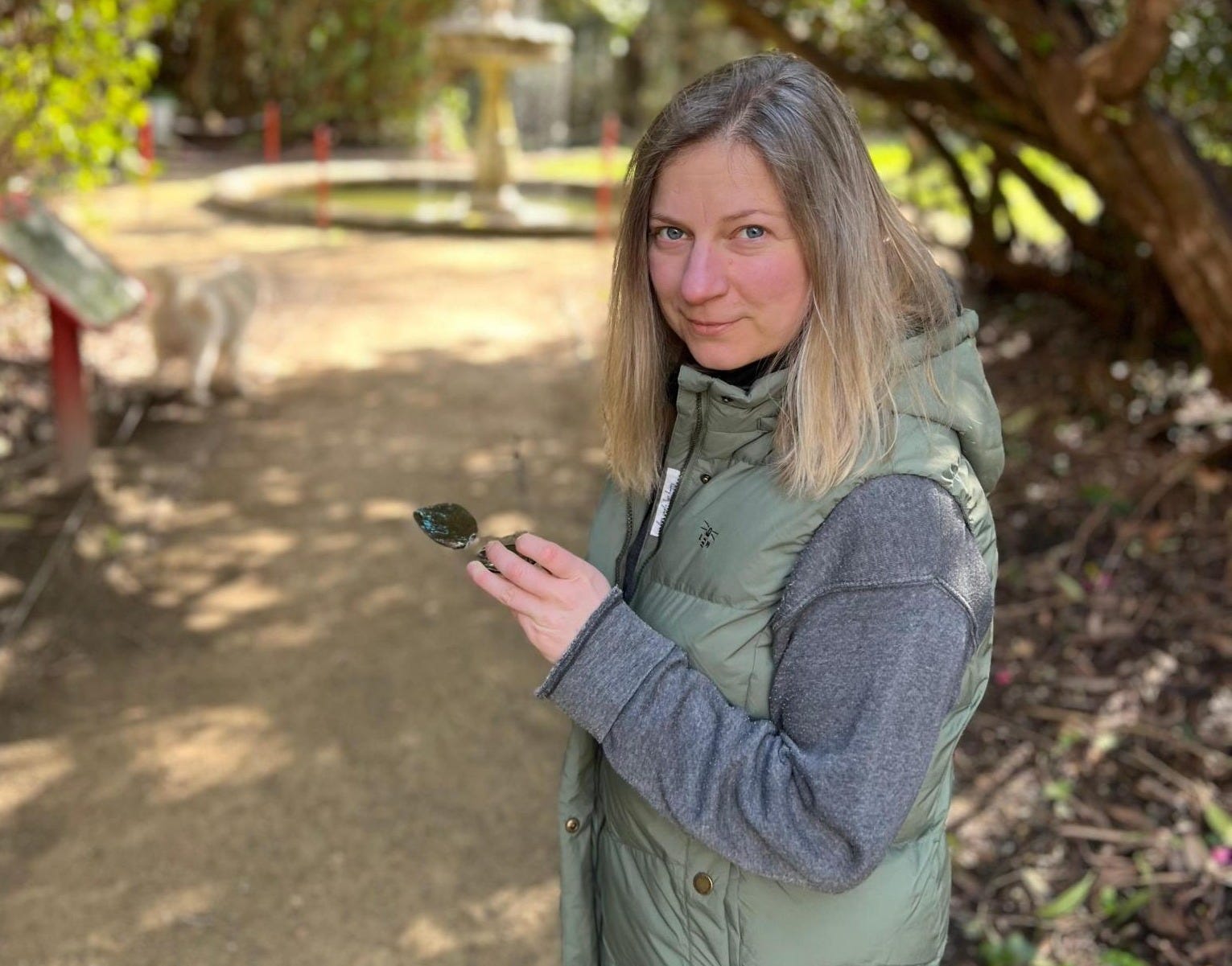
The other month, I found a Substack called Beyond Linear, which was strikingly similar in ethos to my personal Substack about life’s twists and turns (called Nonlinear). Diving in further, I discovered that the creator and author of Beyond Linear is a former tech worker named Yana Michukova who writes frequently about career pivots from tech, and handling the unease of quitting or being laid off without a back-up plan.
Yana has a masters in computer science, and after working at small startups and eventually bigger companies like Lyft, she moved from her native Belarus to Dublin to work at Stripe as a quality assurance engineer and then a product manager.
In April, Yana left Stripe because she wasn’t finding the work especially fulfilling or interesting, which we get into in much more depth below. While she isn’t ruling out a return to tech at some point in the non-linear future, while speaking with Yana I sensed a resolution and contentment in her decision to leave Stripe. Her Substack has become a safe haven for other tech workers handling layoffs, or considering quitting because of a restlessness or lack of fulfillment. Here we speak below about Yana’s particular path and predictions, enjoy!
Ariella Steinhorn: Can you describe the moment when you decided to take the leap of faith and quit Stripe? Or was it more gradual, this realization that you needed to leave?
Yana Michukova: The decision was actually quite spontaneous. My career at Stripe was in a great place, and Stripe was a great company to work for.
But with the rise of AI and the speed of technology, I didn’t have the chance to grow my skills as much as I wanted to. I was spending the majority of my time in meetings and with clients, trying to launch products. Something felt off, I couldn’t quite name it, but I didn’t feel like I fit into the puzzle. I was more fast-paced than Stripe, and I started to sense that I could build something faster outside of it.
One day I was traveling back from a business trip and sitting in the airport. I felt the urge to suddenly text my husband: “What if I leave Stripe?” He responded that he was supportive.
I didn’t have a job lined up. Yet during that eight-hour flight back to Dublin, I became firm in my decision—and by the time I landed, I knew that I was leaving.
One of my mentors has a framework foraround leaving your job around “four Mondays.” If you start your working week on a Monday and don’t feel energy or satisfaction, give yourself four more Mondays. If that feeling doesn’t change, it’s time for a career change.
In any case, I didn’t necessarily follow that rule; after getting the support from my husband and taking a few days to sit with my internal decision, I had a conversation with my manager and put in notice the next week.
Without anything lined up, there was a lot of uncertainty. But when you feel that instant burst of energy, you feel so much better, and you know it’s the right decision.
AS: Can you speak more to this idea of not being fulfilled in a tech job, what that means?
YM: The way I think about it with work is that you can grow your title, your compensation, or your knowledge. Depending on how you prioritize, your boss might be different.
As I continued on at Stripe, I found that the gap of my knowledge and my skills was increasing in the broader market. And I decided I’d trade my title for the sake of learning new skills. (Interestingly, around the time I put in my notice, my manager also left—to acquire more skills at Anthropic.)
I suppose I could have squeezed more meat from the bone at Stripe. But when you’re at a company for some time and senior enough, you have the full picture of the landscape. I knew I wouldn’t be able to get the skillset I desired with any of the teams I was working with—and that if I stuck around, it would take at least six months to change my domain or my team.
Beyond that, the skillset for a product manager is rapidly changing in the broader market. I’m a firm believer that the role of product manager won’t exist as we know it in a year’s time. If you don’t invest now, there’s a chance you’ll be left on the sidelines. Same with the role of the software developer.
AS: What do you think the product manager or software developer roles will look like next?
YM: I think the “product builder” will come next: a person who understands customers and has business-side knowledge, but who also has the requisite skills to build the products.
Today, product managers are not used to building, and software engineers aren’t plugged into the business side. That will have to change.
AS: So the roles may morph into one role?
YM: Yes. If you look at what’s happening with startups and tech companies, the teams are becoming leaner and smaller as tech capabilities are advancing.
AS: Beyond the formation of this “product builder” role, do you have any predictions for how AI will change the day-to-day of tech workers, knowledge workers—really anyone?
YM: Right now, the tech industry is focused on the problem of AI adoption. Not everyone has adopted AI to the maximum extent possible.
The next frontier of problems will be distribution and value creation.
Take Lovable, for example; they claim they have more than a million websites vibe-coded. So then if everybody has a vibe-coded product for themselves, then what will be driving the economic growth and business? How will we think about distribution and marketing?
AS: Then it almost connects back to the creator economy, and people differentiating themselves and their products through branding or personality.
YM: Exactly.
AS: Are you seeing patterns among the people quitting tech? In who they are, how they were brought up, epiphanies they’ve had? Different levels of safety nets? Or does it really vary?
YM: I hear from really all kinds of people, most of them in the middle or senior-middle roles (as opposed to director or junior level). Some people don’t have a safety net and are building their cushion. Some have families, some don’t. Very different situations.
I get messages and emails from folks on a weekly basis; some are considering moving while others are fearful of leaving tech, afraid that their side hustle won’t work out.
It’s a very humbling experience to get all of these messages. I’m not a career expert or a guru, I just try to help as much as I can.
AS: You’ve written about people who have left tech altogether—like a former colleague at Lyft who became a florist. What other stories have you heard that have stayed with you?
YM: The florist example is probably my favorite so far, it’s so unusual. For my next article, I am writing about a tech worker who became a yoga teacher.
Then there’s the person who left Stripe to write a book, but then returned to Stripe. An ex-Meta product manager I connected with started a small business selling kids clothes and accessories, while another former product manager became a dating coach—something I didn’t even know existed.
The creator economy is also a serious path, though I don’t think it’s yet there to financially support people. I believe this will improve, but people still need meaningful income to provide financial stability.
AS: Are you happier now that you’ve left?
YM: 300,000%! You kind of trade one stress for another. One stress of course is the lack of financial stability. The other stress is the stress you experience at work.
It was my cautious choice to choose a bit more financial instability and uncertainty as my stressor at this moment, but I’m much happier.
AS: It’s hard to know what type of stress might make a person more or less happy. What advice do you give to people in order to find that North Star for themselves?
YM: If you’re working in tech and feeling okay, do everything that you can to stay a little bit longer. Maybe that means taking a day off or two weeks’ vacation, changing teams or managers, or taking a sabbatical. The paycheck and financial stability matters.
But, if you are one step away from quitting, I always say that if you are passionate about what’s next, everything will be okay, and the money will be there. People find so many ways to build their income in ways that are fascinating.
I am following this art teacher-creator now. She has built such a fascinating Instagram account that now creates an income for her. That reminds me of a history teacher I had in Belarus, where teachers have one of the lowest incomes of all professions. This teacher was so passionate about history that he eventually found a way to make and sell a product around his knowledge of history.
If you’re passionate enough and believe in yourself, things will work out. I advise caution, but I haven’t yet seen a person who hasn’t eventually made money from a true passion.