


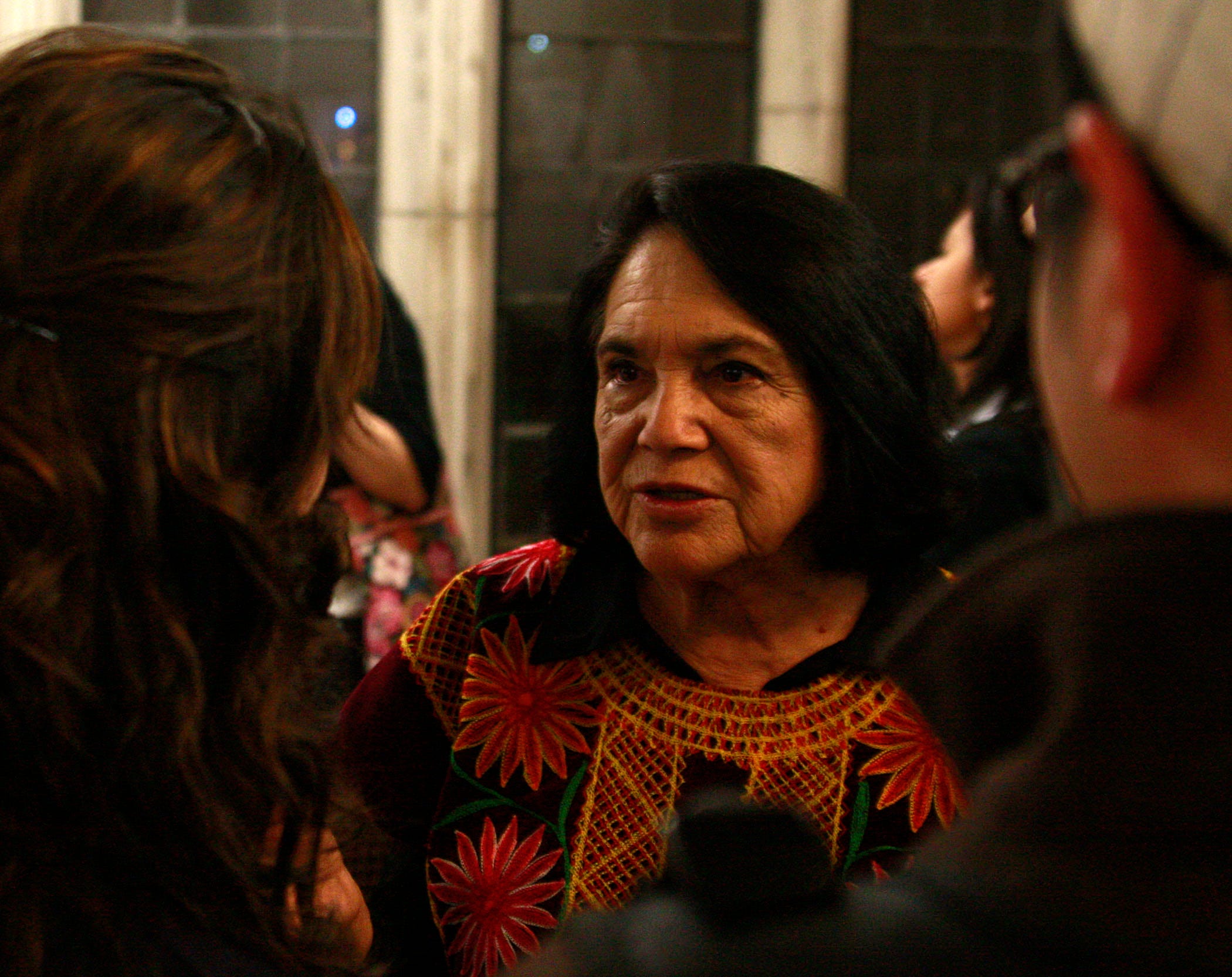
For sixty years, labor leader and civil rights activist Dolores Huerta didn’t want to tell people what had happened to her: as a young mother in the 1960s, she was sexually assaulted by United Farm Workers (U.F.W.) leader and civil rights rights hero Cesar Chavez.
Chavez, who died in 1993, is a man with a legacy; a man who the public believed to be Huerta’s partner and friend. It remains true that he ushered in a pivotal movement to uplift Latinos in the United States, remove toxic pesticides from farms, and fight for dignified lives for farmworkers.
But last week, the New York Times published several accounts from women who allege sexual assault and rape at the hands of Chavez. Some of these women had only been barely teenage girls when these acts transpired.
Huerta, in a statement of her own, revealed that the reason she was silent for all these decades is because she did not want to derail or delegitimize the farmworker movement. I encourage you to read an excerpt below–because as someone who has helped women share their stories of workplace and sexual abuse, it is soul-wrenching to imagine holding onto this pain for so long for something bigger than oneself:
“As a young mother in the 1960s, I experienced two separate sexual encounters with Cesar. The first time I was manipulated and pressured into having sex with him, and I didn’t feel I could say no because he was someone that I admired, my boss and the leader of the movement I had already devoted years of my life to. The second time I was forced, against my will, and in an environment where I felt trapped.
I had experienced abuse and sexual violence before, and I convinced myself these were incidents that I had to endure alone and in secret. Both sexual encounters with Cesar led to pregnancies. I chose to keep my pregnancies secret and, after the children were born, I arranged for them to be raised by other families that could give them stable lives.
I carried this secret for as long as I did because building the movement and securing farmworker rights was my life’s work. The formation of a union was the only vehicle to accomplish and secure those rights and I wasn’t going to let Cesar or anyone else get in the way. I channeled everything I had into advocating on behalf of millions of farmworkers and others who were suffering and deserved equal rights.”
The revelations have reverberated through labor, immigrant, and civil rights groups all week. What’s left in its wake is a group of people–who care deeply about the dignity of all people–now needing to confront whether their hero was indeed a hero.
Movements and organizations, however well-intentioned, are at the mercy of the fallible people at the helm who can succumb to the worst impulses of human nature. Chavez’s actions clearly extended far beyond fallibility or some character flaw and into abuse. But the moment begs the question of: when should a person’s individual needs and safety be cast aside to bolster the reputation of a movement? Is charisma critical to galvanizing people, even when that charisma has a dark shadow to it? How can a person who purports to care so much about the dignity of others abuse their power? Could all of this have been prevented?
These are not totally unanswerable questions. But labor activists and farmworkers are making known that these stories were not told in vain, and that workers rights’ and women’s rights are intertwined in their quest for mutual liberation. People have sprung into action in the last week, calling to rename Cesar Chavez Day to National Farmworkers’ Day, as well as painting over murals of Chavez.
Miguel Santana, President at California Community Foundation, describes the dissonance he feels about these allegations in a piece co-written with his daughter, Amanda. Santana met Chavez in the late 1980s during a protest, and remembers him as “quiet, humble,” and “almost disarming in his gentleness.” Yet he writes with his daughter that accountability must look not like “protection of legacy, but alignment with values.”
And Rudy Gonzalez, a member of the San Francisco Labor Council’s executive committee, echoes the sentiment that this movement was never about just one man: “As a Mexican American labor leader, I was raised on the story of the farm worker movement — on sacrifice, on faith, on the belief that working people deserve dignity…but let me be clear: our movement has never been about one man,” he continued. “It has always been about workers — Filipino, Mexican, Black, immigrants standing together and demanding respect.”

It’s heartening to see these reactions from men, and also not all that common to see such an outpouring of solidarity. Women have been silenced since the dawn of time–with threats to their bodily and financial safety, self- and society-imposed martyrdom, and now non-disclosure agreements in exchange for money. Farmworkers, immigrants, and blue-collar workers are even more vulnerable to abuses of power–and perhaps this fundamental understanding is what united community leaders with the survivor community so vocally.
One silver lining is that Huerta was able to speak her experience into reality while she is still alive. I’ve seen stories take decades to come to light in a meaningful way–several of which, actually, are coming to the fore because of the Epstein Files. But it’s unusual for someone who is 96, as is Huerta, to be able to hold on to something so painful for six decades and then connect with others about it at the end of her life.
Today, I can’t think of a totally comparable larger-than-life figure in the labor movement to Chavez, perhaps with the exception of worker-focused politicians like Bernie Sanders, AOC, and Zohran Mamdani. And while I’m sure power can centralize in niche communities–and that people who do good things for the world can also be abusive to those closest to them–I am hopeful that labor movements recognize this is not ideal for the broader liberation movement.
In many ways, the revelations about Chavez remind me of the age-old conundrum of how people separate art from the artist. Can one separate a beautiful piece of music or film from an abusive bully who created it? With Cesar Chavez, we may have to hold several uncomfortable truths–all while ushering in a future that not only protects workers, immigrants, and farmworkers, but also refuses to silence future Dolores Huertas.
What we’re reading…
A Northern Kentucky family declined a $26 million offer to build a data center on their 1,200 acres of farmland. One of the family members told local news: “If it’s my way, I’ll stay and hold and feed a nation. Twenty-six million doesn’t mean anything.” And: “I say they’re a liar, and the truth isn’t in them,” referring to claims the project would bring jobs and economic growth. “That’s what I say. It’s a scam.”
Mark Zuckerberg is building a personal CEO AI agent to help him do his job faster.
New York City has rolled out guidance for how schools and teachers should use AI. According to the guidelines, teachers can use AI to plan and draft documents, but not to assign grades or discipline students.
The freelance marketplace Fiverr is listing AI advertising and video directors “at the fraction of the cost” of traditional production teams. They’re targeting small- to medium-sized businesses who the advertising has historically been too expensive for.
Software developers are saying that vibe coding–which we wrote about last week–is “intoxicating.”
Senator Elizabeth Warren is launching a probe into how YouTuber Mr. Beast is promoting cryptocurrency to underage users. Beast Industries’ banking app Step previously claimed to be “the first financial app that will allow both teens under 18 and young adults to buy, sell, hold and receive crypto.”
A Substacker called DeepDelver wrote a scathing piece about the Y-Combinator startup Delve. They accused the startup of compliance fraud–and of outsourcing “automated audits” to a human audit firm in India. The founders of Delve are another addition to the list of “Forbes’ 30 under 30” founders accused of fraud.
The editor-in-chief of The Verge confronted the CEO of Superhuman (formerly Grammarly) about how the company impersonated him.
Here’s how the Iran war has thrown a wrench in the Gulf area’s concentration of energy AI power.
I don't seperate the art from the artist. Most artists are assholes. Brian Ferry supports fox hunting. I no longer listen to him haven't in years.