


We’ve reached a tipping point where it’s borderline-impossible to hold politicians accountable when they flagrantly lie or go back on their word. This is mostly the fault of Donald Trump, who does not have object permanence and engages in so much corruption that it all kind of just blends together.
Though they’d never admit it, prominent Democrats have benefited from an overwhelmed public’s despair and news fatigue. I say this as someone who’s reported on, and broken unsettling news about, former Sen. Dianne Feinstein, Congresswoman Eleanor Holmes Norton, and Sen. John Fetterman. Getting those politicians—or their communications teams—to answer straightforward questions is nearly impossible. They strategically ignore scandals of their own making. At most, they might issue a shifty denial, or do a quick interview with a friendly reporter. Then they hibernate until the coast is clear.
California Attorney General Rob Bonta is following the same abhorrent model this week, though his cover-up efforts aren’t particularly spirited. He seems to be annoyed at himself, or maybe the trio of California centrists who ate his lunch.
On Monday, Bonta meekly announced a settlement agreement with Paramount that will allow it to merge with Warner Bros. The most optimistic take I can muster about the agreement is that it will temporarily protect some unionized jobs in Los Angeles, and depending on how other legislation shakes out, could lead to more domestic production of films and TV shows. That’s it.
Paramount’s commitment to release 30 films per year might actually end up penciling out as a net-negative relative to Paramount and Warner Bros’ current output, according to former FTC Commissioner Alvaro Bedoya. A separate commitment to establish a nebulous “independent editorial board” at CNN and CBS is so insulting that I don’t want to give it oxygen. Nothing else in the settlement has any chance of mattering.
Bonta zoomed through a press conference about the settlement agreement and sat for a fleeting interview with CNN anchor Jake Tapper. By Wednesday, he was chit-chatting with the Center for American Progress about election integrity. Now, he and his staff are posting about a generic drugs settlement.
I don’t want to imply election integrity and lower drug prices aren’t worthy topics—they’re obviously important. But Bonta is also eager to move on for a reason. He set the sky-high stakes for this Paramount lawsuit. He spearheaded it and brought along other state attorneys general. He claimed he wanted to keep “certain corporate entities separate.” Before he coasts to re-election in November, I want to at least pause and point out how disappointed the Rob Bonta of a month ago would be with the Rob Bonta of today.
On August 10, Bonta wrote a spicy column for Deadline. He was unequivocal: the potential impact of a Paramount-Warner Bros merger isn’t “remedied with a few one-off, piecemeal promises.” He boasted that “Paramount and Warner Bros see the writing on the wall: that they will lose in a court of law.” He complained that Paramount was wasting time on dirty PR tricks and pushing a political message, rather than negotiating in good faith. And he reiterated that the entire point of this lawsuit was “to ensure that companies succeed based on what they offer, not what backdoor deals they can land [or] connections they can lean on.”
During a Politico panel on August 11, Bonta described behavioral remedies—a “promise to make a certain amount of movies, for example, in a given year,” he said—as “typically not enforceable in the way that we like” and “not particularly good at solving the problem.” Addressing the concept of Paramount releasing, say, 30 films per year, Bonta said, “That is an old stale promise. I’ve heard about that before. It doesn’t really vibe, in my humble opinion, with what the market will dictate and what history has shown.”
During an August 18 podcast appearance, Bonta warned, “This merger, if it occurs… will hurt everyday people like you and me. It will be more expensive to watch cable TV. It will be more expensive to experience the joy of life of going to the movies on a Friday night. Those costs will go up. Jobs will get cut.” Two days after that, on August 20, Bonta told CNBC that he’d only agree to a settlement if it included “robust structural remedies.”
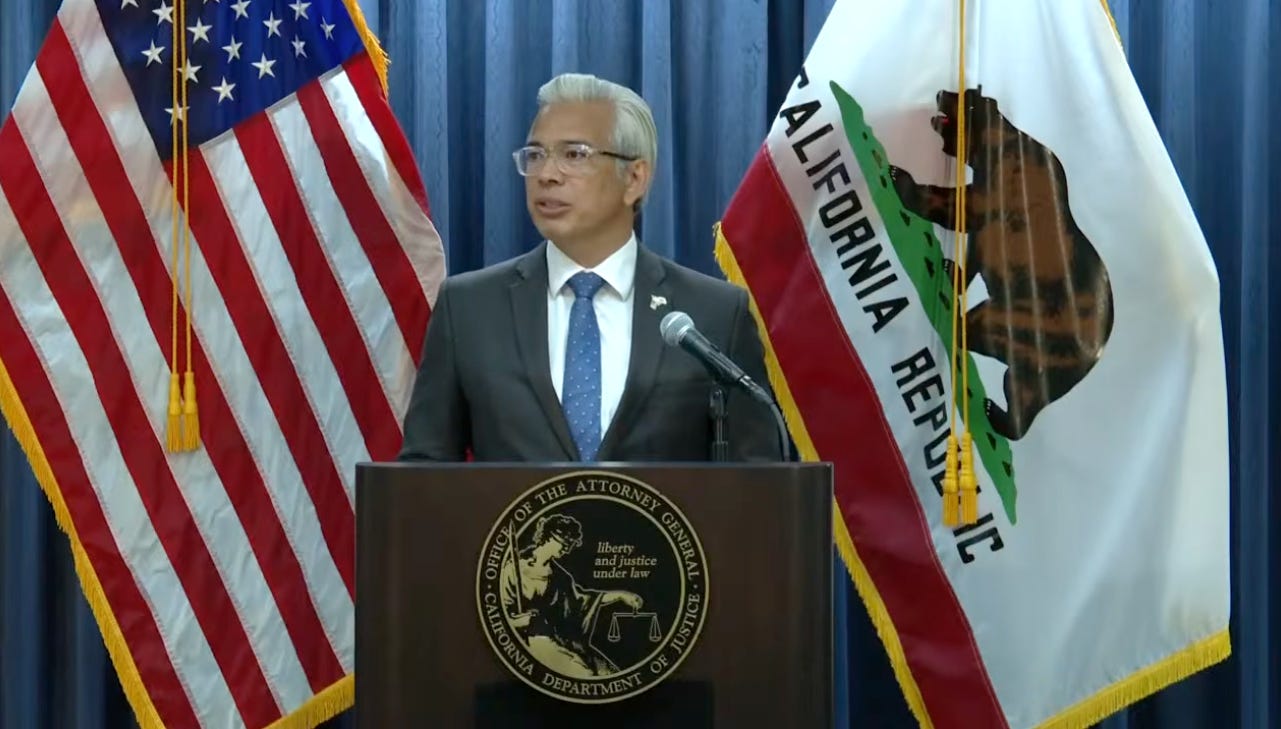
It’s unbelievable how little Bonta ultimately accomplished. And for what? For whom? There are whispers and rumors that he’s distracted by his exposure in an unrelated corruption case involving former Oakland Mayor Sheng Thao. (Bonta has not been accused of any wrongdoing.) There’s also a decent amount of reporting indicating that Bonta folded to Governor Gavin Newsom, Los Angeles Mayor Karen Bass, and presumptive next governor Becerra. Newsom has more or less confirmed his backroom dealing with Bonta and Paramount—the exact sort of ploy that Bonta disavowed in his column from a mere month ago. Bass and Becerra, meanwhile, have been openly pining for a negotiated compromise.
Here’s a question to ponder: Who cares about Newsom, Bass, and Becerra? Bonta is not beholden to the outgoing or incoming governor of his state. If anything, Bonta squandered an unusual amount of leverage. The Ellisons, who own Paramount, are hated by liberals and the left. Newsom has a negative approval rating among California voters, who are increasingly unenthused about the prospect of him running for president in 2028. Bass is one of the least popular mayors in the entire country, and recent polling indicates she’s likely going to get squashed by progressive Nithya Raman in the midterms. Becerra beat one of the weakest gubernatorial slates I can recall—especially for a state as populous as California—and is held in poor regard by many of his former colleagues. I fully expect him to struggle throughout his first term.
During the primaries, I was surprised Bonta didn’t run for governor himself; I thought he could’ve taken down Becerra. I was clearly wrong in my assessment. If anything, Bonta’s decision not to run for governor was prescient. He lacks vision and fortitude, which explains how he was possibly convinced to stand down by three unpopular politicians and a family of Trump-friendly billionaires. The Paramount merger will go through, and Bonta will likely evade sustained inquiries about what happened behind the scenes. So for posterity’s sake, at least, I’m writing this column to bookmark just how badly Bonta screwed things up. The Rob Bonta of August 2026 would agree with me.
Here’s what else we’re reading this week:
Congrats to Ben Horowitz, typically the afterthought of the eponymous venture capital firm Andreessen Horowitz, for securing first billing in the Horowitz Andreessen Academy. All it took was a $35 million investment in what is apparently a for-profit education company with an alleged “campus” (my scare quotes) in San Francisco.
The inaugural “class” (my scare quotes) of 50-ish students—recent high school graduates or college dropouts—will start the “program” (my scare quotes) in September 2027. The “academy” (my scare quotes) is not accredited, does not offer college credits or degrees or certificates, and includes scant details about how often its gaudy list of guest speakers and instructors will actually interact with the students.
Here’s a real quote from the Horowitz Andreessen Academy FAQ page: “Students are responsible for arranging and paying for their own housing, meals, and personal living expenses… The Founding Class Fellowship does not participate in federal or state financial aid programs.” I’m sure that will lead to a diverse crop of candidates in the famously affordable city of San Francisco.
If you want to learn more about this exciting opportunity, check out the academy’s first advertisement, which features an interview with recently renounced Nazi Kanye West about why college is a “choice.”
Meta is touting how Muse, its personal AI assistant, can place calls on your behalf. Except the calls are actually being made by (or taken over by) human contractors, according to 404 Media, which also obtained some of Meta’s internal communications about the purported feature.
“This has potential for so much negative PR,” one employee wrote. “It could portray us as ‘their AI is not good enough so they still need humans’ kind of coverage for this launch.”
More, from the 404 Media report: “Meta suggested to employees that potentially sensitive information shared by the user with AI—and then passed to human contractors—was still safe because the contractors had undergone ‘a lot of training to make sure all your data is safe and secure.”’
Alex’s take: do not let Muse place phone calls on your behalf, unless you really want to share intimate details about your life with a stranger in a call center.
Axel Springer, the parent company of Politico and Business Insider, is honoring Peter Thiel today at a ceremony that reportedly also features Bari Weiss. Status journalist Natalie Korach obtained the letter that Politico and Business Insider reporters sent to their bosses. It says, in part: “We believe Axel Springer should stand for press freedom, not cozy up to those who attack the freedom of the press.”
Bass is feckless, newsom is compromised, but the fact that becerra was part of that push means we in CA are utterly screwed and getting another corporate establishment democrat in power who is going to be beholden to the wealthy corporate interests. so so deeply disappointed