


Palantir CEO Alex Karp loves a manifesto. He put one out in April, though as “Can We Still Govern?” writer Don Moynihan noted at the time, the manifesto was technically excerpted from Karp’s “The Technological Republic”—an unsettling book about how Silicon Valley and the U.S. military should be able to do whatever they want.
The manifesto was inflammatory and got lots of attention, which I presume was Karp’s goal as he promoted his book. This week, Palantir released another manifesto about “AI sovereignty.” The “AI sovereignty” manifesto is only nine points (much appreciated). It arrives at an especially perilous moment for Anthropic and OpenAI. Both companies would like to IPO, but are frantically adjusting to unexpected regulatory scrutiny from the Trump administration, blowback from enterprise clients who have “tokenmaxxing” buyer’s remorse, and the public’s distaste for how AI is a job-killer that’s making everything more expensive.
Wouldn’t you know it, Palantir’s latest manifesto accompanied an announcement about an expanded partnership with NVIDIA; they teamed up to offer an open-weight AI model to U.S. government agencies and “critical U.S. companies.” The pitch is basically that NVIDIA can supply a cheaper LLM than closed-sourced LLMs provided by Anthropic, OpenAI, and Alphabet—and on top of that, Palantir grants clients an extra layer of security and customization around how they deploy and train their models. The implicit promise of “AI sovereignty” is that, unlike Anthropic CEO Dario Amodei, Palantir and NVIDIA will not engage in any pesky meddling or moralizing. How the U.S. government chooses to utilize the NVIDIA-Palantir stack is simply none of Palantir’s business.
My sense is that the “AI sovereignty” manifesto didn’t hit like the last one—it didn’t sufficiently creep people out to the point that it went viral. So on Wednesday, Karp went on CNBC and did his best to reiterate the main sentiments of the manifesto while drawing attention to his new business venture with NVIDIA.

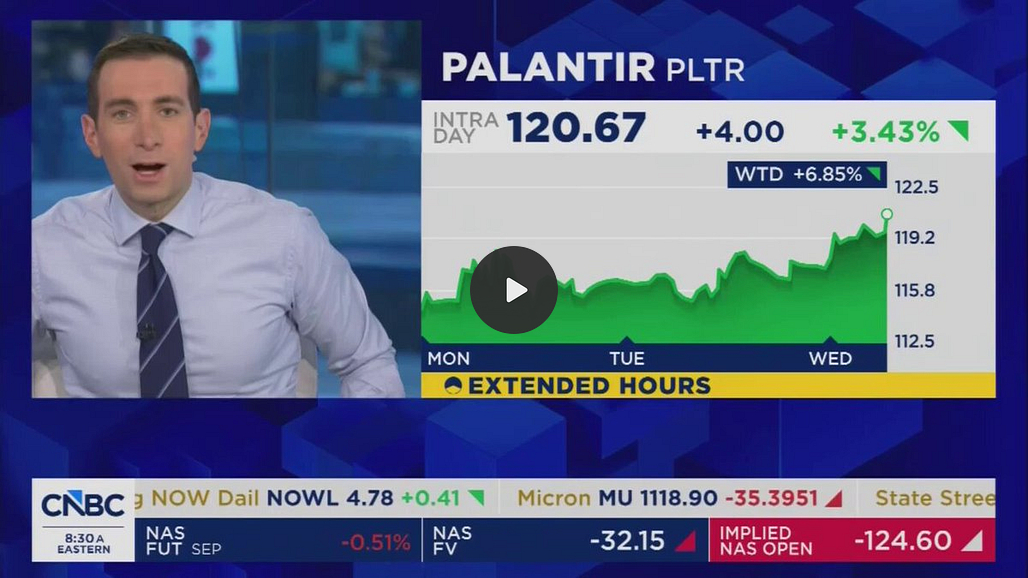
Karp successfully achieved his viral moment. Video Clips Guy Aaron Rupar referred to Karp’s 20-minute “Squawk Box” interview as a “televised nervous breakdown.” To the untrained eye, it certainly appeared that way. I strongly suspect that Karp does not actually care how he presents, and in fact probably lays it on thick on purpose. The people pointing and laughing at his, uh, eccentric behavior are ultimately amplifying his message to a larger audience, which includes prospective clients who are not concerned with whatever Karp has going on, or that Palantir’s headquarters are based in the third circle of hell.
I will caveat that Karp’s nearly uninterrupted “interview” was certainly strange. Roughly halfway through his ramblings, he was possessed by the spirit of Ayn Rand and proclaimed that the “voice of American business [is] being channeled through me.” He spent a considerable amount of time defending the state of Israel, anointing himself “the most publicly supportive CEO” of the country. He complained about how potential wealth taxes would “punish” billionaires. He decried the “far left” and “far right,” though he failed to define what he actually objected to about each “side” of the political spectrum.
Karp also hilariously declared that “American enterprises are run by the shrewdest, most wily intelligent people on the planet.” (They are not.) He continued his longstanding “joke,” or whatever you would like to call it, that although his parents would like for him to become a faculty member at Berkeley, the university is too woke to consider him. (He repeated this “joke” three times.) And he claimed that he does not do drugs—he is simply a “neurodivergent crazy person.”
If you can look past…all of the above, the underlying message that Karp delivered is fascinating. He wants to attach himself to an increasingly mainstream view: OpenAI, Anthropic, and other closed-source LLM providers are overpromising, overcharging, and underdelivering. “Who controls the models?” he rhetorically asked. “Who controls the weights? Who controls the value of your business?”
These are legitimate questions. And this is a legitimate point: “I’m telling you, in this country, at every single enterprise I deal with, these people are livid,” Karp said of CEOs he knows. “They’re like, ‘I am paying for tokens that create no value.”’ He encouraged investors watching the CNBC segment to call up a random CEO and ask for their private opinion about the utility they’re receiving from closed-sourced, token-based providers.
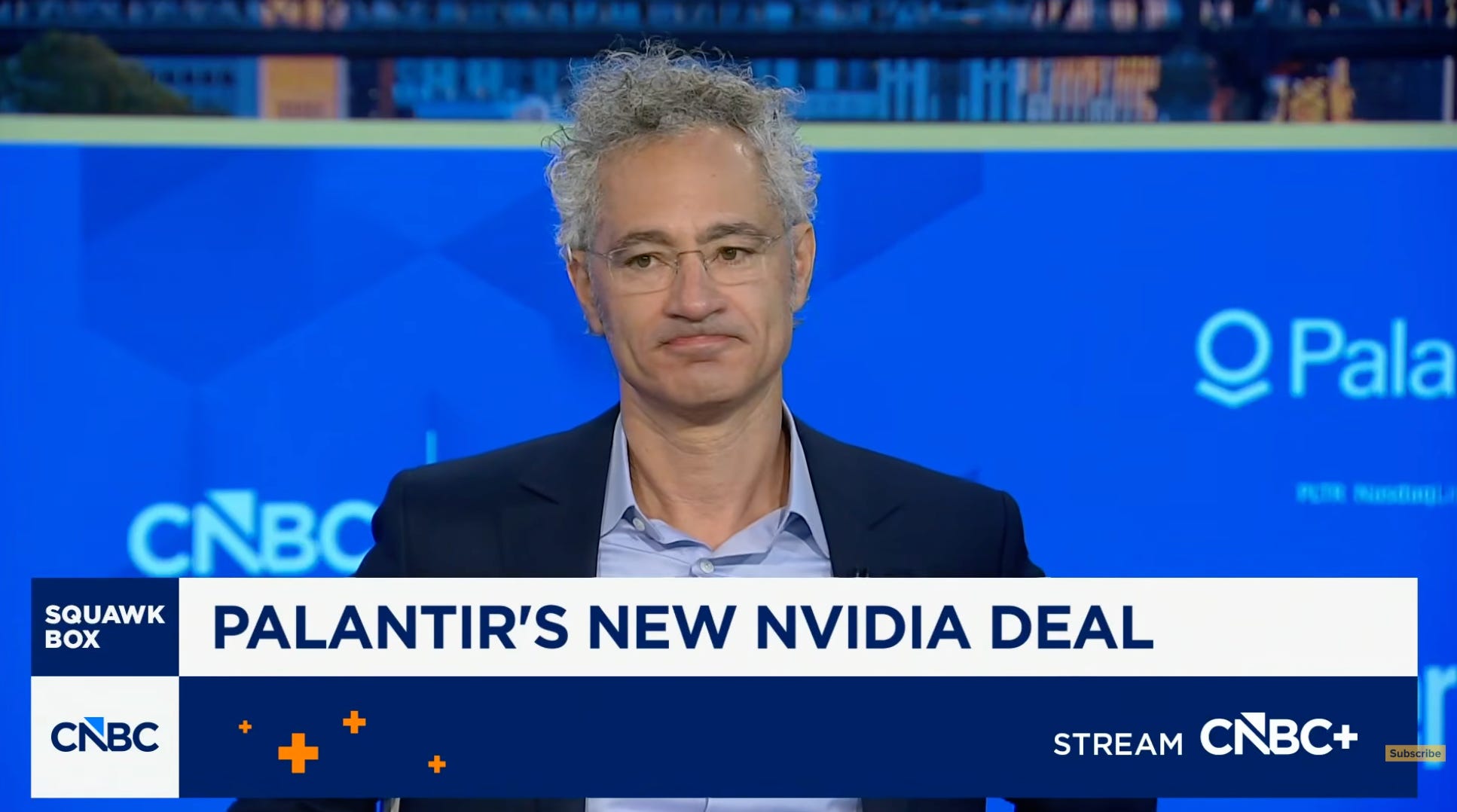
The rest of Karp’s ranting was duplicitous—a naked attempt at getting one over on his newfound AI competitors. He went after Amodei over and over again, poorly softening his insults with assurances that he was not actually “throwing shade.” An example:
“These people are—Sam and Dario—there’s nothing more fun than debating Dario in private. So I’m not throwing shade at them, but something has gone completely wrong. And the basic view among enterprises in this country is I’m going to chillax and waste my time with tokens. I’m going to get no value and they’re going to get my IP.”
One more:
“I’m not throwing shade. Dario is a literally historic figure. And he came from behind, and he’s now number one. I’ve been in business, whatever you want to call I do, for a long time. I’ve never seen anything like this.”
When Karp circled around for a third barb, he finally dropped all pretext and overtly criticized Amodei for trying to establish red lines around the Department of War’s Claude usage. “I would say it is a loser to restrict something from the government because you don’t agree with how the government fights war, and then open it up to the world, including our adversaries,” Karp said. “Go sell that to the American people where they already don’t like you.”
Amodei’s red lines are indeed arbitrary and insufficient, given that Anthropic has otherwise enthusiastically lent its tools to the American military, which likely killed 120 Iranian schoolchildren. But Karp is untethered from whatever he deems to be the “American people.” He’s just trying to score brownie points with the U.S. military, which is why he waxed on and on about America’s alliance with Israel, and how China is our main adversary in an AI race that we must win at any cost. (“It’s binary: they will win or we will win,” he said.)
Ironically, Amodei has talked about China in similarly simplistic terms. He tried to have it both ways with the Pentagon, but publicly second-guessing a contract with the U.S. military is a fool’s errand. Karp recognizes the moment and is pouncing. He’s a more effective messenger for faux-patriotism because he fully aligns with a techno-fascistic vision. He’s already working with U.S. government and law enforcement agencies, and he sees an opportunity to expand those relationships at the expense of Anthropic and OpenAI. He also sees an opportunity to expand Palantir’s commercial ties, which are becoming a real revenue-driver for the company.
Those ties are fickle, though. Palantir is not a popular “brand.” It is prone to backlash because of security concerns and Karp’s horrifying commentary. European countries like France, Spain, and Germany have ended or are winding down their contracts with Palantir; the United Kingdom is rumored to be next.
So yes, on “Squawk Box,” Karp made a persuasive case against closed-model LLMs that could potentially cache or transfer client data. That does not mean he’s operating from a position of undeniable strength. Disregard his claims that Palantir products are “completely agnostic,” meaning the company has zero interest in which AI models it stacks onto. Try to look past his distracting, extraneous musings, and his incessant bragging, like: “In my business, we have much more demand than we can supply,” Karp said on CNBC. Don’t believe him? “Ask the Ukrainians. Ask the Israelis. Ask our Department of War. Ask the enterprises that are working. We do not have to oversell what we have.”
Except, as the interview concluded, Karp—who didn’t seem to realize he was still on camera—said he’d love to appear on “Squawk Box” again soon. A funny offer, given that Palantir supposedly doesn’t need to “oversell” anything. In truth, Palantir is engaged in the same AI rat race as the companies that Karp is impugning. Congrats to him on the free infomercial about his partnership with NVIDIA. I’ll believe Palantir isn’t just as antsy as its competitors when Karp stops releasing a tech manifesto every time he’s promoting a new product.
Here’s what else we’re reading this week:
The New York Times dug into President Trump’s ludicrously corrupt financial dealings since his return to office. According to Trump’s 927-page financial disclosure form, his administration released an “AI action plan” full of potential deregulatory measures on the same day that the president purchased up to $5 million each in “Broadcom, Meta, Amazon, Apple, Microsoft and Nvidia.” Stock prices for most of those companies have increased. Incredible foresight from our brilliant leader.
Meta’s endless string of embarrassing updates and news reports continued this week. My three favorites:
Meta is instituting rate limits for the “conversation focus” feature of its AI glasses, meaning you have to spend an additional $20 a month to unlock more hours per month where you can “dynamically amplify the voice of the person you’re talking to,” as Meta defines it. The Verge has an interesting breakdown about why “conversation focus” doesn’t seem like the sort of thing that needs to be rate limited at all.
Meta is reportedly gearing up to start a cloud computing business—basically, renting out its computing power to companies that have at least a little bit of traction with their AI models. You may recall xAI announcing a similar plan a few months ago. Not a good sign about interest in Meta’s own AI models.
Mark Zuckerberg considered purchasing cursed predictions market Kalshi, according to NPR. Reportedly, negotiations didn’t go very far, and so now Zuckerberg wants to launch his own prediction market that (allegedly) will not use real money. We’ll see how long that lasts, or if the play money predictions market even launches.
Amazon and Google’s newest greenhouse gas emissions reports are bleak: Amazon’s emissions increased by 16%, and Google’s emissions increased by 18%. Both Big Tech companies cited data center construction as a contributor to the uptick.
WOW! No Words, but thanks for the post.