


Many tech oligarchs (and their influential friends) were jubilant after Donald Trump won the 2024 presidential election. Elon Musk celebrated at Mar-a-Lago and wrote that the American people gave Trump a “crystal clear mandate for change.” Marc Andreessen infamously wrote, “It’s time to build,” a callback to his manifesto. David Sacks, who was quickly anointed the White House’s AI and crypto czar, wrote, “Nixon ‘68 was The Greatest Comeback—until tonight.”
OpenAI CEO Sam Altman, who’d previously asserted that Trump is “abusive, erratic, and prone to fits of rage,” “unfit to be president,” and “a threat to national security,” congratulated Trump on his victory and wished him “huge success.” Google CEO Sundar Pichai struck a nearly identical tone in a congratulatory post of his own. A few months later, in January 2025, Altman fully capitulated: “Watching [Trump] more carefully recently has really changed my perspective on him.”
Altman’s and Pichai’s nakedly cynical attempts at cozying up to Trump are not far off from how other executives at Big Tech companies have spoken about MAGA. This was always a calculated risk, though. Trump’s comeback was improbable, but it was by a slim popular vote margin against a historically unpopular party that swapped out its presidential candidate at the 11th hour.
I’m not surprised that Trump’s legion of Big Tech backers aren’t immediately, publicly disavowing him after Tuesday’s midterms, which have aptly been characterized as a bloodbath for the GOP and MAGA. There are massive egos to massage in Silicon Valley; Trump is still the president and as volatile as Altman once correctly described him; it’s not in the interest of AI providers to admit that they are in a much weaker position than a week ago.
It’s still noteworthy, though, that some of the biggest Trump suck-ups are saying so little. Musk, who meddled in the Texas Senate race with a historic amount of contributions to freaky Ken Paxton, extended an olive branch to Senator-elect James Talarico because Talarico said something not-terrible about him. He’s otherwise avoided wading deeply into political discourse over these last few days. Sacks, who incorrectly predicted that the media was overhyping a blue tsunami prior to the midterms, hasn’t posted on X in a week.
So thank goodness for the Wall Street Journal’s tech conference in Napa, which the outlet smartly scheduled for the day of, and the day after, the midterms. The WSJ conducted live interviews with OpenAI co-founder Greg Brockman and Meta President Dina Powell McCormick. Their responses suggest that Silicon Valley isn’t really processing the midterm results, or how to effectively message the purported benefits of AI and data centers. If anything, they sound just as out-of-touch as they did when the Republican Party had a government trifecta.
Let’s start with Brockman, who was asked what it means for OpenAI that so many candidates ran, and won, on promises to support data center moratoriums. His reply, in short, is that OpenAI needs “to do a better job of really communicating to people, to local communities, about why data centers are something that can be beneficial to them.” I expect this to be a common refrain: it’s simply a PR problem. During his own WSJ Tech interview, the Pentagon’s Chief Technology Officer Emil Michael literally said the AI industry has a PR problem.
In my view, there’s an underlying sense of condescension to this analysis. We have to explain why our technology is so great and helpful to these dummies. Whatever contrition Brockman is claiming to express is undone by his actual beliefs and motives. We’re talking about a guy who gave $25 million to an anti-regulatory super PAC. He gave $25 million more to MAGA Inc., a super PAC that vehemently supports a president who thinks his voters are ungrateful and stupid. Brockman, who is a cloistered-off billionaire, tried to invoke his humble roots to explain OpenAI’s supposedly newfound commitment to investing in local communities.
“I grew up outside of a town, Grand Forks, North Dakota, where we had a sugar beet factory,” he said. “And by the way, the sugar beet factory smells incredibly bad. You don’t want to live right next door to it. But it was really a staple of the town. And I think it was something that had created a lot of jobs. It’s kind of in many ways the centerpiece of the community. I think that helping people understand not just that data centers—the investment, the community benefits—for example, in Georgia we’re sponsoring free lunches for students. All of that is beneficial. But even the output: AI technology is also something that is important for them, for their lives.”
Data centers: not as smelly as sugar beet factories, also uncomfortable to live nearby. Not gonna work, Greg. Nor is the insinuation that regular people simply haven’t grasped AI’s excellence. This is where Brockman really shows how little the election results have registered. Part of why voters aren’t convinced about AI’s potential societal uses is because people like Brockman say outlandish shit like the following, which also came from the same WSJ interview:
“Even just thinking about death becoming a choice, like, all of this is possible,” he said. “Having cures for diseases, this is something that’s become a trope in this field, but I think that you’re going to see real delivery and real significant strides and impacts on biology health and curing of diseases over the next 12 months, 18 months.”
Just put the sugar beets in the bag, brother. Stop promising immortality and curing disease every year! It is insulting to normal people who might even like using ChatGPT or Codex or are relatively hopeful about AI!
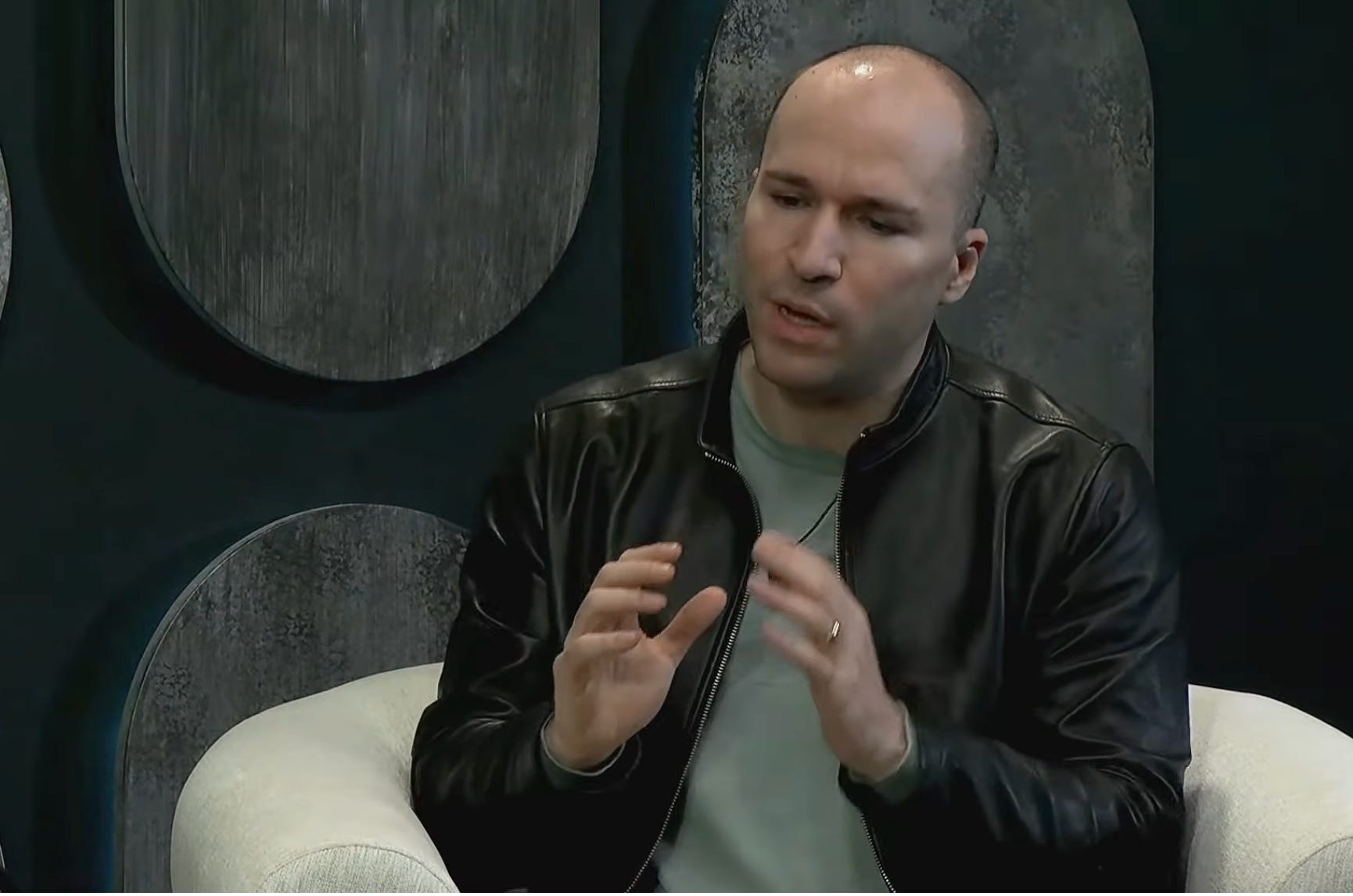
For her part, Powell McCormick tried (keyword tried) to strike a conciliatory tone about Meta’s post-election vision for AI and data centers. According to Powell McCormick, Meta has been building data centers for a long time; it’s aware of the political headwinds and is responsive to community concerns. “It has to be bipartisan,” she said of data center investments. “You cannot build today in a community like that if everyone is not committed to it. And our lesson is that as important as the elected officials are, the way more important people to us are the local citizens, because they are who drive whether or not elected officials want us in those communities.”
Powell McCormick, who’s married to Republican Senator Dave McCormick, returned to her “bipartisan” shtick later in the interview. “Our path is not only to remain completely bipartisan, of course, but to show that communities that welcome these investments will have an enormous amount of benefit, and the communities that don’t want our investment will of course have the right to stop them.”
Powell McCormick chose a curious success story to land her point, pointing to Meta’s data center in Richland Parish, located in northeast Louisiana. “It’s a town of 20,000 people that really welcomed this investment,” she said.
In July, the New York Times ran a damning exposé on Meta’s Richland Parish incursion. The article was titled, “How Meta Got Everything It Wanted in a Secret Louisiana Data Center Deal.” According to the Times, Meta gave the state of Louisiana seven months to iron out “a deal that normally takes years to plan.” That’s not all: “Everyone involved agreed that it needed to be kept secret. [Louisiana Gov. Jeff] Landry invited every member of his cabinet who needed to know about the project to a meeting at the governor’s mansion. His chief of staff passed around a stack of NDAs and freshly baked peanut butter cookies.”
There are many local residents who are thrilled with a boom in high-paying temp work opportunities. They also wondered aloud to the Times what’s going to happen after those jobs dry up. And the idea that there was bipartisan, transparent communication between Meta, Louisiana’s Republican-led state government, and residents of Richland Parish is laughable. “Transparency is a very interesting word,” Gov. Landry told the Times. “Because what we’ve seen is people have used the word transparency to basically kill deals like this.”
Powell McCormick, of course, knows all of this. But she’s got more data centers to sell to localities who made their displeasure clear during the midterms. Her (early) post-election strategy is similar to Brockman’s: Big Tech is pivoting to a faux-populist sheen, with slightly fewer overtures to President Trump.
“If we’re really witnessing the transformation of humanity, then the people who are helping build that should be treated as heroes,” she said of Meta’s data center workers. “If you look back during World War II when Americans came together to physically build the arsenal that defeated tyranny, we’re seeing that again. American people are coming together to build a different kind of infrastructure that will ensure that America is at least as competitive as it possibly can be. Because the stakes are just so high.”
The stakes are quite high, it’s true. In Louisiana’s Senate race, Republican Rep. Julia Letlow won by two-ish points over Democratic candidate Jamie Davis—a massive underperformance by the GOP. Why? One possibility: Letlow signed an NDA with a Meta shell company prior to its joint announcement with the state about its sprawling Richland Parish data center. Davis, meanwhile, criticized that shady arrangement and called for a data center moratorium.
“Jeff Landry, you’re on notice, buddy,” Davis said of the Louisiana governor on election night. Landry’s not the only one on notice. So far, though, OpenAI and Meta are pretending otherwise—and the rest of the MAGA-aligned tech industry is staying quiet.
Here’s what else we’re reading:
BALLS AND STRIKES TIME. I got 10 out of 11 midterm predictions correct. I mistakenly thought Annie Andrews would narrowly lose to Sen. Darline Graham Nordone, because I underestimated turnout across the South.
My best call: In Ohio, I said Amy Acton would outperform Sherrod Brown (though both would win). And I said that Acton would purposely send her opponent, Vivek Ramaswamy, to voicemail when he called to concede. That’s exactly what she did! Good for her.
One of my midterm predictions was that California’s wealth tax, Prop. 40, would flounder. California takes forever to tally its votes, so Prop. 40 hasn’t officially failed, but it will. (As of Friday afternoon, “no” leads “yes” 54.6% to 45.4%.)
I’m curious how this affects the 2028 presidential primaries. My assumption is that moderate candidates who are averse to threatening taxes on their rich donors will use Prop. 40 as a convenient excuse. “I’m all for making billionaires pay their fair share, but even voters in California didn’t want to single anyone out,” or something similarly stupid. I remain hopeful that progressive candidates will take a different tack.
Over at How Things Work, Hamilton Nolan has a great write-up about how to effectively message a national wealth tax.
During his WSJ tech conference interview, Emil Michael claimed the U.S. military’s strike on a school full of Iranian girls, which killed 156 people, is still under investigation. That strike occurred on February 28, 2026.
The New York Times published a feature on Anthropic CEO Dario Amodei with new details about his long-held interest in rationalism and effective altruism, “two interwoven philosophies that share an uncompromising belief that mathematical reasoning can change the future of humanity.”
The article also includes unfortunate information about the wedding of Daniela Amodei, a fellow Anthropic co-founder and Dario’s sister. Apparently, Daniela and her now-husband Holden Karnofsky passed out stuffed animals and awarded prizes to wedding guests who arranged “the most romantic hookups between the different characters.”
There are other off-putting tidbits on the archived version of their wedding website, if you’re so inclined.
Tesla Cybertruck is dead. It will not be missed.