

On Monday, March 23, OpenAI published an updated safety research paper about Sora 2, its latest video generation model. The paper was forward-looking—it laid out how OpenAI was working to “strengthen Sora’s guardrails” and “continuously” updating its content filtering systems. A day later, on March 24, OpenAI killed off Sora.
For those of you who did not dabble with it, I would describe the Sora 2 model as technologically impressive, but vapid and uncanny. As an example: The official Shaquille O’Neal Sora account posted a 10-second clip of an AI Shaq swimming with gators in a swamp. The clip pretty closely resembles what it’d look like if a real, not AI, Shaq actually swam with gators in a swamp—so long as you keep the sound off (the audio quality is terrible). Crucially, though: why would anyone want to watch a short, AI-generated clip of Shaquille O’Neal swimming with gators in a swamp?
For a brief moment, it seemed as if there was an audience for this sort of… content. In October 2025, Sora hit No. 1 on Apple’s U.S. App Store. It surpassed one million downloads faster than ChatGPT did. The Sora app’s popularity swayed then-Disney CEO Bob Iger to strike a deal with OpenAI. In December—just three months ago!—Disney committed to licensing its iconic characters so they could be integrated on Sora. Disney even pledged a $1 billion investment in OpenAI. Like other offerings hyped up by Chief Hyperbole Officer Sam Altman, Sora seemed to be safely nestled within OpenAI’s mathematically improbable business model. As long as the money spigot never shut off, it was, at least temporarily, too big to fail.
Which is why Altman’s decision to knife Sora in the back is such a big deal. In a vacuum, it’s not all that unusual for a tech company to launch a product, realize it does not work as intended, and then discontinue the product. (Sora downloads fell off a cliff this year.) But OpenAI is not an ordinary tech company—it subsists on a faraway promise of endless revenue streams that will offset years and years (decades?) of losses. OpenAI can’t really afford to admit defeat on any of its signature products, because retreating indicates that other products might not actually pencil out someday. As Slate’s Nitish Pahwa aptly put it, Sora’s abrupt death is “a sign that the A.I. bubble, while far from bursting outright, is wobbling and weakening.”
I completely agree. For the first time, OpenAI’s facade is noticeably cracking in a way that’s evident to more than just skeptical tech journalists. Amidst the whiplash, it’s important to chronicle just how much Altman and Head of Sora Bill Peebles—aided by thirsty podcasters— treated video generation as the Next Big Thing. They were wrong. Very, very wrong. And I have a feeling investors are taking note.
On October 10, 2025, Altman and Peebles appeared on TBPN, a daily show hosted by techno-optimists John Coogan and Jordi Hays. Coogan segued into the interview by raving about how much fun he had making videos on Sora. As far as I can tell, he posted twice prior to the interview with Altman and Peebles, and then never posted on Sora again.
Altman told TBPN that his Sora feed was full of “very beautiful, sort of fantastic scenes that are just not things that could have existed without something like Sora, or wouldn’t have been easy to make.” Peebles bragged that 70 percent of Sora users were creating content, which was a vastly higher figure than other social media platforms. He also confidently stated that there’s “clearly such an incredible value proposition for celebrities, for rights holders” to get on board with Sora.
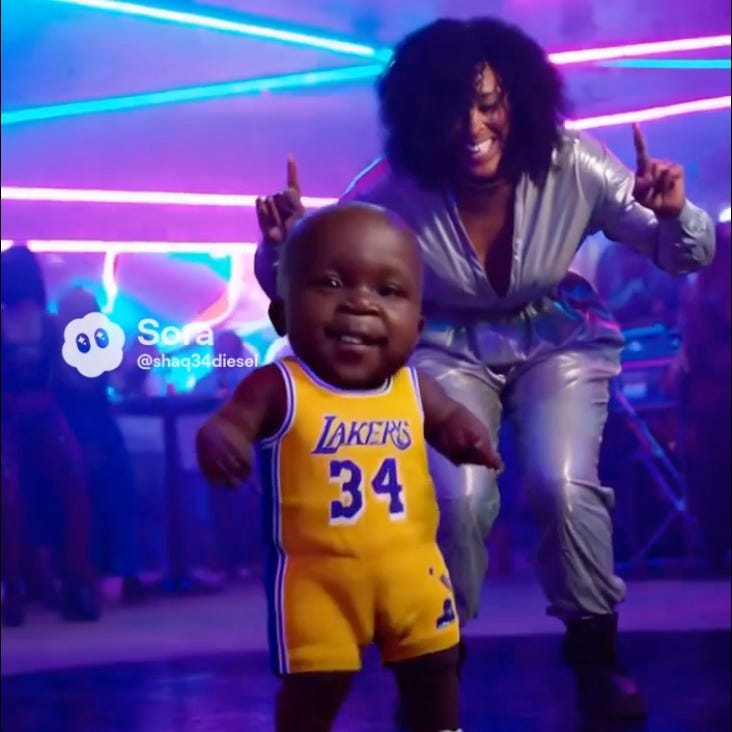
As it turned out, Sora’s influx of users quickly got bored and largely abandoned the app. That includes Sora’s celebrity users, a roster led by the aforementioned Shaq, as well as Snoop Dogg, Mark Cuban, and Jake Paul, all of whom have never turned down a business opportunity (except, I suppose, on Shark Tank). Jake Paul appears to have stopped posting many months ago. Same with Shaq; one of his most recent posts, aside from swimming with alligators, is him at a club, as a baby, dancing in front of a woman. The post is captioned, “Baby@shaq34diesel dancing in a club with beautiful blackwoman,” which raises some questions about who was running his Sora account.
Later in their interview, the TBPN hosts briefly addressed the unsustainable amount of compute that video generation requires. They did not press Altman on this, of course. Instead, they assured him that he’d figure it all out. “When I think about scaling up Sora, I feel like it’s crazy to bet against you,” Coogan said. “You’re going to get the chips.”
In November 2025, Peebles made two more notable podcast appearances. On “Redpoint’s AI Podcast,” Peebles declared that “the company really feels invested in Sora’s success,” adding, “People see that we need to take these new bets, that it’s important for the company’s longevity not just to have a super successful LM-facing consumer product, but also the winning one in video. And everyone’s willing to chip in—you know, do your part in wartime.” I’d be curious to hear Peebles’ take about what Sora’s death means for OpenAI’s “longevity.”
The most egregious Sora-related prediction from Peebles was on the official Sequoia Capital podcast. In fairness, the hosts teed him up to speculate about what Sora might someday become, as opposed to what it was capable of doing at that moment. Even still, Peebles certainly did not have to disclose his belief that in the future, “we are headed” towards a situation “where there are just copies of yourself running around in Sora, in the ether, doing tasks and reporting back to the physical world.”
One of the podcast hosts followed-up: “So you’re building the multiverse?” Peebles’ response? “Actually, kind of, yeah.”
I don’t mean to pick on Peebles, who I imagine is having a terrible week. Sora’s implosion is Altman’s fault before anyone else’s. It’s Altman’s responsibility to set realistic expectations, both publicly and internally. In Sora’s case, he failed.
I suspect this will be the first of many tangible failures. The fallout from Sora’s death has been swift and striking. A blindsided Disney pulled out of its licensing partnership, which led to another admission: Disney had yet to invest the $1 billion it committed to OpenAI. Uh-oh.

Altman and other OpenAI leaders have been busy spinning up counter-messaging that everything is fine. Earlier this month, OpenAI executive Fidji Simo reportedly told an all-hands gathering, “We cannot miss this moment because we are distracted by side quests.” After the news of Sora’s demise broke, an OpenAI spokesperson told Wired that “as we focus and compute demand grows,” Sora’s research team will pivot to “world simulation research to advance robotics that will help people solve real-world, physical tasks.”
These are defensible and, in theory, far more grounded business decisions. If they were coming from a different AI company, I might believe they were earnest attempts at a hard reset. I do not believe OpenAI.
Case in point: As OpenAI claims to be embracing a more practical outlook, it is also reportedly changing Simo’s title from “CEO of applications” to “CEO of AGI deployment.” Is OpenAI pretending it has cracked artificial general intelligence? Is this the company’s Next Big Thing? I’ll believe OpenAI is capable of pulling off AGI if, and only if, Shaq unlocks the real-life ability to Benjamin Button himself, turns into a baby, and goes dancing at the club.
Here’s what else we’re reading this week:
Meta “misled users about the safety of its platforms and enabled the sexual exploitation of young users,” a New Mexico jury found this week. Meta was ordered to pay $375 million in damages—a paltry sum on its own, but a big, big warning sign that the tech giant could be held liable in other, similar cases. Meta plans to appeal.
Speaking of other, similar cases: A Los Angeles jury found that Meta harmed “a young user with design features that were addictive and led to her mental health distress,” the New York Times reported this week. The jury awarded the 20-year-old plaintiff $4.2 million from Meta, and $1.8 million from YouTube. TikTok and Snapchat already settled with the plaintiff.
X’s Head of Product Nikita Bier very nearly instituted a sensible policy for the Everything App: he proposed a tweak to X’s revenue sharing system that would “give more weight to impressions from your home region.” This would, for example, make it less lucrative for shit-stirrers in Australia and the UAE to post incessantly about American politics. A better solution—getting rid of X’s blue-check system—is off the table. Presumably, that’s why Bier tried for a middle-ground approach that might appease his boss, Elon Musk, while also signaling to people outside of the X echo chamber that the right-wing platform is only 98% unusable, instead of totally unusable. The gambit didn’t work; Musk immediately, publicly squashed Bier’s idea.
Melania Trump walked into a room alongside a robot.
Is it possible he wanted to preempt Disney announcing their withdrawal from the partnership? Never really understood why Disney wanted to let OpenAI have a go at their IP unless they v wanted to have Sora do all their animation. Oh well it's all good. Everyone still has their billions.
And we are see “boutique” Claude suddenly surfing an ever-ascending popularity wave.