


Anthropic and OpenAI sponsored a Make America Healthy Again summit in Washington D.C. on Sept. 29, which is the sort of factoid that probably would’ve generated more discourse were it not for another, concurrent summit at our nation’s capital. I am referring to President Trump mediating a historic pinky-promise among AI industry leaders—an agreement for everyone to keep doing what they’re doing, just be cool and chill about it, that was apparently drawn up by Mark Zuckerberg.
On the same day that Anthropic CEO Dario Amodei hobnobbed at the White House, the company’s head of healthcare, Dr. Syed Mohiuddin, spoke at a MAHA summit panel called “AI and Healthcare.” Not to be outdone, OpenAI’s government sales lead, Felipe Millon, appeared on a MAHA summit panel called “Building the AI Health Stack.” It’s unclear whether Anthropic and OpenAI paid extra for the panel spots, but at least some of the summit’s sponsors did, according to Bloomberg.
Among other panelists at the MAHA summit was Agriculture Secretary Brooke Rollins, who earlier this year responded to criticisms about high grocery prices by saying, “We’ve run over a thousand simulations: It can cost around $3 a meal for a piece of chicken, a piece of broccoli, a corn tortilla, and one other thing.” There was also Russell Brand, who is facing multiple rape and sexual assault charges in the United Kingdom (he’s pleaded not guilty), and Mike Tyson, who is a convicted rapist.
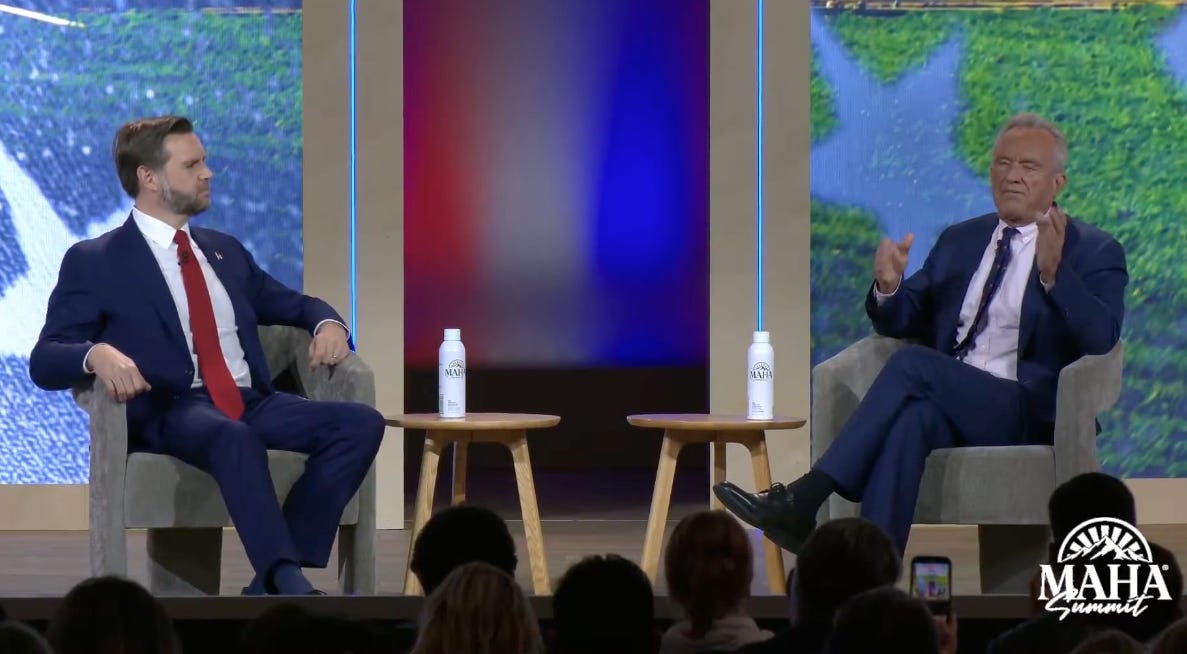
The headline event was a brief conversation between Vice President JD Vance—who recently taunted Angie Nixon, a Black woman running for Senate in Florida, by telling her to “get the hell out of here, you don’t belong in America”—and HHS Secretary Robert F. Kennedy Jr., the de facto leader of the MAHA movement. RFK Jr.’s vaccine skepticism has played a detrimental role in America’s declining vaccination rates; as a country, we no longer have herd immunity against measles.
Some progressive politicians, including Rep. Alexandria Ocasio-Cortez and Senate hopeful Abdul El-Sayed, have recently attempted to extend an olive branch to MAHA followers. They’re smart to do so. The platonic ideal of the MAHA agenda has some inoffensive and important components to it that are worth addressing. Specifically: encouraging healthier diets and removing harmful toxins and dyes from our food. RFK Jr. has done little to help since entering office; he’s promoted a bizarre carnivore diet consisting of red meat and fermented foods, and he pathetically defended the Trump Administration’s decision to boost the production of a harmful pesticide.
Unsurprisingly, his hypocrisy extended to the entire MAHA summit, which accepted a litany of corporate sponsors like Walmart. As Politico correctly noted, Walmart is “America’s biggest retailer and a leading purveyor of the ultraprocessed foods MAHA decries.”
Walmart spotted a business opportunity to further ingratiate itself with the Trump Administration, as did Anthropic and OpenAI. AI’s growing presence in the healthcare sector dominated many of the panels during the MAHA summit. Private corporations ingesting your personal health data (and hopefully safeguarding it) in order to present you with more medical information was repeatedly presented as a no-brainer, including by RFK Jr.
AI “can give you a second opinion that is much better informed than any doctor in the country,” RFK Jr. raved to Vance. Later, he suggested that AI chatbots might discourage Americans from scientifically sound practices that were especially prevalent during the COVID-19 pandemic.
“If somebody tells you, ‘Masks work, trust the experts,’ AI may tell you otherwise,” RFK Jr. said. “If somebody tells you, ‘Social distancing works, trust the experts,’ AI may correct that. And if somebody tells you that a vaccine will prevent transmission and infection, you need to take it to protect your grandmother, AI may say it actually doesn’t do that.”
Curiously, RFK Jr. revealed that he’d just met with OpenAI CEO Sam Altman. According to RFK Jr., Altman said the following during the meeting: “Two years ago, I wouldn’t have advised anybody to take medical advice alone from AI. But today, it would be malpractice for a doctor to make a diagnosis or to make a prescription without at least checking AI.”
ChatGPT for Clinicians, a specialized service, is designed to “support” doctors, though the company warns that doctors “remain responsible for all clinical decisions and should independently verify information as appropriate.” That doesn’t quite have the same ring to it as, it would be malpractice for a doctor to make a diagnosis without checking AI.
Meanwhile, OpenAI’s general service terms page is quite explicit: “Our Services are not intended for use in the diagnosis or treatment of any health condition,” the company cautions. I found similar disclaimers for the other major AI providers, which do not want you to use chatbots to diagnose or treat yourself.
I reached out to all of those AI providers—OpenAI, Anthropic, Google, Meta, Microsoft, and SpaceXAI—with a few simple questions. I wanted to know if they shared the view that Altman purportedly expressed to RFK Jr. I asked if they believed AI “can give you a second opinion that is much better informed than any doctor in the country.” And I asked if their chatbots might discourage users from getting vaccinated, as RFK Jr. suggested. For OpenAI, I had additional inquiries. Did RFK Jr. accurately recall his meeting with Altman? Did Altman want to clarify anything about how RFK Jr. had characterized their conversation?
I admit I didn’t expect much in the way of responses, especially among the companies that, to their credit, didn’t participate in the MAHA summit. Sure enough, Google, Meta, Microsoft, and SpaceXAI didn’t reply to me. Anthropic and OpenAI, on the other hand, have no excuse. They sponsored the MAHA event where RFK Jr. played his greatest hits. Where do OpenAI and Anthropic draw the line? No idea. Neither company responded to my requests for comment.
In fairness, AI can be beneficial to the healthcare sector. Americans have discovered ailments or come to understand test results simply by having AI digest their medical information. A quarter of Americans, in fact, have used AI chatbots to distill research and supplement their healthcare visits. There are similarly early signals about how AI tools can assist clinicians in new and novel ways.
The problem is that these AI tools are still developing. They’re being honed by tech companies whose executives are having a very public panic attack about possibly destroying the world. Americans are stuck; they’re beginning to rely on ChatGPT and Claude and Grok for healthcare inquiries partially because of our failed healthcare system, rather than an abiding faith in AI. (Only 4% of Gallup respondents said they “strongly trust” AI-generated health information.) Doctors are in the same boat: they often don’t have enough time to give patients the attention and care they need. So they, and we, are looking for anything else that might help—including impressive but unsteady tech created by unreliable actors.
Dr. Mohiuddin, Anthropic’s head of healthcare, opted for a measured tone about AI’s use cases. “The reality is, most of what a doctor is doing every day is not determined by AI,” he said during his MAHA panel. “Doctors are using it some, but we have to work up a maturity curve to getting really confident and comfortable with what we’re doing.”
His sentiments are eminently reasonable—and they don’t make sense at a MAHA gathering. That’s the risk of allying with RFK Jr. You get to buddy up to the HHS Secretary, yes, which is a potentially lucrative partnership. But at the same summit, RFK Jr. will undercut your even-keel approach. Right now, AI can give you a much better second opinion than any doctor in the country, RFK Jr. claimed. AI might even give you his unvarnished truth about vaccines.
It’s a shame we’ve arrived at a juncture where tech companies aren’t taking the opportunity to explicitly distance themselves from RFK Jr.’s corrosive messaging about doctors, medicine, and vaccines. Quite the opposite: Anthropic and OpenAI are sponsoring a MAHA event and speaking at a MAHA panel. They want to have their beef tallow and eat it too. Let’s see how it works out for them.
Here’s what else we’re reading this week:
President Donald Trump is reportedly enthralled by Grok, which he spent hours interrogating “about his presidency and legacy,” according to Time.
Former FTC Chair Lina Khan contributed a much-needed retort to the Trump Administration’s collective shrug about AI regulation, as well as its cozy relationship with Big Tech. In a New York Times op-ed, she called out the purposely advantageous regulatory proposals of Dario Amodei and others: “Policymakers should look to laws already on the books, not to the online manifestoes and blog posts written by tech chief executives, for guidance,” she wrote. “Much of the commentary from the executives suggests they currently operate in a legal vacuum, as if A.I. has wiped clean the regulatory map. In fact, their business practices—including how they develop and deploy their technologies—are already subject to longstanding laws.”
The America dot gov AI chatbot launched last week. I played around with it and found that it’s not quite as useless or sycophantic as I presumed, but my expectations could not have been lower. According to NBC News, the chatbot is scraping information from a Clinton-era FAQ site. Improbable as it sounds, the alleged goal for America dot gov in 2027 is that it becomes the one-stop shop for renewing your passport and applying for Medicare.
Meta is taking advantage of a tax credit loophole to stash billions of dollars, according to a New York Times investigation. “It claims that its A.I. data centers are a giant experiment that could fail… so it can tap into a tax credit intended for research and experimentation,” reports the Times, which characterized the ploy as an “aggressive interpretation of the tax break.”