

On February 18, Meta CEO Mark Zuckerberg testified in front of a Los Angeles jury as part of a first-of-its kind trial about social media addiction. Zuckerberg was there to address allegations that Facebook and Instagram do not have proper safeguards for minors, and in fact keep minors hooked on their platforms. According to Wired, Zuckerberg gave mostly-canned, evasive responses while on the stand. My Hard Reset colleague Jacob Ward also relayed details about Zuckerberg’s testimony, including that members of Zuckerberg’s entourage were chided by the judge for wearing Meta glasses (which can record footage).
Meta is just one of the Big Tech companies on trial. The other is YouTube, which is owned by Google; during opening statements, YouTube’s lawyers reportedly argued that the platform doesn’t count as social media and isn’t addictive.
The trial is expected to last well into March, and will surely produce more revelations. There’s another social media addiction case slated to go to trial this summer, which also features Meta and YouTube as defendants—plus Snapchat and TikTok. New court documents were just released in the latter case; they’re heavily redacted, but still contain a few newsworthy items. I haven’t had a chance to go through the Meta and TikTok filings, but I did go through everything I could find about Snapchat and Google/YouTube.
The early-mid 2010s was a pivotal time for YouTube and Snapchat. YouTube was largely banned in American schools, much to the company’s chagrin. Snapchat exploded in popularity because it was so difficult for schools to police. These new court filings peel the curtain back on how YouTube and Snapchat were thinking about growth opportunities at the time—how they wanted to entice more teenage users, and in YouTube’s case, how they hoped to relax classroom restrictions. Other filings dated to the late 2010s and 2020s go over YouTube’s autoplay feature—how it causes an increase in screentime, especially at night—as well as Google’s strategies for onboarding children into the Google ecosystem.
To be very clear, these are only portions of court filings. They do not represent all of the research, findings, and deliberations at Google and Snapchat. They do, however, provide insights into how both companies internally discuss their youngest users.

Snapchat
“Hiding under tables and sending snaps”
A Snapchat document that appears to be from 2013 explains how “teens and young adults are at the core of the Snapchat phenomenon.” The document hypes the release of “Snapchat Micro,” which basically allowed users to send Snaps via a Samsung wristwatch. To demonstrate how teens can surreptitiously send Snaps at school, the document includes a made-up (but certainly realistic) hypothetical about a 13-year-old Snapchat Micro user named Evan. If you want to see how teachers and school districts spent the last decade-plus being driven insane by smartphones and wearables, look no further than the below.
(I bolded a few spots for emphasis.)
“Sitting shotgun in his mom’s car, [Evan] opens the app on his watch and points the watch’s tiny camera at a nearby pedestrian. He takes a snap, sets the timer and sends it to all his friends without the smartphone ever leaving his pocket. Walking through the school’s front gate he snaps another picture and pulls out his phone before sending. Happily, the preview of the photo has already synched to his phone and he adds a quick caption and drawing to it. He glances back at his watch—the changes have been updated already! He slips his phone away as the bell rings and begins choosing friends to receive his masterpiece, all from his watch’s screen. As class drags on, he sends a few more snaps from his watch to his friends (that will no doubt be flabberghasted at his courage to Snapchat despite Mrs. Franklin’s strict ‘use it you lose it’ cell phone policy). Sure enough, the entirety of lunchtime is spent passing the watch around amongst his peers, humming James Bond theme music, hiding under tables and sending Snaps.”
Evan Spiegel says Snapchat isn’t addictive because he’s not addicted to it
Internal communications from Spiegel, Snapchat’s CEO, were unsealed in November 2025—I covered the most damning ones here, if you’re interested. This latest batch of filings has a deposition from Spiegel, dated to April 2025. It’s relatively tame, in that Spiegel does his best not to answer very much, but the following exchange did make me laugh.
Attorney: You testified earlier, Mr. Spiegel, that your personal belief is that Snapchat is not addicting. Is that right?
Spiegel: That’s correct.
Attorney: What is that based on?
Spiegel: That’s based on my knowledge of the way that I use Snapchat and the way that I’ve observed other people using Snapchat primarily as a communication service to talk with their friends and family.
Attorney: Well, Mr. Spiegel, I don’t want to insult you. But you’re in your mid-30s, 40s.
Google/YouTube
“Pent-up demand”
A June 2012 report from YouTube’s “EDU team” listed a number of “problems we’re trying to solve,” including that more than 70% of U.S. schools were blocking YouTube. The same report estimated that YouTube could add something like 42 billion views per year if it had broader access to students during the school day. YouTube was just one piece of the puzzle—Google was also trying to get its laptops and apps into classrooms. Within a handful of years, the tech giant had clearly succeeded, as the New York Times chronicled in a 2017 feature called, “How Google Took Over the Classroom.”
“Why aren’t you watching more YouTube?”
The image below really speaks for itself; all I’ll add is that as best I can tell, it’s from an early-2010s slide deck, when YouTube’s education incursion was in its infancy.
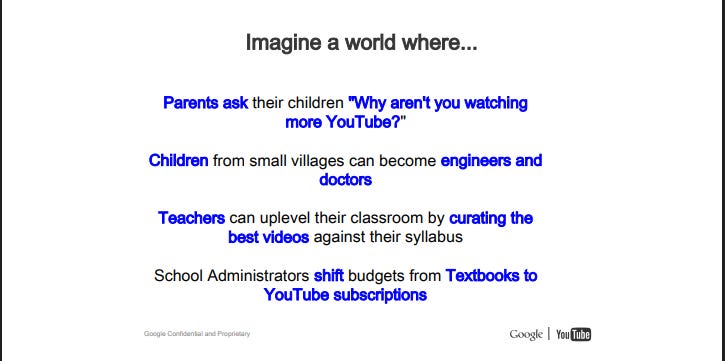
A decade or so later, it’s fair to say parents are not asking their children “why they aren’t watching more YouTube.”
YouTube (sort of) reckoned with its autoplay feature
A 2018 internal presentation explored YouTube’s autoplay feature and whether it might be a contributing factor for someone who has a “technology addiction,” defined in the presentation as “widespread obsession, compulsive and excessive use of technology that interferes with daily life.” According to YouTube’s metrics at the time, 31% of “night watchtime [was] driven by autoplay.” My take: that is quite a lot!
The next slide of the presentation noted that autoplay-driven watchtime was even higher among kids. In California alone, children logged up to 214,000 hours per week of late-night watchtime. If autoplay was disabled at night, California children would gain back roughly 9,000 hours of sleep time per day, according to the presentation. The “verdict” slide of the presentation concluded that autoplay “could be potentially disrupting sleep patterns,” and “disabling or limiting autoplay during the night could result in sleep savings.”
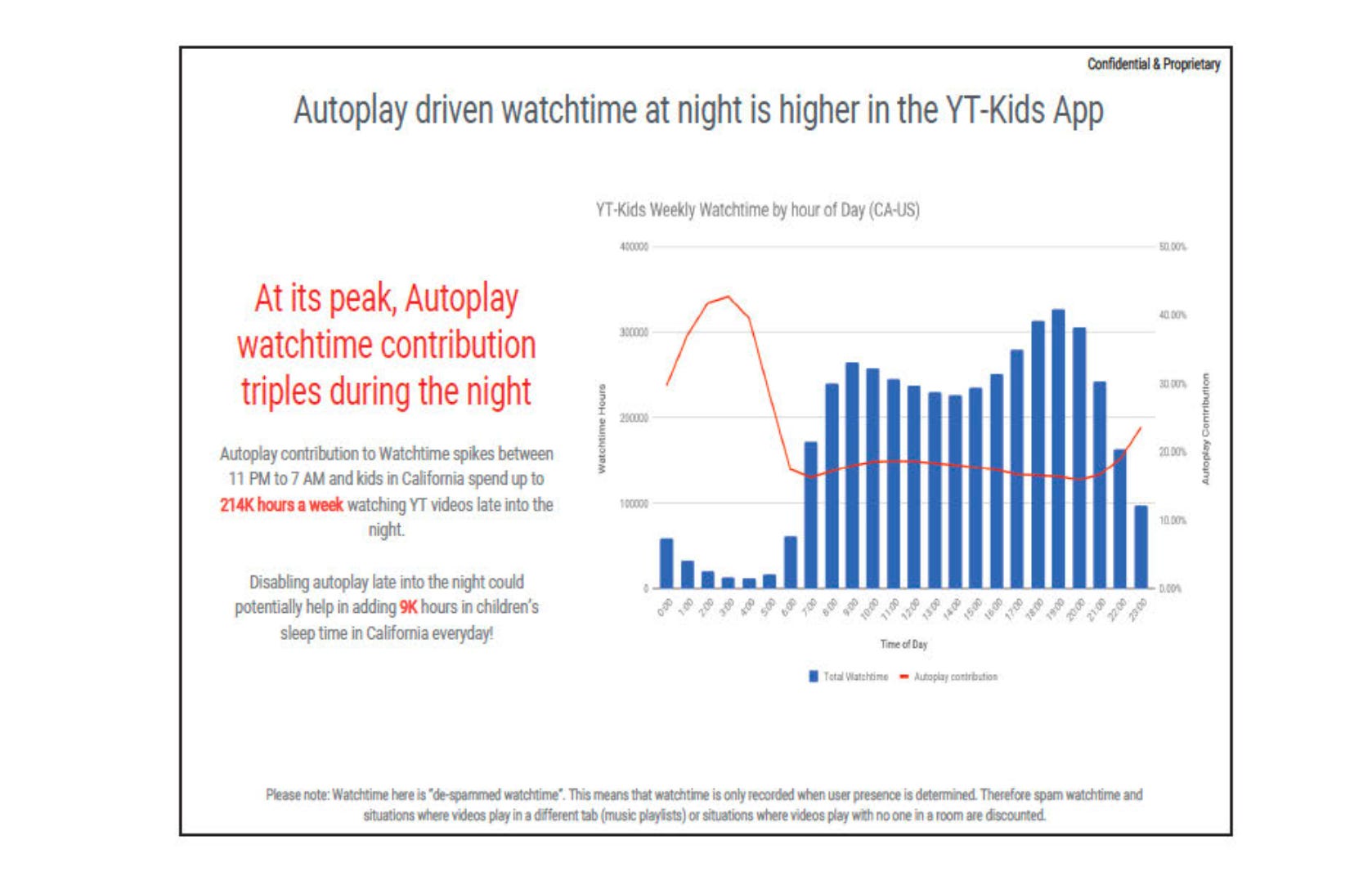
As of February 2026, Google’s autoplay FAQ page says the feature is off by default for YouTube users between the ages of 13 and 17, but unless they have a supervised account, those same users can simply toggle the autoplay feature on whenever they want. There’s also a bedtime reminder feature, but that, too, can be dismissed or snoozed with a tap.
“Solving kids is a massive opportunity”
A November 2020 presentation entitled “Business Case for Kids and Families at Google” is full of remarkably blunt takeaways penned by a redacted product manager. A slide called “Solving Kids Is a Massive Opportunity” included a statistic that “kids under 13 are the fastest-growing internet audience in the world.” It mentioned that 170,000 children go online for the first time every day, and that they’re largely doing so on mobile devices.
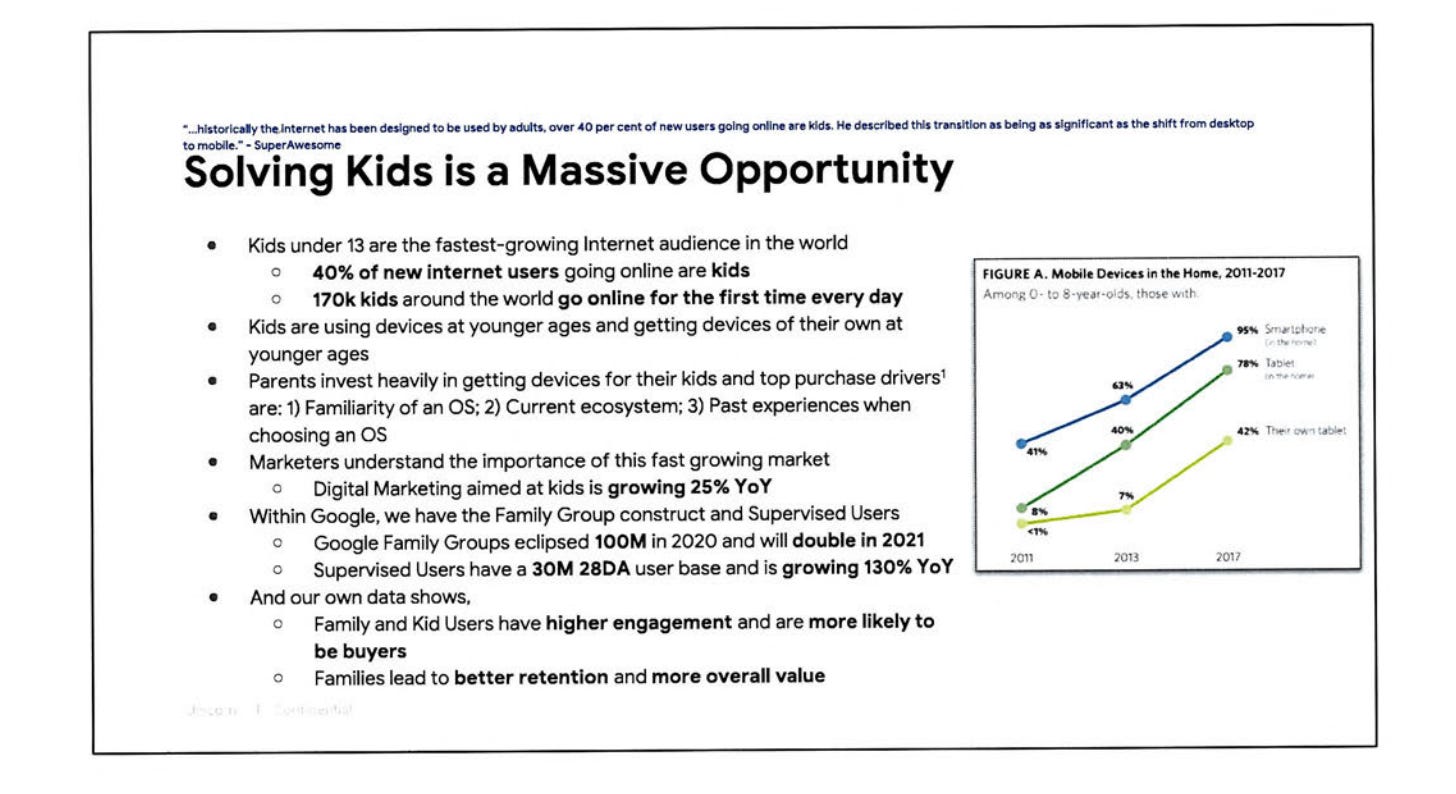
A few slides later: “Onboarding kids into Google’s ecosystem leads to brand trust and loyalty over their lifetime.” The slide states that “investing in schools helps onboard kids into Google’s ecosystem,” and that school laptop brands affect future purchasing patterns.
A “goal” in the presentation is to “build out a business case for investing in kids at Google.” There’s also discussion about how, despite having won the battle for the K-12 education market, Google wasn’t converting as many Chromebook buyers after high school graduation as the company would like. Unfortunately, MacBooks still appear to be cooler.
Here’s what else we’re reading this week:
OpenAI CEO Sam Altman and Anthropic CEO Dario Amodei refused to hold hands during a photo-op with Indian Prime Minister Narendra Modi. Having slowed down the game tape, I would say neither Altman nor Amodei makes a good-faith effort at momentarily clasping hands. However, Altman eventually puts up a closed fist, foreclosing any possibility of hand-holding, so I am penalizing him for unsportsmanlike conduct and letting Amodei off with a warning.
Bradford William Davis reported that Blue Owl Capital, an investment firm and stakeholder in four NBA teams—the Sacramento Kings, Atlanta Hawks, Minnesota Timberwolves, and Charlotte Hornets—sold an empty warehouse/potential future concentration camp to the Department of Homeland Security for $120 million. The NBA markets itself as a socially conscious sports league, but that is patently ridiculous and always has been. The NBA’s ownership class is right-wing even relative to other multi-millionaires and billionaires; Miriam Adelson and her family own the Dallas Mavericks, for instance. I am surprised Bradford (who, full disclosure, is a friend!) got any sort of comment from the league office, which tends to be extremely snippy about what it perceives to be negative coverage. “We know nothing about it,” an NBA spokesperson wrote about Blue Owl Capital’s warehouse sale to DHS.
Substack is making it even easier to integrate Polymarket data—which is worse than useless—into posts and notes. This is a stupid and bad idea, and should be called out as such.