


San Francisco doesn’t do a ton of media parties — there’s a decent one maybe a few times a year. So when there’s a good one on the books, it’s worth it for us writerfolk to show up.
And so last night, I headed out to Bimbo’s 365 in North Beach for a party hosted by Substack. This was a hot ticket by Bay Area standards, with a line for the approximately 500-person venue stretching around the corner.
The newsletter company, a media-meets-tech startup that hosts tens of thousands of newsletters, including this one, had rented out the classic nightclub — an old-school joint with a carpeted floor and table seating — to host a round-robin of debates between well-known tech writers on technology and A.I.
These included:
British writer Sam Kriss, who recently wrote a withering takedown of A.I.’s writing skills, debating anti-woke venture capitalist Mike Solana on whether San Francisco “is back.”
Tech journalist and friend of the newsletter Brian Merchant facing off with conservative writer Noah Smith over whether the robots should take our jobs.
Biohacking researcher and influencer Josie Zayner debating health reporter Kristen V. Brown about ethical concerns surrounding genetic engineering.
And tech writer Jasmine Sun debating novelist Robin Sloan about whether A.I. can have taste.
The winners were determined by audience applause.
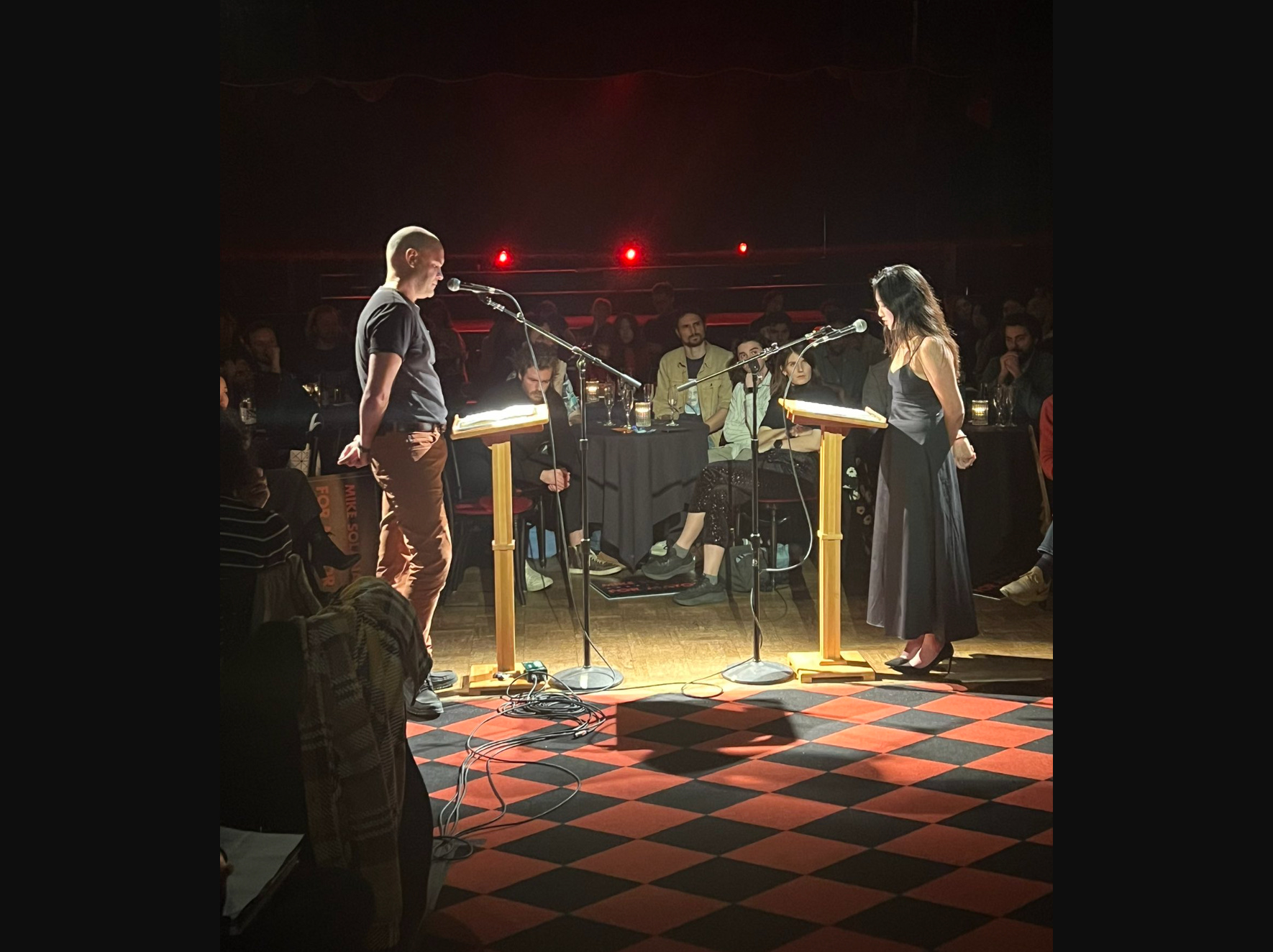
Live debates seem to be trending these days — think Newsom v. DeSantis, the “Debate Me, Bro” culture epitomized by Charlie Kirk and others, The Free Press’s oh- so-thirsty events, and even a completely separate debate on A.I. also held last night, in Washington. They make sense culturally, on a couple of levels.
For one, they are an IRL product of internet culture, after social media helped foster a culture of disagreement that has reshaped politics, while also souring everyone to life online. Why not do it in person instead of typing away on our couches — maybe that would help? There’s a nostalgia angle too, with events like these having some shared DNA of what is an old political tradition.
But Lincoln-meets-Douglas these debates are not. They are very much constructed with an eye on the internet too, where they are streamed, cut, and uploaded instantly — as influenced by shows like Jubilee, that have harnessed the format to drive digital engagement, as they are by any august American ritual. And there’s a more pessimistic take too: the format is a natural outcropping of a society where suddenly everything is up for debate politically. Questions about what topics are fair for debate — on your panel, your platform, in your publication — are more complicated than the “Free Speech” crowd likes to admit.
It was hard to gauge the politics of the audience at Bimbo’s who were instructed to applaud not for who they agreed with, but for who made the most persuasive case. Ultimately, everyone just wanted to have a few laughs over their martinis. This is the site that brought you “Is This Monsters Inc. Character Jewish or Polish” after all.
If there was any deeper resonance to be gleaned, team human seemed to have won out. The side arguing for humanity had bested the person more aligned with A.I. and the tech industry in three out of the four debates, with the lone upset being Smith’s plea for a robot-heavy workforce.
Despite the hosts’ exhortations at the top of the event for the gloves to come off, for no punches to be pulled for decorum or deference, for the rhetorical blood to be spilled with abandon, it was interesting to see how congenial the vibe was. Had these writers and their adherents in the audience — been duking it out on X, Facebook or even Substack — the tone would have demonstrably been sharper, less forgiving, more punishing and unyielding. Maybe IRL debates are the answer, after all.
Here’s what else we’re reading this week:
Kamala Harris hasn’t announced yet, but she’s coming back for 2028. This Times profile explores her contradictions: how she believes people are eager to hear her voice, even if she doesn’t really know what to say about her vision or pitch for the country. She announced a March event in Oakland yesterday.
Data Workers’ Inquiry profiled a worker from Kenya who gets paid to chat with lonely people who think they are talking to a romantic interest online. The worker, Michael Geoffrey Abuyabo Asia writes about the mental toll that the sexualized and ultimately dishonest communication took on his life, including the shame of engaging in this type of work to support his family without their knowledge.
We deserve better. The users being deceived deserve better. And the future of AI must be built on something other than our broken humanity. Until then, remember that an AI girlfriend responding to your loneliness might just be a man in a Nairobi slum, wondering if he’ll ever feel real love again.
A good scoop from Wired alleged that OpenAI’s economic team is being leaned on to produce reports that align better with the company’s PR mission. We wrote about some questions raised by the company’s economic releases a few months ago, after OpenAI argued that A.I. would help society by increasing productivity — without acknowledging that the benefits of increased productivity have been systematically denied to workers for more than 50 years. Now, Wired reports that at least two employees of the company’s economic research team have departed in recent months, including one economist who concluded that “it had become difficult to publish high-quality research.”
Generation Blank? The Baffler reviewed David Marx’s Blank Space: A Cultural History of the Twenty-First Century in The Baffler, which it said, “redramatizes the anni horribiles of the last American quarter century as one big ‘lowest-common-denominator battle for attention.’”
OpenAI is trying to introduce a dueling ballot measure to counter a child safety proposal from outside the industry that seeks to reduce risks and exposure to children from chatbots. Politico notes that this move “could hurt both measures’ chances of passing — a situation which would likely benefit any tech companies looking to avoid strict regulation, while still allowing them [to tout their support for] a proposal aimed at protecting young chatbot users.”
John McAuliff, a 33-year-old business owner and former civil servant won a seat in Virginia’s legislature last month after his campaign focused in part on the ills of A.I. datacenters.
See you all next week!