


I did not expect to follow up my colleague Ariella Steinhorn’s coverage of Nvidia and Jensen Huang from a few days ago, but things change quickly when the CEO of arguably the world’s most valuable company is pushed out and, I presume, banished to a faraway data center where he can only keep a handful of his “30 or 40” leather jackets.
The backstory here is that Huang, a very horny man, recently admitted to an affair with a woman named Alice Huang (no relation). Alice is a suspected Chinese spy, according to American intelligence agencies. She worked for a shady data center company called Megaspeed, which has been accused of smuggling Nvidia’s most technologically advanced chips from Singapore to various subsidiaries to China, where said chips are supposed to be banned by American export controls. A Commerce Department probe about Megaspeed was reportedly halted after Nvidia’s general counsel reached out to investigators at the agency. President Trump seemed well-aware of this unfolding scandal and didn’t seem to care, or maybe just forgot. Hard to say with him.
Which brings us to somehow-even-more recent developments. On Wednesday night, the Times reported on a second Jensen Huang affair—this time not with a spy (good!) but with a subordinate Nvidia executive (bad!) Once you surpass one affair, I am going to assume you are engaging in more than two affairs. Huang’s security guard reportedly had an NDA prepared for a bystander who recorded Huang “being affectionate” with his subordinate.
(Wait, okay, no joke: as I was writing the above paragraph, a friend sent me this Reuters report about a third affair. Awesome.)
Hard Reset’s official stance is that cheating is bad, though it’s typically not grounds for you to lose your job. That standard does not apply, however, when your extramarital affairs involve a possible spy and someone who works for you, duh. Moreover, Huang’s behavior demonstrates that he’s way too volatile and emotionally compromised to lead Nvidia.
Jensen Huang has been by far the most vocal, and most influential, proponent of easing export controls on Nvidia’s most advanced chips. He’s openly called for more trade between the United States and China, and had some success in loosening controls on older Nvidia chips. He is not a China hawk like Anthropic’s Dario Amodei, or much of the national security apparatus. I share the belief that stringent export controls do more harm than good, and are contributing to an unnecessarily antagonistic dynamic with the world’s other superpower. I do not share Amodei’s existential (and impossible-to-define) fear of “losing” the AI race to China.
But crucially, I do not run Nvidia. If Alice Huang is indeed involved in Chinese espionage efforts, what did she report back to Beijing about her conversations with Jensen Huang? Did they ever chat about trade secrets? His private meetings with the president of the United States? (The Wall Street Journal reported on Thursday that Alice Huang’s husband, a Chinese businessman, introduced her to Jensen Huang, and spoke openly about their close relationship. Nice guy!)
Some are skeptical of the spy angle, which is currently based on reporting attributed to anonymous intelligence officials and maybe China hawk Marco Rubio. Fair enough. Let’s say Alice Huang is a commercial fixer, not a spy. There’s still a big problem: Alice Huang’s Singaporean company was allegedly bypassing export controls while Nvidia’s CEO was, at a minimum, turning a blind eye. That’s the charitable interpretation. My guess is Jensen Huang was more tapped in than that. Why else would Nvidia’s lead counsel poke around and ask the Commerce Department for more information about its Megaspeed investigation?
There’s more smoke here. In the summer of 2025, Nvidia reported that a whopping 22% of its revenues came from Singapore, which is ground zero for China’s AI chip diversion scheme. By late 2025, Nvidia announced a conveniently-timed change to its earnings reports: it would start listing revenue based on a company’s headquarters location, rather than a customer’s billing location. In other words, Nvidia no longer wanted the public to see how much business it was doing in Singapore.
As Nvidia rolled out some not-very-clever accounting tricks, U.S. law intelligence agencies took a long nap. On Thursday, The Washington Post reported that in the summer of 2025, the Singapore government investigated Megaspeed and requested assistance from the U.S. Justice Department and FBI. How’d that go? “Singapore has to date received limited information or assistance” from U.S. intelligence agencies, the Singapore government wrote in a statement to the Post. Eeesh.
Following Huang’s ouster, Trump officials are now blaming each other—especially Commerce Secretary Howard Lutnick—for not closing export control loopholes. Why Lutnick (and Trump) have been so wishy-washy about their preferred export controls is an open question. Is there a personal enrichment angle? Fears about “disrupting” the stock market? (Too late on that one.) Friends helping friends? Is there a genuine tug-of-war between China hawks and others in the administration? The boring answer is probably some combination of “all of the above.”
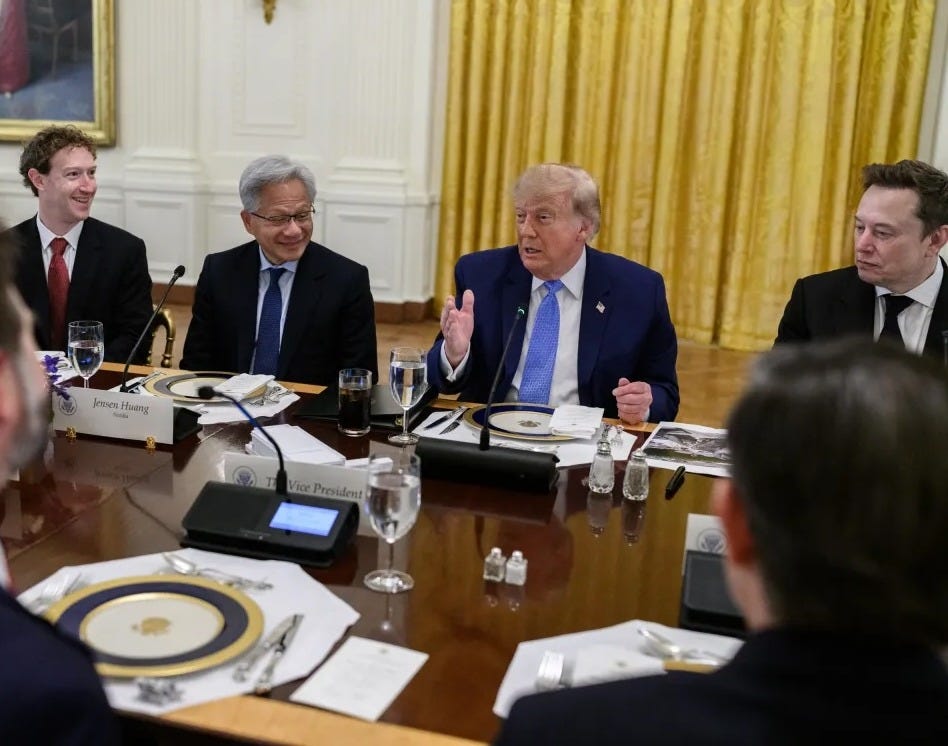
Tech executives and oligarchs—especially the loud-mouthed ones—have taken a self-serving stance on Huang’s dismissal. They’ve diminished his affairs as minor indiscretions and claimed that kicking him to the curb will cause irreparable harm to the AI industry. Sequoia partner Shaun Maguire wrote that Jensen did something “incredibly dumb” but that he’s “irreplaceable.” Angel investor Ron Conway wrote that Huang showed “grace and dignity” by (extremely belatedly) admitting to his (first) affair. Elon Musk is already posting about how it’d be “an honor” to hire Huang. Anduril founder Palmer Luckey says, “China wants Jensen out, so I want him in.” (I genuinely have no idea what he’s talking about.)
Amjad Masad, the billionaire founder of Replit, is wondering aloud about an anti-Nvidia conspiracy. “Why are old stories that were not even covered up all that well become sudden international and geopolitical news?” he asked. “The timing is suspicious, so worth asking: who benefits and why now? If Jensen, the premier champion of open models, is taken out then anyone who wants AI closed, centralized, and controlled might benefit. Why now? The midterms seem relevant. But also perhaps the upcoming IPOs.” Masad’s rhetorical questions were reposted by Y Combinator founder Paul Graham.
These are childish excuses and illogical theories. Breaking news: the public is more interested in stories about sex scandals than investigations into export controls. Sometimes it takes a story about the former to get people to notice the latter. Is it possible that there are interest groups or individuals—maybe even with ties to Anthropic—that are capitalizing on Huang’s terrible decisions? Yes, for sure, though Nvidia is reportedly planning a $10 billion investment in Anthropic after its IPO, so…not a great moment in time for Anthropic to endanger their partnership.
Here’s what I think: If anyone was in a position to further loosen the Trump Administration’s export controls, it was Jensen Huang. He’d already made decent progress on that front. He had the president’s ear, for God’s sake! And then he blew up his own efforts with his brazen conduct and sketchy associations.
Huang defaulted to a worst-of-both-worlds outcome: powerful AI chips making their way to China, just through a corruptible gray area. The China hawks didn’t corner him; he did this to himself.