

There are long stretches of time where I’m pretty skeptical that Elon Musk is doing anything other than posting on X. But I will give him this (and only this): he seems to be pretty busy lately.
He and X finally settled a long-simmering class-action lawsuit brought by laid-off Twitter employees who alleged that they were owed severance. Musk’s “don’t pay people” strategy did not work out; the agreement reportedly calls for full payouts, plus interest.
Additionally, Musk’s SpaceX just filed confidentially for an IPO. The New York Times reports that SpaceX is likely to go public in June at a valuation of more than $1 trillion. Musk, who’s currently worth more than $800 billion, could easily be a trillionaire by summer’s end.
And Musk is the plaintiff in another case that’s tentatively set to go to a jury trial later this month. That case, Elon Musk vs. Sam Altman, is a grievance-filled heavyweight battle. Here’s a quick summary, which I wrote in January, when I examined hundreds of pages of discovery:
Musk’s lawsuit alleges that OpenAI cofounders Altman and Greg Brockman deceived Musk (also a cofounder) during the organization’s early days, when it was solely a nonprofit. Musk wanted it to remain a nonprofit, but his fellow cofounders had other ideas, he alleges. OpenAI was ‘nurtured in its infancy by Musk’s money, advice, recruiting efforts and connections,’ Musk’s legal team wrote in an amended complaint, but ‘at the direction of Altman, Brockman, and Microsoft, [OpenAI is] fast becoming a fully for-profit subsidiary of Microsoft.’ Musk has accused OpenAI of breach of contract and fraud, among other allegations, and has also roped in Microsoft as a co-defendant.
OpenAI tried to get the case thrown out, but Judge Yvonne Gonzalez Rogers ruled against a summary judgment. It seems, at a minimum, that Musk’s central claim isn’t implausible. Much less plausible: his request for up to $134 billion from OpenAI and Microsoft. My understanding of the case is that a jury will issue a verdict on whether OpenAI/Microsoft are liable for the allegations lodged against them; if so, Gonzalez Rogers will decide on a disgorgement award amount for Musk.
Gonzalez Rogers recently ruled on which pieces of evidence and expert witnesses must be excluded from the trial. For instance, OpenAI is not—I repeat NOT—allowed to inquire about Elon Musk’s ketamine use. (During his September 2025 deposition, Musk said he did not recall ingesting rhino ket at Burning Man in 2017. He was asked this question because, during the time period in question, he was negotiating with others at OpenAI about the organization’s future financial structure.)

Gonzalez Rogers is allowing evidence about Musk’s hazy relationship with Shivon Zilis, a former OpenAI board member and the mother of four of Musk’s children. Zilis is likely to be a key witness during the trial. Not only was she on the OpenAI board for more than three years, but she was also potentially privy to Musk’s behind-the-scenes opinions about OpenAI’s restructuring plans. Gonzalez Rogers seems to have been convinced by a number of disclosures made during Zilis’s September 2025 deposition, as well as a February 2018 text exchange between Zilis and Musk.
The deposition featured a dispiriting debate about what constitutes a relationship, a relatable topic for many, minus the involvement of a 54-year-old billionaire who has at least a dozen children.
Attorney: Have you ever been in a romantic relationship with Elon Musk?
Zilis: “Relationship” is a relative term. But there have been romantic moments.
Attorney: And when did you first have a romantic relationship with Elon Musk?
Zilis: I don’t know that I agree with the term “relationship.”
Attorney: What term would you use?
Zilis: Well, a relationship describes some sort of discussed structure and so I don’t know how to answer that question.
Later in the deposition, Zilis relented—she acknowledged that she’s currently in a relationship with Musk, and that they had spoken in-person on the morning of the deposition (though not about the deposition itself).
More pertinent to the lawsuit is a February 2018 text exchange between Zilis and Musk that turned up in recent filings. The exchange took place five days before news broke that Musk was stepping away from OpenAI.
Zilis: Do you prefer I stay close and friendly to OpenAI to keep info flowing or begin to disassociate? Trust game is about to get tricky so any guidance for how to do right by you is appreciated.
Musk: Close and friendly, but we are going to actively try to move three or four people from OpenAI to Tesla. More than that will join over time, but we won’t actively recruit them.

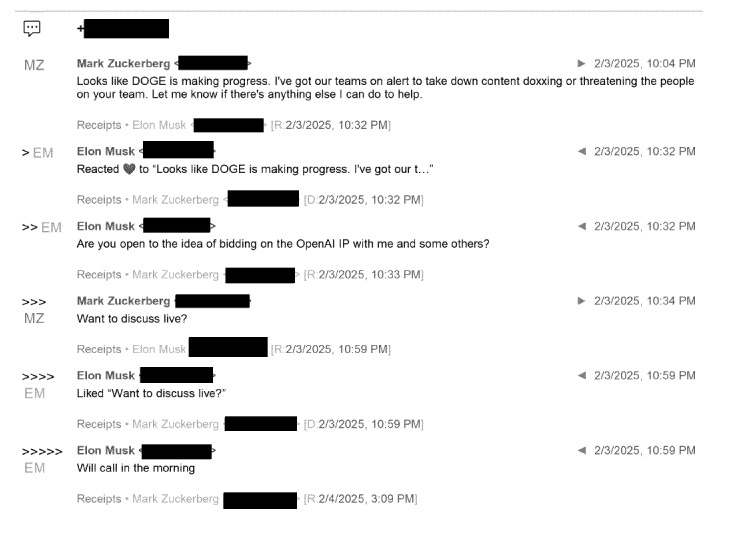
Other recent filings also include text exchanges between Musk and Meta CEO Mark Zuckerberg; they briefly chatted in December 2024, when Zuckerberg let Musk know that Meta was supporting Musk’s lawsuit against OpenAI/Microsoft. And they swapped messages again in February 2025:
Zuckerberg: Looks like DOGE is making progress. I’ve got our teams on alert to take down content doxxing or threatening the people on your team. Let me know if there’s anything else I can do to help.
Musk: Are you open to the idea of bidding on the OpenAI IP with me and some others?
Zuckerberg: Want to discuss live?
Musk: Will call in the morning.
I plead guilty to being amused by some of the silly details that have emerged during discovery. But even the ancillary personal reveals are (mostly) newsworthy. It is exceedingly rare to get a peek behind the curtain at how oligarchs and the titans of the AI industry interact with one another, make decisions, and even just live their lives.
This trial is pitting a likely trillionaire against AI’s No. 1 spin doctor. Musk and Altman are expected to testify. So is OpenAI President Greg Brockman. So is Musk’s top advisor, Jared Birchall. So is former OpenAI CTO Mira Murati. So is Microsoft CEO Satya Nadella. So is Sam Teller, who was formerly Musk’s chief of staff. So is OpenAI cofounder Ilya Sutskever. So is Zilis!
There are certainly trial outcomes where one side ends up being viewed as the clear “loser.” And Musk could end up being awarded some serious cash, which would certainly be considered a “win.” Frankly, I have no idea what’s going to happen, and it would be irresponsible to pretend otherwise. My one narrow prediction is this: Musk v. Altman will tell us a lot more about both men than we knew before, and neither side will emerge unscathed.
Here’s what else we’re reading this week:
OpenAI announced that it’s acquiring TBPN, a daily tech talk show hosted by Jordi Hays and John Coogan. Last week, I looked into how Altman and Head of Sora Bill Peebles hyped up Sora on TBPN, when the video generation tool was having its 15 minutes of fame. During that October episode, Coogan fawningly volunteered to Altman that any compute issues associated with Sora would work themselves out: “When I think about scaling up Sora, I feel like it’s crazy to bet against you. You’re going to get the chips,” Coogan said.
I don’t think that OpenAI’s formal acquisition of TBPN is some sort of enormous breach of ethics. The show serves a purpose similar to that of CNBC: getting otherwise-reticent founders and CEOs to provide public commentary about their products. There is utility in that, even if the questioning and commentary leave something to be desired. I just wish OpenAI wouldn’t insult our intelligence by pledging “editorial independence” as a central part of the deal: “TBPN will continue to run their programming, choose their guests, and make their own editorial decisions,” OpenAI’s press release says. “That’s foundational to their credibility, and it’s something we’re explicitly protecting as part of this agreement.”
Allow me a sports metaphor. Every year, the NBA asks a panel of sportswriters and broadcasters to vote on the league’s most valuable player award. Imagine if the NBA added the world’s No. 1 Shai Gilgeous-Alexander super fan to the panel, then released a statement that the super fan has full independence to vote for whomever he wants. Technically true! And also patently ridiculous.
The CFTC and state regulators are engaged in an increasingly contentious tug-of-war about who has jurisdiction over prediction markets. On Thursday, the CFTC sued Arizona, Illinois, and Connecticut, alleging that these states do not have the authority to restrict access to free-for-all betting platforms like Polymarket and Kalshi. State regulators believe that prediction markets are a form of gambling. The CFTC is sticking to its very charitable view that prediction markets do not involve gambling—just betting on future events, which is different somehow.
Sometimes a headline doesn’t warrant any summarization or analysis. Here’s one, from Futurism: “Almost Half of US Data Centers That Were Supposed to Open This Year Slated to Be Canceled or Delayed.”