


It was interesting but not shocking to learn, yesterday morning, that Jensen Huang was reinstated as Chief Executive of Nvidia. I previously joked to my boyfriend the other week that the only thing that would stop Jensen from vying for his job back would be casting him as James Bond. (The name’s Huang, Jensen Huang.)
However, despite all the tech oligarch obsession with James Bond’s ability to naturally attract women, Jensen Huang may share more with the villains that James Bond likes to pursue than with James Bond himself.
Last week, the New York Times published an account of how Jensen “belittled” his staff and made humiliation rituals “routine.” Some of the highlights: when Jensen realized his employees were making too much money to care about money as an incentive, he decided that degradation might be the only way to motivate them psychologically. He reportedly said he would pee down the brains of employees, and beat them with their own severed limbs. “I’d rather torture you into greatness, because I believe in you,” he once said.
We also learned recently that Jensen was not only shipping billions of dollars worth of chips to China via his paramour, but also shipping Nvidia chips to Russia, where they were being used to power Russian drones. If all of that weren’t enough: there are more affairs, and still no succession plan should Jensen die or become otherwise incapacitated.
In the days since Jensen’s brief leave from Nvidia, one thing is clear: that this leather-jacket-wearing, affair-having man desperately wanted to live the life of a bad boy and a cult leader. Most importantly, it’s been revealed that the system presently enables it.
Whether we can attribute Jensen’s individual actions to a revenge-of-a-former-nerd-now-in-power—or to something else entirely that his new therapist uncovers—Jensen’s lust for domination and subjugation, a mirror image of the power structures that enabled him, is impossible to unsee.
Now, if Jensen were a person with a normal position in society—not at the center of a circular financing scheme upholding OpenAI, Microsoft, Oracle, and many other stock prices upholding our retirement savings—there would be no question about the fact that Jensen’s behavior is maladaptive and probably sado masochistic. A therapist in any other scenario would likely tell Jensen—a person worth many billions of dollars, who could retire for several lifetimes—to step down from Nvidia and seek serious psychiatric help.
However, while I am not personally a psychologist, I do know that when the entire global capitalistic and political system rewards and abets literally any behavior, even the best EMDR therapist or psychoanalyst in the world isn’t going to radically change your personality.
Without that, Jensen seeking therapy is just a preposterous talking point. Jensen doesn’t care about becoming better, or being faithful to his wife. He cares about fulfilling some prophecy he has convinced himself, with the help of other delusional or nihilistic kleptocrats, that only he can fulfill.
The whole Nvidia saga actually reminds me of President Trump’s statement years ago: that if he walked down Fifth Avenue and shot someone, his voters would still forgive him.
It follows, then, that Trump—who can only “like” people so long as they adore him, or remind him of himself—would produce an AI-generated version of Trump surviving his assassination attempt, with Huang in Trump’s position defiantly waving a red bra. (Donald Trump, Jr. nauseatingly reposted it, calling it “funny” and telling people to relax because the market is up “3 trilly.” I gagged.)
The grift has become so normalized that much of their power, and they know this, is about the cult of personality—the mythology that one person is the hero, and that we must enrich them and organize society around them for the rest of us to literally survive in a body.
At this point, the juxtaposition of how the tech oligarchs are allowed to act versus everyone else in the world is laughable, in a tragicomic sense. It’s pretty unfathomable to consider what most people must face to survive, compared with what the elite can get away with.
And in our right minds, we realize that this is the stuff of a cult. When you see some of Jensen’s employees sprinting to embrace him upon his return, it all starts to feel like the creepy trailer to a Netflix documentary. Because in this last year, amid so much uncertainty, most tech workers are not dying to hug their executives. And over the past five years, the tech industry has laid off hundreds of thousands of people.
There are going to be as many hot takes about this unfolding scandal as dollars that Huang adds to his net worth. And there are countless angles to cover, too much to cover in this single newsletter: why the economy is being held hostage by one man’s problems with fidelity, Nvidia’s circular financing setup, whether the stock market desires of the President took precedence over the national security community’s warnings.
There’s also the question of why anyone would bother taking a workplace harassment module or ethics training ever again. There’s the fact that a class of super-billionaires and the current administration believe they are post-national. But there is one element of all of this that I can’t stop thinking about: what if Jensen were a woman?
First of all: no woman could be treated as such a “singular visionary” as Jensen. I can’t think of any woman in tech seen in this light—perhaps with the exception of Elizabeth Holmes, who was sentenced to time in a federal prison. There are female CEOs in the chips space, including Lisa Su, the CEO of semiconductor company AMD. But I cannot fathom Lisa Su declaring, as Jensen did today, that she has no succession plan.
Then, if you transpose Jensen’s reported acts of sadism onto a woman in his position, it actually becomes absurd to envision. Women are not perfect, by any means. But imagine a woman CEO telling someone that she would beat them with their own severed limbs and pee into their brain?
She would be institutionalized. Immediately. Not only would she be cocooned tightly into a straitjacket, but she would also be lobotomized whenever a surgeon had availability. Next: if a woman had multiple affairs with her subordinates, she would most certainly be called all the names that women are called when they are sexually free. If she had an affair or even correspondence with a foreign spy, she would probably be burned at the stake, humiliated via televised trial where we would inspect her appearance and voice and possibly send her to prison.
When women CEOs of the “girlboss” era committed far less offenses, or weren’t perfect—including Audrey Gelman of The Wing, Steph Korey of Away, and Ty Haney of Outdoor Voices—they were ousted, or pressured to step down. And while anything resembling girlboss makes me feel ill—in that it is just a perpetuation of the same sort of systems enabling these guys in “mean girl” form—all of this sends the very explicit message that men in tech can do what they like, and women can’t.
Case in point: one of the first stories I looked into after making a hard pivot away from tech communications was about a tech CEO named Vishal Garg. Garg, who founded a fin-tech company called Better.com, ecstatically called his employees “dumb dolphins,” and his investors “sewage.” In a deposition, he threatened to burn his former business partner alive, and staple him to a wall. A Better.com employee who I spoke with shared that he started contemplating taking his own life as a result of Garg’s abuse.
While some board members tried to remove Garg this summer, raising securities law concerns, somehow this guy is also back in the saddle as CEO. And guess who he’s defending?
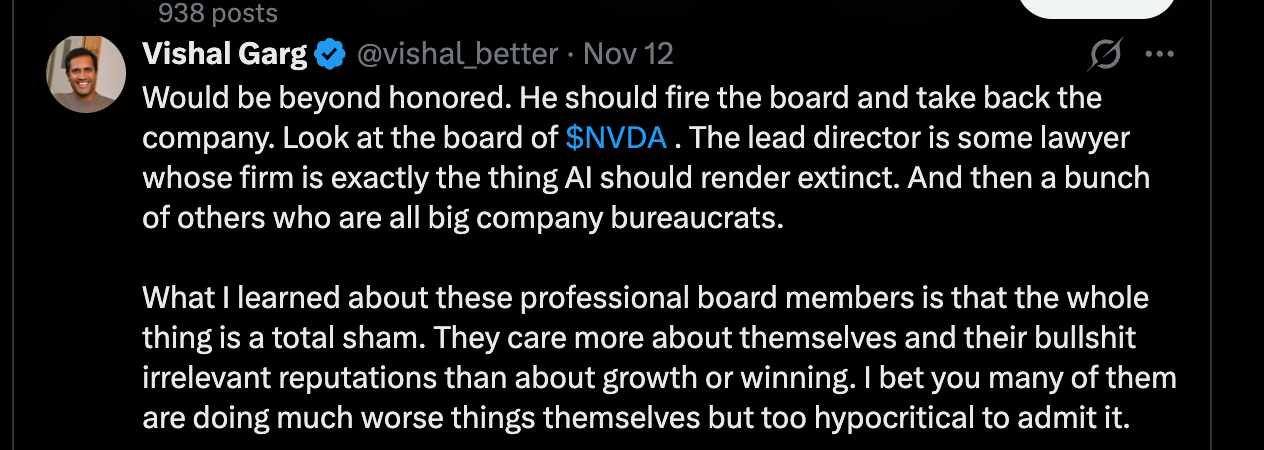
Another person who is defending Jensen, naturally, is Travis Kalanick—citing Jensen, bizarrely, as a counter to “techno-authoritarianism” —I think referring to the notion that Jensen would enable open models vs. closed frontier labs as Anthropic. Still. Read the room.
I think that all of this reassures male tech CEOs and some men in tech that it is simply normal to act this way. It’s the same messaging, honestly, as the Cornell 7 case and others like it: oh, he made some mistakes. We can’t ruin his future. What if he goes on to found a monopolistic tech company and he employs all of us? We need him.
Do we? Or is it a story that they tell to cement their positions, via blunt force, through shaming literally everyone else but themselves?
Last week, I dropped by for dinner with a bunch of tech founders at an exclusive membership club (purely for anthropological reasons). One of them mentioned he was investing in Jeff Bezos’ businesses, to which I blurted out the first question that came to mind: “Does Jeff Bezos…need more money?” The investor responded that yes, he did; especially after “that woman” took $30 billion from him. “His wife..?” I asked, feeling a bit stupefied.
Naturally, Mackenzie Scott is the villain in this guy’s mind. I imagine that Nvidia CEO Jessica Huang might have been one too.
Jensen and Travis though? Brilliant founders, man. Brilliant.