


The thing about overly relying on AI is that everyone else can usually tell. The infamous LLM tics—it’s not this, it’s that—are the most obvious signs. If you’re reading this, meaning you’re (hopefully) a subscriber to our tech-oriented newsletter, then you might also know someone who lets chatbots influence their life decisions. You may have witnessed their slow descent into AI dependency. I’m talking about a person who constantly queries ChatGPT or Claude about recipes, medical and health questions, romantic advice, ethical conundrums, email drafts, and sartorial choices. Everything is filtered through a chatbot that acts like it’s emotionally invested in what you’re saying and doing, which encourages further correspondence.
There are escalating levels of AI dependency. Overreliance is, frankly, the best-case scenario. The situation gets more dire when users incorporate AI into most of their real-life interactions, or come to believe that their dozens of coding agents unlock supercomputer-levels of productivity. The Wall Street Journal just reported on how tech entrepreneurs and venture capitalists are increasingly recording their meetings and even their dates, so that conversations can be distilled and analyzed by Claude afterwards. This bucket of folks, unsurprisingly cloistered in Silicon Valley, thinks everyone else is weird for finding their behavior to be concerning. And then there’s a batch of users who suffer from life-threatening delusions as the result of their extensive, near-constant dialogue with chatbots. In some cases, these users have allegedly been driven to self-harm and violence.
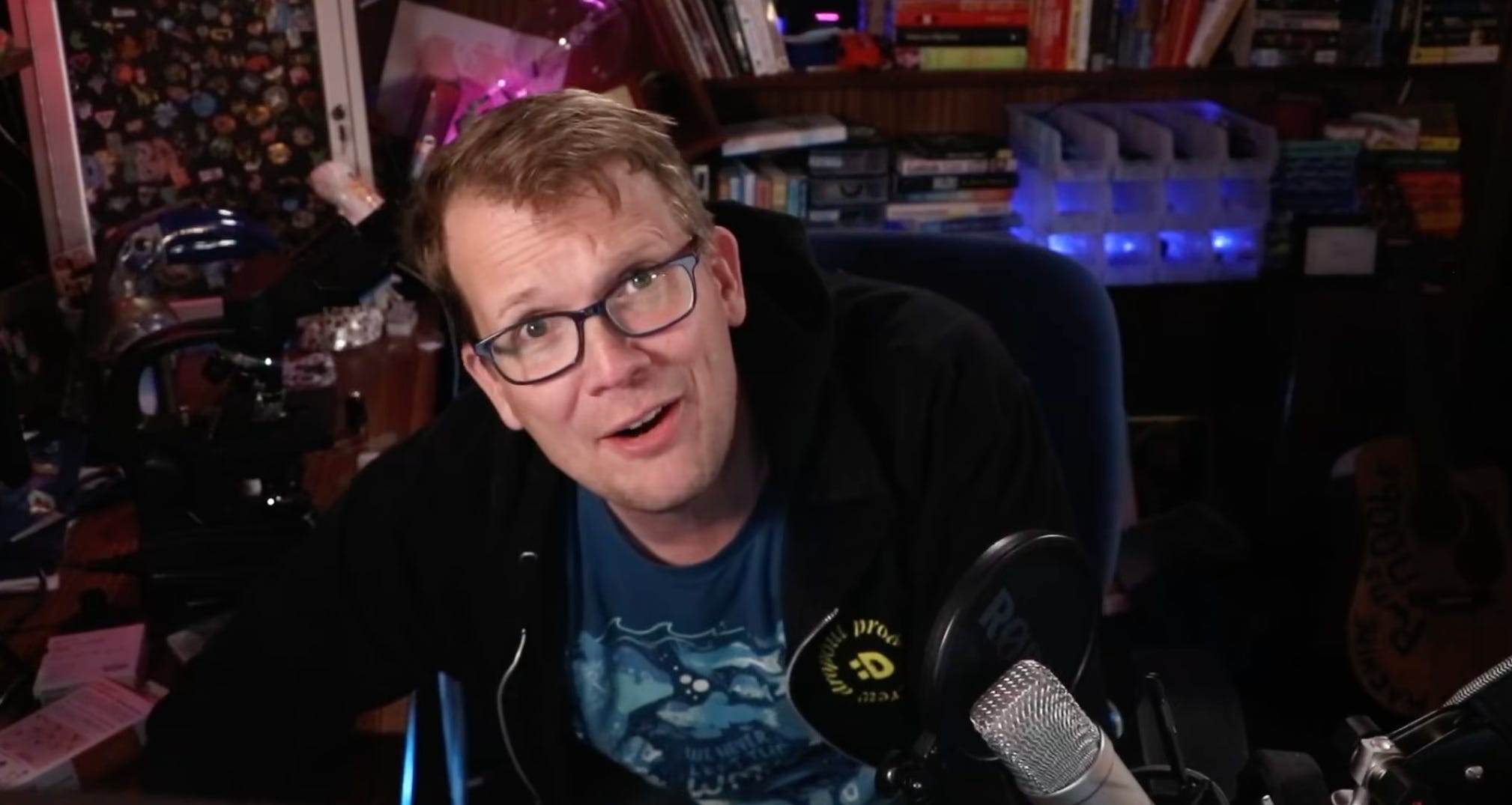
It seems Hank Green, a world-famous YouTuber with millions of followers, has an unhealthy relationship with an AI chatbot. Luckily for him, he was called out for his behavior last week, while he was still in the “overreliance” phase. His full response to this controversy wasn’t necessarily laudatory—I found it borderline-cloying and definitely annoying—but the fact that he ultimately fessed up and admitted he has a problem is, in my opinion, a first-of-its-kind development and a blueprint that shouldn’t be outright ridiculed.
For the uninitiated: Green is basically Bill Nye for Gen Z. For decades, he has enthusiastically educated students (and curious adults) about science, the environment, and all sorts of other pet interests. His brother is John Green, world-famous author of novels including The Fault in Our Stars. They are both YouTube pioneers and have squeaky-clean reputations, especially compared to every other internet-famous figure with a parasocial following.
Long story much shorter (Vulture has an explainer if you want the nitty-gritty details), Green was recently criticized by his fans for using an AI-generated diagram in an educational video called “You Have Never Seen a Normal Star.” The diagram apparently had incorrect information in it, among other issues. Green acknowledged inserting the AI-generated diagram and agreed it was in bad taste.
Green’s fans remained on high-alert about his AI usage, which he’s been teasing out with increasing frequency on podcasts and social media posts. Then last week, when he was reading off a script during one of his videos, he tossed in the phrase, “And I appreciate the pushback.”
It was an odd interjection, and the exact genre of groveling that chatbots use when you tell them they got something wrong. Fans asked him what was going on, and at first, Green obfuscated. In a now-deleted X post, Green wrote that he produced the video in question “under a ton of pressure” and “did use ChatGPT for research on this script,” adding, “watching it I definitely get an AI feel, so I think it’s fair to say I was relying too much on generated notes.” But he also claimed to have ad-libbed the “I appreciate the pushback line.” If he was lying about that, yikes. If he was telling the truth, then it means he’s emulating the cadence of a chatbot, which is probably worse.
The latter scenario suggests Green is spending a ton of time talking to ChatGPT. He’s hardly alone among power users. Google’s AI “users are writing queries three times as long as the keyword-heavy questions they asked of traditional searches,” the New York Times reported, citing Google’s own research. “People are spending one to nine more minutes in AI Mode than on traditional Google searches,” according to the Times. That’s just Google Gemini, arguably the least “charismatic,” most annoying of the mainstream chatbot options. ChatGPT and Claude offer an even more personalized experience, and an alarming number of people enjoy that intimacy: 16% of Americans, including 25% of users under 30, utilize chatbots for “companionship,” according to a 2025 poll from the Associated Press.
After deleting his X post, Green re-emerged on Reddit with another explanation and something approaching an apology. “I’m mortified that I have let so many people down and I think I understand how that happened,” he began. He promised to “change things about how I make stuff” and admitted that he’s been “diluting” himself by “relying too heavily on AI as a research aid.” He’s clearly in the bargaining phase, because he wrote multiple paragraphs about how he’s more bullish about AI than other people in his community. Eventually, though, he wrote the following:
“But mostly I need to come to terms with the fact that the level of dopamine I’ve been getting from interacting with LLMs...with doing more and more and more and more...is not healthy for me or good for the world. It is careless, and has disconnected me from where people are on this.”
He invoked his wife and brother, both of whom “did not pull any punches” when they talked to him about his AI dependency: “Neither of them think [I’m being] healthy,” he wrote. “I need to readjust.” He ended his note by announcing he’s going to pull back on some of his work, and that he’s “very sorry for harming the thing this is all based on.”
Transparently, I find Green’s AI reflections to be fairly unsympathetic and grating. His line about “dopamine” hits from LLMs is silly and dramatic. (Hank, you’re using AI to research and possibly script episodes of your show; you are not Robyn.) Green’s assertion that reasonable people can disagree over whether AI is going to destroy the fabric of society also drives me nuts. It reads like fence-sitting and cope—a defense of his behavior and beliefs only after he got caught in the act.
I struggle to sympathize with anyone, not just Green, who’s exposed for depending so heavily on AI. I harshly judge journalists and writers who lean on AI to draft their work—it’s a duplicitous, oft-disqualifying practice. Tech executives who are haughty about their extensive AI usage are even worse. I totally get why Green’s fans are unsettled and angry by his belated disclosure.
All that said, I see a silver lining here. Green might not be querying ChatGPT all day for a “dopamine hit,” or whatever, but he certainly appears to have experienced something approaching an addictive relationship with his chatbot. He is hardly alone. As much as I want to roll my eyes at his (and others) predicament, I don’t think that’s always an appropriate or constructive response.
The chatbot users who end up falling victim to delusions and worse were, at one point, lost but not gone. Their chatbot was an unhealthy companion, not yet a total life-ruiner. They could’ve benefitted from an intervention of sorts. Green got one on the internet and, it sounds like, from his family.
Was there too much handwringing when Green finally came clean? Yes. His message is still a net-positive. Green is, at least as far as I can tell, the first legitimately famous person to come out and say they’ve become too reliant on AI. It’s a meaningful concession, and undoubtedly an affecting message for others in a similar position.
After months of chatter about tokenmaxxing, amassing armies of AI agents while running on no sleep, and how every successive model released by Anthropic is more powerful than God, it’s nice to witness a cringey-but-earnest reality check and reset. I have no idea if Green will stick to his pledge, but I’m going to try and take him at his word, if for no other reason than he might just help other people snap out of it.
Here’s what else we’re reading this week:
Regular people who learn about and/or encounter Flock Safety tend not to like it. The mass surveillance company is aware that its invasive technology is difficult to defend, and so it is reportedly providing talking points and guidance to police departments. Those talking points include the following: “Don’t avoid the concept of mass surveillance because you’re not going to convince opponents that it’s not.”
Nikita Bier, the head of product at X, announced he’s stepping down. He took a victory lap about his 13 months on the job, during which the X platform somehow became more unusable.
In Michigan’s 7th Congressional District, William Lawrence scored a hard-fought victory over two other Democratic Party primary challengers. Lawrence, a progressive, has called for a year-long federal moratorium on new data centers. “Tonight the people of Michigan’s 7th District sent a clear message: they are tired of Silicon Valley billionaires and DC insiders determining the future of our towns and our country,” he wrote in a statement after his win on Tuesday.
Francesca Hong, the frontrunner in Wisconsin’s Democratic Party gubernatorial race, has also made a data center moratorium a central part of her campaign. The Wisconsin primary is next week. Putting my pundit hat on: voters will care more about her position on data centers than her grouchy holiday takes.
Speaking of data centers, I (like many others) enjoyed Jasmine Sun’s writeup of her trip through Wisconsin and Michigan, where she talked to a bunch of data center critics and proponents and unpacked why this has rapidly become such a potent political issue.
Anduril Industries co-founder Palmer Luckey is now the “godfather of Republican fundraising on the West Coast,” a GOP operative told The Guardian.
So hes been producing high quality educational videos since ky childhood but now suddenly its too much pressure to do without AI?
And hard agree on the cope comment: how does someone who claims to love science insist AI isnt harmful? Even if you dont believe its gonna harm jobs, etc., have we all forgotten about global warming?
Lastly, I hate when people say its a research tool. No its not. Research is heavy mind activity and requires questioning what you are consuming - which is not what people using AI are doing. Theyre just copy pasting shitty incorrect graphs. Thats not research.
Meanwhile 90% of other video essayists are running all their scripts through chatgpt and it's so fucking obvious if you have the truesight of ever using these tools yourself, it drives me mad every time I go on youtube. And yet nobody notices, while Hank gets crucified for using it to… collate research sources? Moronic.