


You’re hearing the same news about AI as I am. The dominant narrative is now an existential concern for our safety. That felt fast.
Politico released polling last week quantifying concern of the likelihood of artificial intelligence destroying humanity. It showed a majority of Americans are worried about AI safety, without a meaningful split along party lines or ideology. Nearly half of all respondents, politics aside, said AI development should be paused. There’s palpable public unease, and it can hardly be dismissed as dooming. Two weeks later, it’s still incredibly unsettling that Anthropic publicly validated their whistleblower’s statement that AI has a one in ten chance of causing mass human extinction in ten years.
This month’s news cycle has been one alarm after another that AI safety needs prioritization, now — Just in time for Dreamforce, forcing safety into a recurring theme. NVIDIA CEO Jensen Huang, in contrast with the majority of Politico’s poll, said there should be no new laws or regulations against AI, nor should the speed of development be slowed. He insisted speed isn’t mutually exclusive with safety.
A ‘Stop The AI Race’ protest had been publicized by several local San Francisco outlets leading up to Dreamforce’s final day. I saw posters for it in several neighborhoods and sponsored geographical posts on social media. For a protest organized by a reputable group, that targeted a globally visible tech event like Dreamforce, overlapping with a prominent AI safety news cycle, and based in San Francisco — the city hosting Frontier AI headquarters, and that repeatedly shows willingness to show up for protests — I still can’t believe there were fewer than fifty people there.
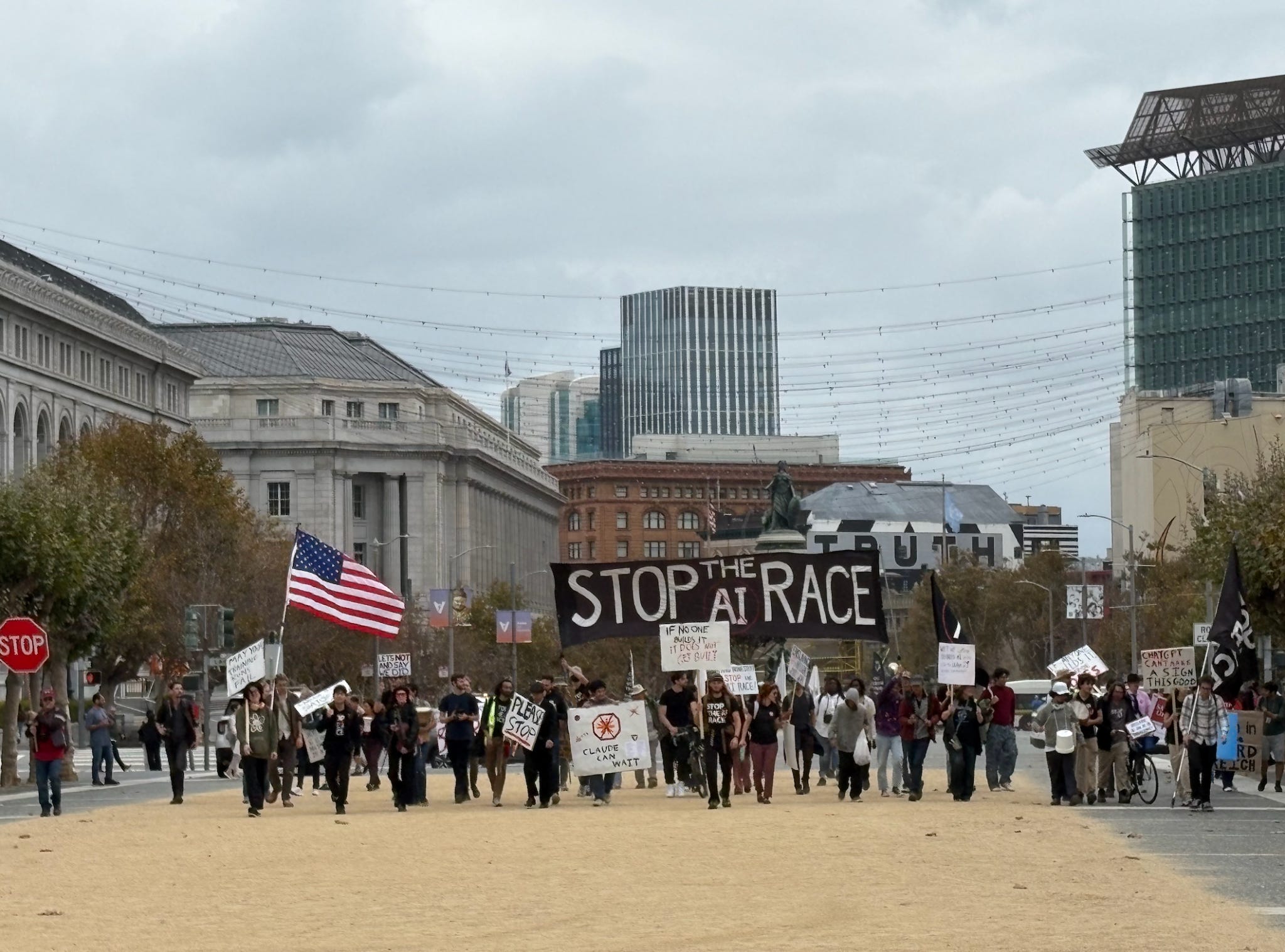
The activists with Stop The AI Race (STAIR) who did show up marched from OpenAI’s HQ, to Anthropic’s, to San Francisco City Hall, where they called on our mayor and board of supervisors to declare a state of emergency.
Guido Reichstadter, who led a monthlong hunger strike last year outside of Anthropic’s headquarters, said from City Hall’s steps: “We are in an AI emergency, and San Francisco is ground zero. Everybody knows this. The CEOs of the tech companies know it. They’ve been saying it for years. It’s an open secret that is so open that nobody’s noticed it.”
Between viral safety warnings and the data center boom, AI is now mainstream political discourse, and one of the only issues transcending ideological divide right now. I saw it firsthand in Wisconsin this summer — in a swing state with a famously unpredictable electorate, data centers are inciting AI safety concerns, and bringing politically split families and communities together to protest their city governments. More people show up regularly to protest AI development at town council meetings in central Wisconsin than in San Francisco itself. This one protest wasn’t a one-off. STAIR claims to have hosted the largest anti-AI protest in American history this July in San Francisco; it had only 400 people.
Most of us finally agree on something. AI’s pace of development and lack of regulatory structure is a breeding ground for an existential threat. Why is there no visible mass movement against it?
It’s definitely hard to choose a starting point. AI safety doesn’t just boil down to some amorphous mass extinction. It’s an economic and class issue with job replacement and a consolidation of power into a couple of massive Frontier companies, a security issue with mass surveillance and AI’s presence in the military industrial complex, a sociopolitical threat with misinformation, an environmental threat with data centers. Those are all facets of one issue. We’ve been successfully overwhelmed.
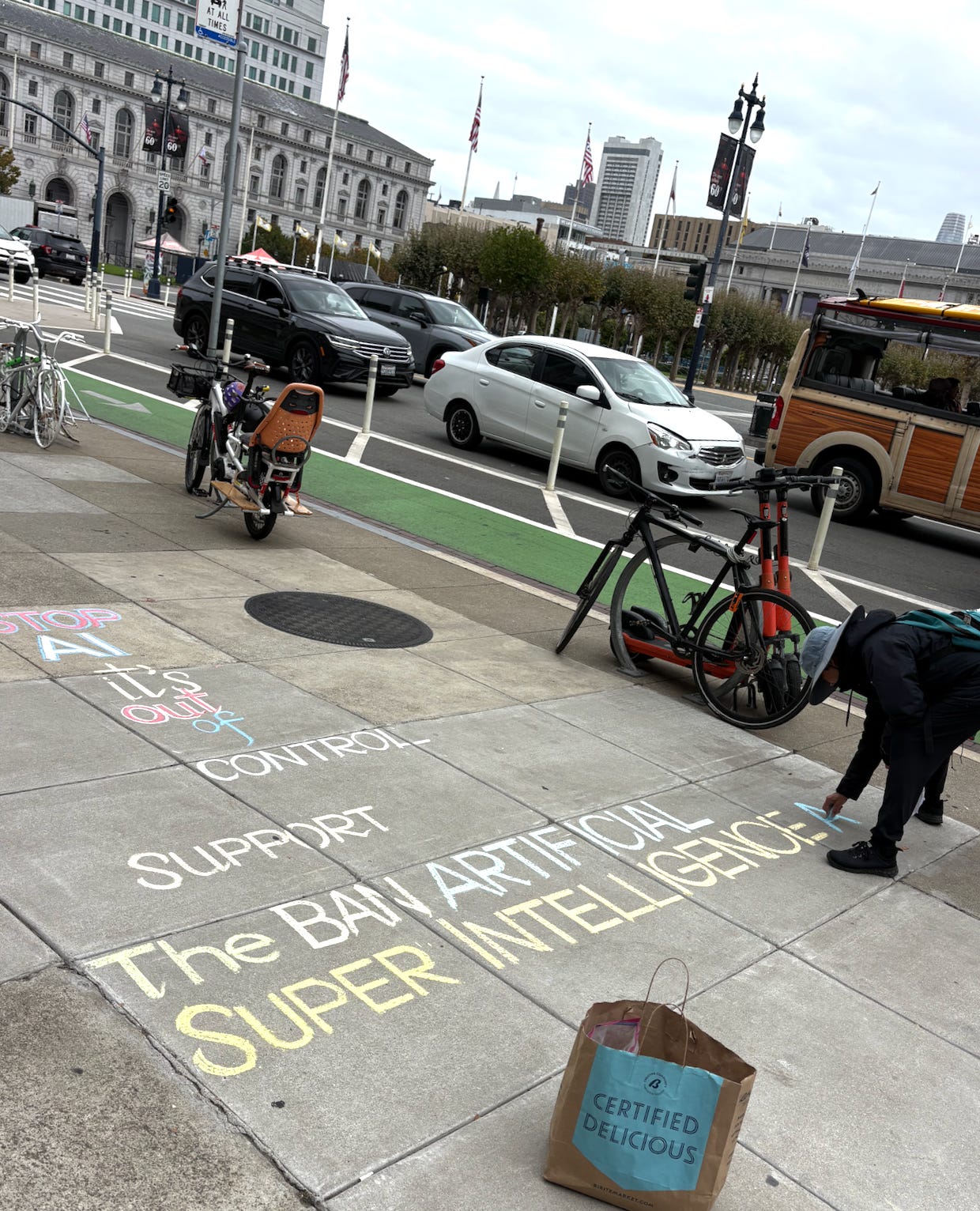
What does resistance look like, here? Swaying public opinion isn’t the goal; public opinion is clear. Development continues regardless. Developers seem so confident it will continue that they’re openly confirming the harrowing claims of their own whistleblowers. The language around AI that mirrors the language of the Space Race, emphasizing its advancement as an inevitability and a national duty, is an intentional choice that makes nihilism feel like acceptance. Regulation at a federal level is constantly reframed into a US vs. China national security narrative, even as President Trump tells the United Nations he “rejects any attempt to construct a globalist scheme to control” artificial intelligence.
AI is a decentralized technology. It’s possible that a successful civic action against its effects looks the same way. One massive anti-AI movement embodies so many problems that must be addressed individually. The people I met in Wisconsin this summer are, at least in some cases, winning tangible victories in their fight against data centers, because the fight is specific to a place where its consequences are visible. This fall, one of those places is the ballot box. As the same CEOs that advise Trump’s AI policies speak against regulation at Dreamforce, hundreds of candidates running for state and federal offices are centering AI and data center policy in their platforms.
The protest last week didn’t have the numbers, but they do have the public on their side. The question of who controls the future of AI safety hasn’t been definitively answered.