


The Democrats swept the midterm elections last night—a strong rebuke to rising prices, street executions by ICE, data center development, and tech oligarch money attempting to buy politicians and centralize power. Places like Kansas, South Carolina, and Texas saw historic upsets. The results prove that organized people, including younger generations, can beat organized money from billionaires and oligarchs.
While Elon Musk spent a staggering $446 million on the U.S. midterm elections this year, it backfired spectacularly—especially in Texas, the state he moved from California to in order to escape the “woke mind virus.” Texas now will have its first Latina Governor and a Democratic Senator. Beyond Texas, of the 21 races that Musk poured cash into, his candidates only won one.
While Musk may have the greatest means—and perhaps the most unhinged megalomania in his pursuit for power and ubiquity—he wasn’t the sole oligarch spending. The Brennan Center for Justice reports that “this election cycle, just 40 of the biggest donors gave $2.4 billion through mid-October, a record high for this point in the midterms since the Supreme Court decided Citizens United in 2010.” According to Americans for Financial Reform, “from January 1, 2025 through July 28, 2026, the eight crypto and AI PACs in the top 50 Super PACs spent over $100 million to influence over 70 Congressional elections in 28 states through independent expenditures.”
Yet it didn’t seem to work. And the blue wave will have serious ramifications for the future of tech, even if only on a state level at first. As a result of Governor Gina Hinojosa’s win, data center developers in Texas are about to run into her data center moratorium. Combined with Democratic gubernatorial wins in Iowa and Pennsylvania, Bloomberg reports that half of all planned US data centers face delays or cancellations. Even Elon now gets it:

Overall, it will be fascinating to see how the spineless tech chief executives shape-shift to adjust to this new political reality. It’s true that the Senate doesn’t have the 60 votes needed to overcome a filibuster, and Trump can still veto bills. But the election is a signal of what people are feeling and will be feeling in 2028, so long as this fascistic, people-diminishing regime continues.
Perhaps sensing this, OpenAI CEO Sam Altman changed his tone on X last night, a far cry from his doomsday prophecies of late:
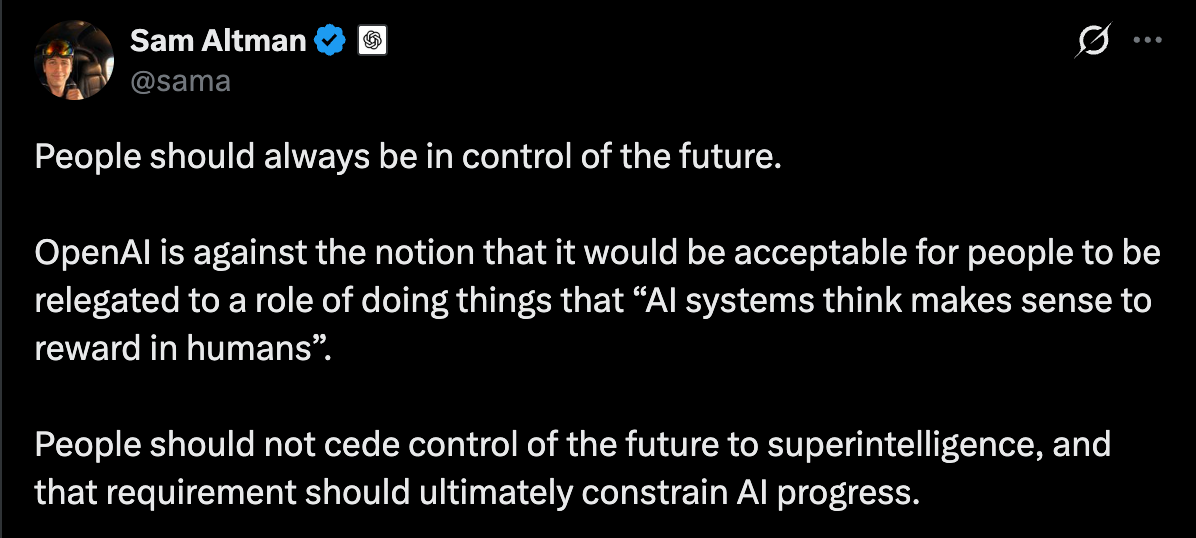
It may be a realization tech CEOs are confronting—that despite their sycophantic echo chambers, it turns out that gigantic, humming, polluting, faceless data centers are not popular among actual human beings. Nor is the premise of AI taking away our dignity of work, or our agency to form independent thoughts without the help of large language models
An NBC exit poll found that corruption, cost of living, immigration—and yes, AI and data centers—were among some of the most salient issues for voters. One in four voters expressed that AI and data centers were one of the big issue areas for them.
I think it’s been apparent for some time now that the Trump administration represents a kakistocracy, which is a system of government run by the least competent or qualified. But I suspect it has more recently become clear to voters that money in politics is unfair—not some sort of display of great might, or an example of America “winning.” Economic inequality is undeniably linked to data centers, AI, and the rich Silicon Valley types trying to buy elections.
Whether it’s the crypto firms getting favors to discreetly move money—or the entire AI ecosystem enriching themselves via circular deals to amass data, land, water, chips, and underpaid labor from developing countries—the midterm results have made it obvious that people realize that the current administration and many of its enablers are kleptocratic. Corruption will never be popular in a democracy, which luckily we still are.
It does seem paradoxical to me that while all of these tech elite chase immortality, space travel, private land, and a separation from the rest of us in common society, their billions of dollars and interest in the existing political system makes clear they actually want a whole lot to do with us mere mortals—so long as it involves control.
Americans saw through it. As The Beatles once said, money can’t buy you love.
What else we’re reading…
“Don’t be evil” Google is denying schools access to its search engine if they prohibit usage of AI—which may be an antitrust violation, in that it’s one company tying a product with huge market power to another product. They’re also imposing nondisparagement agreements on researchers “for the rest of their lives,” according to a contract reviewed by the Washington Post.
Speaking of employment agreements: Elon Musk threatened to sue Substack cofounder Hamish McKenzie for speaking publicly about his brief time as a communications hire at Tesla.
The bank Wells Fargo is requiring that customers take on responsibility and liability for any rogue AI agents that have access to their accounts.
Jill Hazelbaker, the former comms boss at Uber and Google, has left Uber to become chief corporate affairs officer at OpenAI. We wrote a bit about her in the context of Uber’s self-interested alignment with the taxi industry, and how the ridesharing firm is falling behind in the autonomous vehicle space.