


Happy last weekend of Pride month! Time for the traditional parades and traditional international Artificial Intelligence conferences!
Over 150 parades happened across the country this past weekend. In major cities, especially tech hubs like New York, Austin, Seattle, and San Francisco, Pride can be a sociopolitical wind sock for prominent industries. Last year, we saw overall corporate participation and sponsorships of major Pride celebrations drop. Organizers, and businesses themselves, attributed this to Trump’s return to office and intense attacks on DEI.
Tech wasn’t an outlier. In 2025 Amazon and Google were among major companies to noticeably scale down their acknowledgements and sponsorships of Pride. Meta did not acknowledge Pride at all last year. Their absence from their HQ city’s parade was very noted in San Francisco.
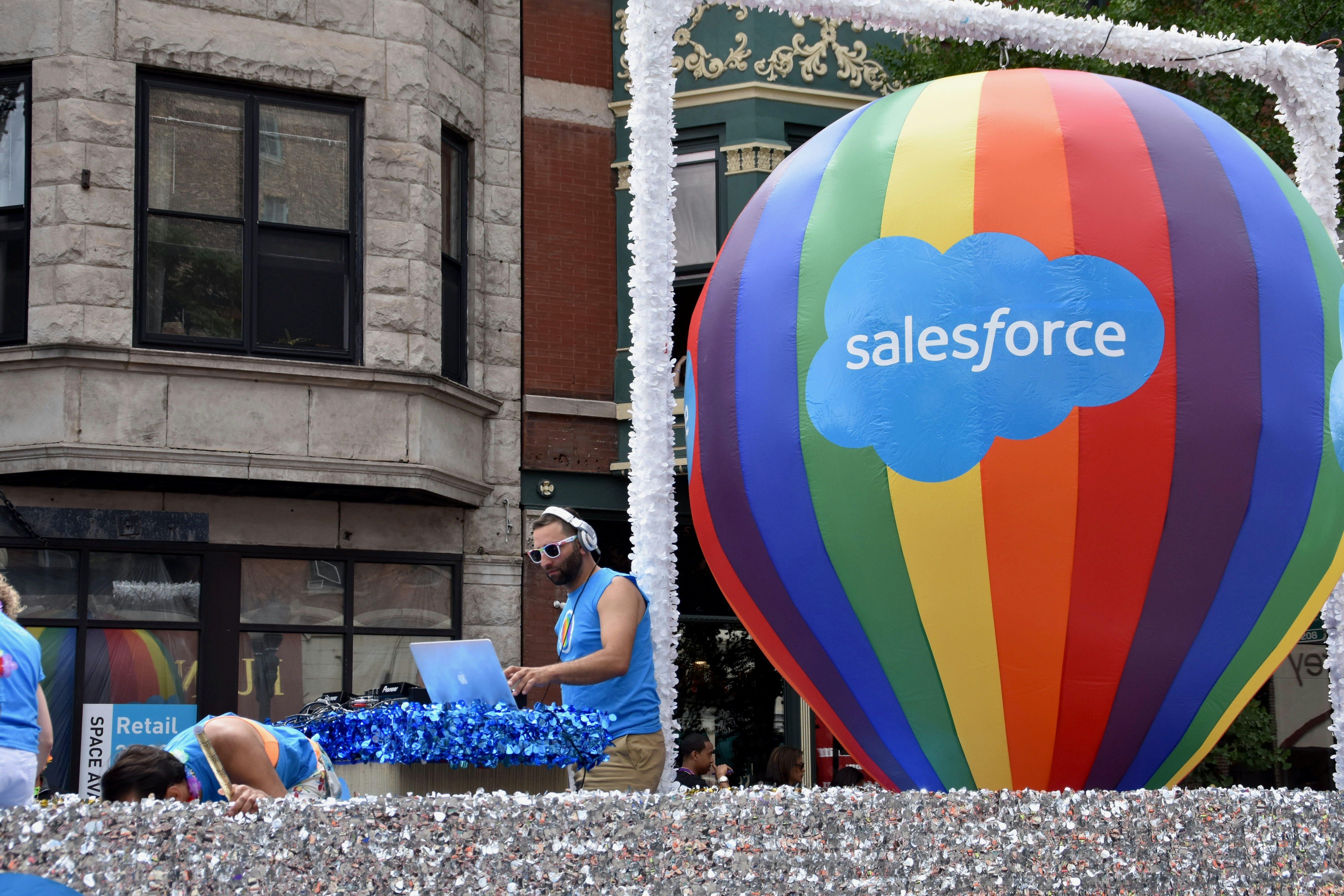
Like many young people flocking to SF for jobs in tech’s new gold rush, I got to experience San Francisco’s Pride parade for the first time this past weekend, and kept my eye out for rainbow tech logos. Amazon, Apple, Salesforce, and Zoox (a subsidiary of Amazon) participated. Meta, X, and Google, in a rare occurrence for the Bay Area, did not make their presence known.


In the best of times, we can dismiss corporate participation in Pride as rainbow capitalism. In the worst, I get to see a meaningful look on my friend’s face when they see their employer, Salesforce — home to a grueling entry-level culture I’ve written about — publicly endorse the validity of their identity when they have something to lose.
It’s far from altruistic, but it’s not nothing.
I was interested to see if any of the Frontier AI companies that have made homes in San Francisco would participate. They did not. OpenAI, Anthropic, and NVIDIA, to name a few, haven’t been around long enough to publicly fluctuate their support for diversity and equity with changing political climates, and possibly learned from their tech boom elders who have. There is little to no scrutiny of their absence in comparison with companies like Meta, who had a public falling out with San Francisco Pride. Most conversation in relation to AI at Pride concerned gay bars installing facial recognition devices that tracked the information and behavior of patrons.
After laying low throughout the weekend, AI was back to cultural preeminence with a duo of major conferences.
The fourth annual AI Engineer World’s Fair is back in town. Over six thousand engineers and researchers from around the world are attending in person. The schedule is overwhelming. There are over 400 official conference sessions. Themes range from security to tokenmaxxing. The cheapest tickets available were over a thousand dollars each. The only thing more exclusive than the conference are its side events and afterparties — freeform discussions about AI over ping pong, pickleball, World Cup watch parties, bar trivia, and run clubs. They require applications upon RSVPing that are reviewed by the host.
The Laude Institute held a one-day Open Frontier conference Tuesday in San Francisco with global leaders in AI research. The entirety of the seven hours of panel discussions were livestreamed on YouTube, then inexplicably made private early Wednesday morning. Before it was taken down, the description billed it as “A day of talks, panels, and conversation about what it means to keep AI research open at the moment it matters most.”
Opening speaker and moderator Andy Konwinski, co-founder of Laude, Databricks, and Perplexity, said openness and open access has historically been one of America’s competitive advantages in innovation.
“Open needs a heavyweight contender in the ring with the big labs, and we are it,” he said. “If we don’t do it, I don’t think anybody is going to.”
‘Open’ in this context does not refer to OpenAI, the company; as defined by TechTarget: “The practice of open AI entails openly sharing AI models, the provenance of training data and the underlying code. Closed AI obscures or protects one or more of these things.” To some high-profile participants, it also seemed to mean anti-regulation.
Bryan Catanzaro, Vice President of Applied Deep Learning Research at NVIDIA, said there’s a need to stand up for “the philosophy of pluralism,” and that he feels the anti-regulation perspective is “not heard loudly enough.”
“The voices that are calling for AI to be controlled, and basically closed, are coming at it from a position that it is somehow worse for us to be free to explore our ideas with AI,” Catanzaro said. “The history of technology shows that when things are open, people use them to build, to defend, and to explore in ways that are just really fundamental.”
Nathan Lambert, post-training lead at the Allen Institute for AI, said that AI will be the most powerful technology of our lifetimes, and therefore, one of the most closely regulated. He expressed concern of “[T]he top open models being banned in the next three to six months.”
Panels brainstormed aloud methods for raising the American public’s confidence and comfort with AI models, out of fear that public opinion correlates with regulation. Ion Stoica, professor of computer science at the University of California, compared American public sentiment on AI to China. He thinks the positive sides of AI are not being pushed enough by researchers.
“If you look at the sentiment, [China] is much more positive about AI than the US,” Stoica said. “We [researchers] are not enough, because the people are going to drive the politics. If 70% or 80% of the American public is going to be against AI, it’s going to impact regulatory framework.”
A coincidentally-timed poll this week illustrated bipartisan support for tightening AI regulation. More than two in three respondents were in favor of the federal government establishing “a formal review process for the most advanced AI models before they can be widely released.”
A participant summarized: “The talk of the town is mistrust.”
If a better relationship with the public is the goal, especially after a celebration of visibility they were notably absent from, Frontier AI may need to decide if openness and plurality are philosophies, or the theme of the week.