


Join Hard Reset at SXSW! Need a break from the chaos? Do you want to keep both Austin and tech weird? Are you a founder, engineer, or designer who is tired of building for the broligarchy? Come climb with us! No, really: Hard Reset is hosting a climbing getaway this weekend. We’ll kick off with a (coached!) climbing session at Crux Climbing Center Central, and follow it up with chats and beers from the Brewtorium next door. Register here.
California Governor Gavin Newsom will be termed out of office soon. The race for his successor is, in my humble opinion, equally meaningful as any midterms contest, including in the U.S. Senate. One in every 10 Americans lives in California. The California legislature, which has a Democratic supermajority, advances policies that are regularly adopted by other blue states. The California governor is an active behind-the-scenes participant in modulating those policies—bolstering them, watering them down, and killing them.
For his innumerable faults—and trust me, I shudder at the thought of a President Newsom, one of the most duplicitous men in politics—Newsom understands the gravity of his position. He knows that California is a country unto itself, and that the state’s governor is the de facto bulwark against President Donald Trump. When Newsom directly involved himself in California’s emergency redistricting ballot measure, he wasn’t solely doing so to strengthen his presidential bid. He correctly recognized that his state could easily squash the collection of punier red states trying to gerrymander at Trump’s behest. (Newsom is now using his remaining political capital to kill a one-time tax that would affect approximately 200 billionaires; again, duplicitous.)
California’s gubernatorial primary is less than three months from now, on June 2. It is a “jungle primary,” meaning it includes both Republicans and Democrats, and the top two vote-getters advance to the general election regardless of party affiliation. The field of candidates is frequently described as “crowded,” “uncertain,” and “without a frontrunner.” This is all true, but it’s also polite-speak for “remarkably bad.” Not what you want for the country’s most important gubernatorial role.
According to recent polling, Rep. Eric Swalwell, billionaire businessman Tom Steyer, and former congresswoman Katie Porter are registering support in the low- to mid-teens. They are the “leading” Democrats. The two Republicans in the field, Steve Hilton and Chad Bianco, are polling at a combined 30-ish percent. This has raised alarms among Democratic pollsters, who fear that both Republicans might advance to the general. Not going to happen, but it does seem likely one of the two—probably Hilton, a former U.K. spin doctor and Fox News host who’s the husband to powerful tech exec Rachel Whetstone—will secure enough votes to make it to November.
The unimpressive collection of candidates is reminiscent of New York City’s 2021 mayoral primary, when Eric Adams barely squeaked out a win against a blob of forgettable Democrats. Big Tech execs and other oligarchs in California seem to share my opinion, because they’re making a last-minute ploy to elevate their chosen stooge: San Jose Mayor Matt Mahan.
Like the other candidates in the race, Mahan, 43, has no sauce. He’s perhaps the most sauceless, actually, which is really saying something. Watch any interview with him, and you will see what I mean. His affect is unimaginably dry. Imagine a deadpan Norm Macdonald bit that goes on for 10 minutes, but there’s no punchline at the end.
Mahan’s CV is that he went to Harvard, worked in tech, won a city council seat in 2021, then immediately launched a mayoral campaign. He’s now running for governor, having yet to complete a full, four-year term in office. He’s a self-described pragmatist, though he’s not very good at triangulating. In January, for instance, he wrote an op-ed for the San Francisco Standard about why Newsom and Rep. Ro Khanna are both right and both wrong about stuff. Newsom is right to oppose a proposed wealth tax, but wrong to claim there is no “waste” and “fraud” in the California government. Khanna is wrong to back the wealth tax, and right to acknowledge there is “waste” in the California government.
For those of you following along, Mahan is adopting the conservative view that a wealth tax is destructive, and instead of collecting revenues from high-earners, the state should be “rooting out this waste, fraud, and abuse,” which “makes government more effective.” Speaking of sounding like DOGE, Mahan’s campaign manager is reportedly a 23-year-old conservative. The same report from the San Jose Spotlight noted that “President Donald Trump has mirrored Mahan’s platform on homelessness with an executive order in July calling for an end to ‘housing first’ policies in favor of forced treatment.”
Mahan was a late entrant into the governor’s race, announcing his candidacy at the end of January. It is very difficult to win a statewide election with only four months of campaigning, and indeed, Mahan is polling around 3% so far. If there were even a couple of decent candidates in the field, I would be ready to completely write off Mahan.
Alas. There is no leftist insurgent (I wish!). There isn’t a smooth-talking “popularist” who’s swaying voters to the center. There isn’t a convincing Goldilocks progressive who can unite various left-of-center factions. There are many, many Democratic candidates who think they fit these bills, but they do not.
Steyer’s leftward shift is undone by the fact that he’s a billionaire whose best-known campaign moment is when he danced to “Back That Azz Up” during the 2020 presidential primaries. Swalwell spent the last decade aimlessly wandering the halls of Congress, muttering, “Donald Drumpf. That’s It. That’s The Tweet.” Porter ran a terrible campaign for U.S. Senate in 2024, and is once again running a terrible campaign for governor. At the Democratic Party State Convention last month, she held up a mini-whiteboard that said “Fuck Trump.” Her polling has not yet improved, despite her subversive act.
Mahan has even less political talent than Swalwell, Steyer, and Porter, but he remains a long shot threat for one reason: money. He’s already accumulated more than $7 million in campaign funds, and a Mahan super PAC is cleaning up too. Among Mahan’s supporters are Google co-founder Sergey Brin, billionaire venture capitalist Michael Moritz, crypto billionaire Chris Larsen, and a bunch of other Silicon Valley founders who spend their days posting on X.
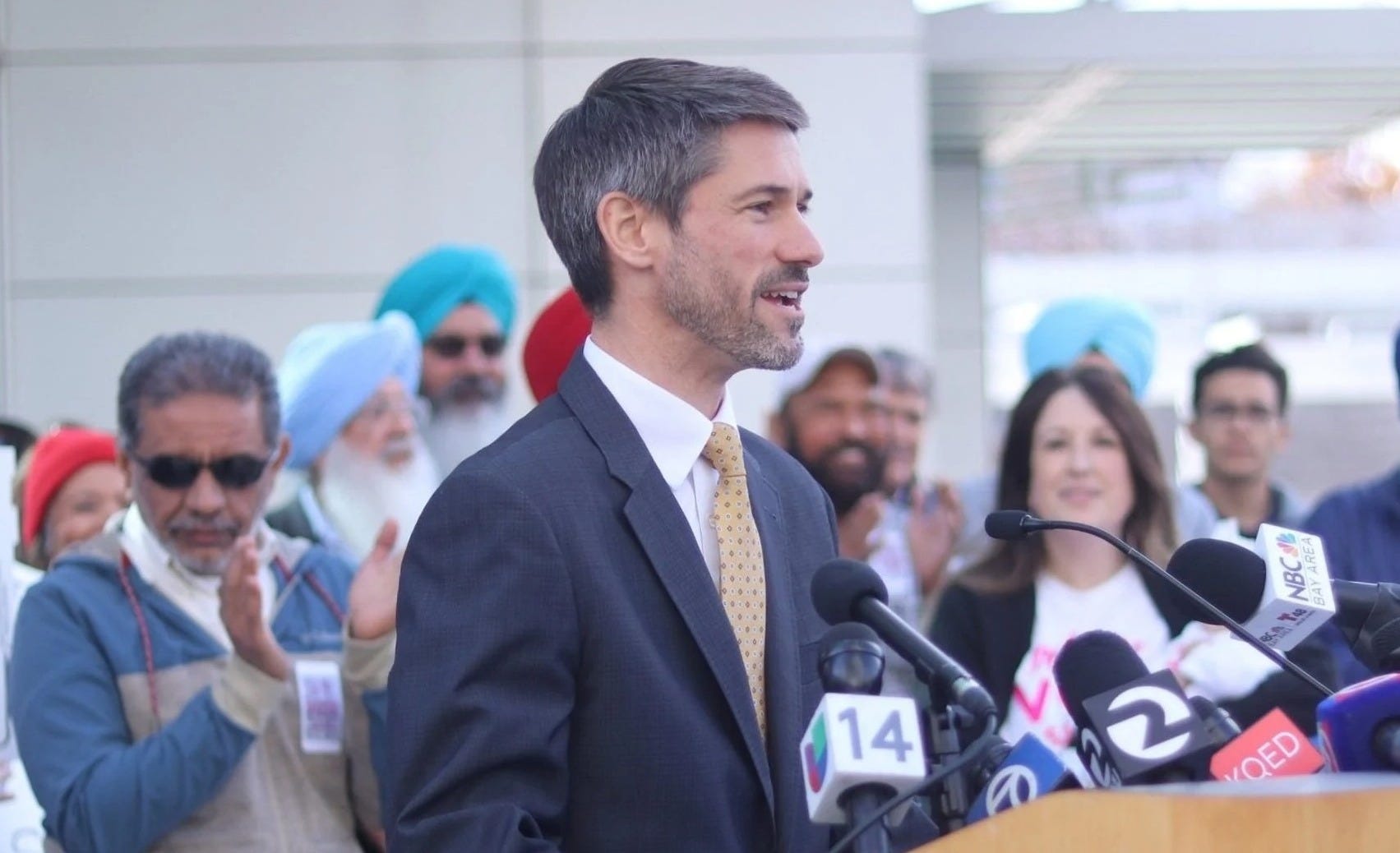
Those funds will undoubtedly be used to raise Mahan’s profile. If you live in California, you’re going to see a bunch of advertisements about cool, calm, and collected Matt Mahan until June 2. But I suspect Mahan’s coiffed messaging might run into some Katie Porter-esque snafus, shall we say.
In 2023, I blogged about a letter Mahan co-wrote and sent to Major League Baseball; the letter presented San Jose as a possible landing spot for the outgoing Oakland A’s, and cheekily argued that MLB should not “conflate San Jose with our smaller neighbor to the north, San Francisco.” The letter boasted that San Jose’s population “dwarfs” Oakland’s population. Later, in a TV interview, Mahan added, “Nobody going to a sporting event wants to worry about their car being broken into and in San Jose, they don’t have to.” He put an even finer point on it: “We are the safest big city in the Bay Area.”
I titled the blog, “San Jose mayor derides San Francisco, Oakland in renewed plea for MLB team.” Mahan quickly issued a response that he was not deriding anyone, just pointing out that his city “has less than half the property crime rate of other major Bay Area cities.” The same day, I fielded an angry phone call about the blog from Mahan’s camp. (It was off-the-record, so I will leave it at that.)
I’ve taken complaints from prominent figures and their flacks on numerous occasions—it’s part of the job. This experience really stuck out, though. Why were Mahan and his camp panicking over a blog that just… quoted him, with a headline he didn’t like?
Well, not quite three years later, Mahan is running for governor and needs to earn the support of voters in San Francisco and Oakland (and the rest of California!). I’ll give him this: he’s good at spotting an opening. That’s how he won his mayoral election, it’s why he tried to poach the A’s on their way out of town, and it’s the reason he’s parachuting into the governor’s race. I don’t think he’s got much of a shot, but having unlimited Big Tech money in a putrid field is better than nothing—and better than nothing is more than many of the candidates can claim.
Here’s what else we’re reading this week:
AI researcher Zoë Hitzig, who wrote a NYT essay about why she quit OpenAI (and then spoke in-depth about her decision with my Hard Reset colleague Ariella Steinhorn), is joining Anthropic as a founding member of a new effort called the Anthropic Institute. According to a company press release, the Anthropic Institute “will draw on research from across Anthropic to provide information that other researchers and the public can use during our transition to a world containing much more powerful AI systems.”
Grammarly was sued this week over its ridiculous, short-lived “Expert Review” feature, which purported to provide editorial feedback from famous journalists and authors. The problem with the feature—one of many problems, actually—is that “Expert Review” was just an AI chatbot emulating real people, and Grammarly did not obtain permission to use famous journalists’ and authors’ likeness, according to the class action suit. Grammarly wound down the “Expert Review” feature and apologized for it before the class action suit was filed. I am not a lawyer, and have no idea if Grammarly’s preemptive retreat will make a difference in what otherwise seems like a pretty cut-and-dry case.
In a new, characteristically meandering interview with CNBC, Palantir CEO Alex Karp said he didn’t support America’s prior wars because they were premised on regime change. He does, however, support the Iran war, which he called a “policy,” rather than a war, because he’s decided it’s not premised on regime change. I do not agree with Karp. The United States just killed Iran’s Supreme Leader, and President Trump has intermittently mused that he will pick Iran’s next leader. That sounds like attempted regime change to me, but I am looking at the situation from a different lens than Karp, whose company is powering the Pentagon’s Maven AI battlefield system, which is being used in Iran to surveil and target alleged combatants.
Speaking of Maven, the subject of my previous newsletter: reporting indicates there are three plausible explanations for the U.S. military’s strike on an Iranian school, which killed at least 175 people and is now drawing scrutiny from Democrats in Congress. The first explanation is that the U.S. military intentionally targeted the school. I think this is totally possible and deserving of more consideration. Explanation two is that the U.S. military was using outdated intelligence about the target area, but there were no AI tools in the mix. This seems the least likely to me. Explanation three is that Maven had outdated surveillance data, or otherwise erred, and the “human in the loop” fired on the school because of Maven’s erroneous intel. All three explanations are appalling. AI’s role seems increasingly likely, if you read between the lines of this recent Washington Post report.