


Matt Scherer is a fellow at the Open Markets Institute, where his research and advocacy focus on developing policy responses to the eventual bursting of the AI bubble. His Hard Reset pieces focus on highlighting the risks posed by the AI bubble and pushing back against the hype that is inflating it. The opinions expressed here are solely his own.
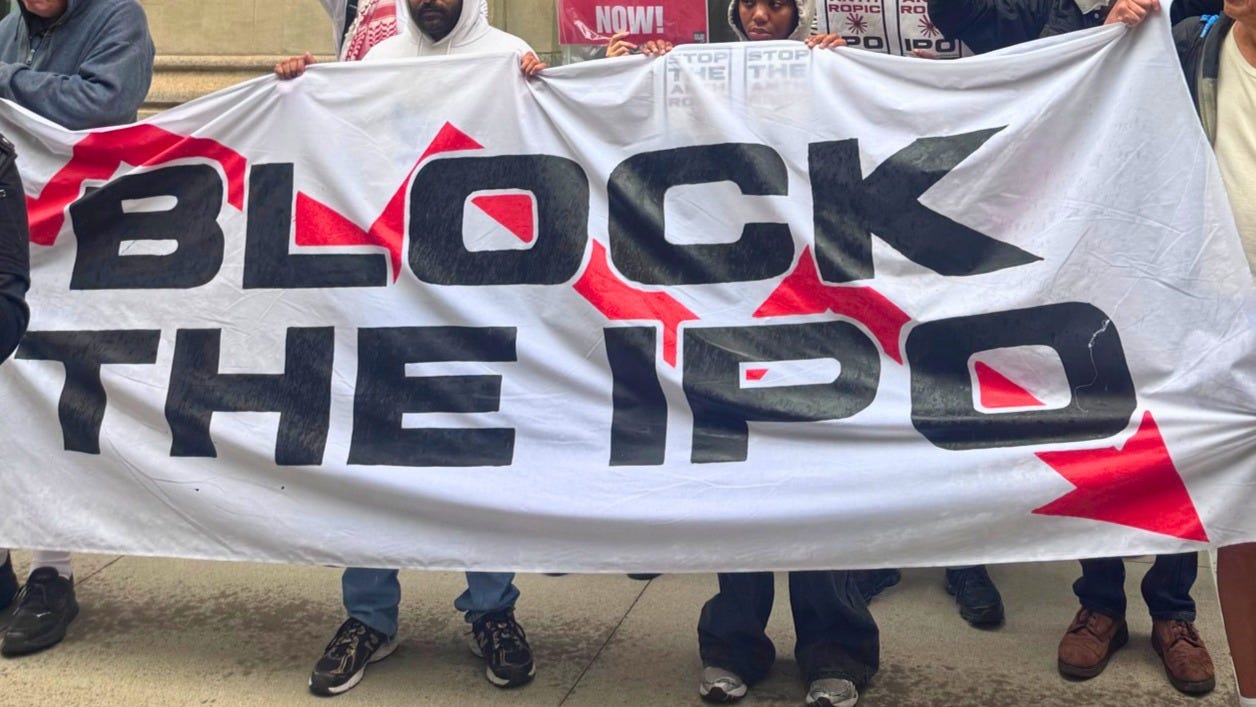
Last week, New York City Comptroller Mark Levine sent Anthropic a letter asking it to “pause” its initial public offering (IPO), which is currently expected next month. Levine’s letter points to Anthropic’s “unusually direct public statements acknowledging that the pace of frontier-model capability development may now exceed society’s capacity to understand and control the resulting systems” as the reason for delaying the company’s stock market debut.
I’m not here to litigate whether those Anthropic statements should be taken seriously or dismissed as a stealth marketing campaign designed to showcase the supposed power of its AI models (though, more on that later). Instead, I want to focus on a separate issue: there is strong reason to distrust the information the company provides the public regarding its finances, and that provides a clear legal basis for the Securities and Exchange Commission (SEC) to block the company’s planned IPO. Allowing Anthropic’s massive IPO to go forward would threaten to further destabilize capital markets that are already dangerously dependent on the speculative and increasingly teetering AI trade.
Publicly traded companies must release audited financial statements every quarter showing their actual revenues, expenses, and other key financial information. Privately held companies, even if they have trillion-dollar valuations and hundreds of billions of dollars in off-balance-sheet obligations, need not do so. Anthropic, like many Silicon Valley startups, has taken advantage of that loophole by occasionally and selectively leaking information about its finances to reporters, most notably a metric called revenue run rate.
Run rate is a dubious projection that takes a company’s revenues over a recent period and calculates what the company’s revenues would be if it sustained that performance for a full year; it does not reflect the company’s actual annual receipts. That enables a company to, say, wait until it has an unusually lucrative month, multiply that month’s revenues by 12, and represent the resulting figure as its “annualized” revenues — even if the company has not made close to that amount of money in any actual 12-month period. For example, Anthropic announced a run rate of $9 billion at the end of 2025, but when forced to disclose its actual revenues in a court filing, the company revealed that its revenues were closer to $5 billion over the course of 2023, 2024, and 2025 combined.
Because run rate is non-standardized, it is difficult for outsiders to know what an announced run rate includes. That can be a boon to companies with shaky finances because it allows them to project an artificially rosy financial picture by cherry-picking when and how it calculates and announces its run rate. But the past couple weeks have shown how this gambit does more to mislead than inform as well as how run rate announcements can backfire when a company’s revenue growth slows.
The first illustration of that came in late September, when some news outlets reported that the run rate of OpenAI, Anthropic’s archrival, was approaching $70 billion. But earlier this month, the Financial Times reported that the ChatGPT maker’s run rate was closer to $50 billion — nearly 30% lower. The discrepancy apparently arose, as Bloomberg reported, because “Anthropic counts as its revenue the gross amount of certain sales through cloud partners like Amazon, while OpenAI recognizes only its share of revenue generated from such partners” (emphasis mine), and someone failed to account for that distinction when trying to make an apples-to-apples comparison.
The italicized bit should have received more coverage than it did. At best, it shows that run rate basically means whatever a company wants it to mean and that model developers’ incestuous relationships with cloud providers make it easy for them to manipulate the financial information they report to the public. The incident starkly illustrated how little markets know about the actual financial performance of the two companies whose performance will ultimately determine whether the multi-trillion-dollar AI build-out generates enough revenue to cover its costs.
Less than a week later, another Financial Times report revealed that Anthropic’s revenues for the third quarter came in at $16.8 billion, or $67.2 billion on an annualized basis. Early news coverage spun the figures in a positive light, emphasizing that Anthropic’s revenues had grown 50% from the previous quarter as well as the fact that Anthropic told investors that it had achieved a profit “on an adjusted basis.” The best analysis of the latter claim came from the FT story’s comments section:

Shame on FT for printing that claim without pressing Anthropic to specify what the “adjusted” profitability calculation includes and excludes. But the bigger issue is that Anthropic told investors (again) that it is “profitable” when it almost certainly was not (today, the Wall Street Journal reported that Anthropic actually lost a staggering $81 billion in the first half of 2026), and that someone — most likely one of Anthropic’s investors or financiers, if not Anthropic itself — used the press to communicate the clearly misleading “profitability” claim to the public.
But despite these efforts at positive spin, the financial commentariat soon pointed out that the $16.8 billion revenue figure actually showed that Anthropic’s revenues had effectively stopped growing. That is because Anthropic had announced a revenue run rate of $65 billion as of the end of July, which comes out to $16.25 billion per quarter. Had its revenues continued to grow quickly over the next two months, one would expect its Q3 revenues (covering July, August, and September) to be substantially higher. Instead, its full Q3 revenues came in just 3% higher than its July run rate.
Perhaps there is an explanation for this that will allow Anthropic to shore up the deteriorating perception of its finances. But regulators should not be fooled. The most generous interpretation of the leaked information regarding its revenues and profitability is that Anthropic’s finances are so opaque that even sophisticated investors and financial journalists have trouble deciphering them. The more ominous possibility is that Anthropic and/or its financiers are actively attempting to mislead the public regarding the model developer’s financial condition.
That provides a more-than-sufficient basis to block Anthropic’s IPO until the public can get a clear and reliable picture of its financial condition.
Before a company can go public, the Securities and Exchange Commission (SEC) must approve its registration statement. The SEC can delay or block an IPO if it believes a company’s registration statement, which includes information on the company’s finances, is “on its face incomplete or inaccurate in any material respect.” SEC guidance states that the regulator “will not declare a registration statement effective if the staff has reason to believe that the disclosure is incomplete or inaccurate in any material respect.”
There is, at this point, little reason to trust and every reason to doubt any financial information that Anthropic provides to the public. The SEC should refuse to approve its registration statement until it provides two consecutive quarters’ worth of audited financial statements. Ideally, given the possibility that Anthropic or those acting on its behalf are attempting to mislead the public regarding its finances, the SEC should demand that those disclosures do not merely match but exceed the financial transparency expected of public companies.
Anthropic’s recent musings about the potential for its technology to destroy civilization provide an additional reason for regulators to delay its IPO, regardless of the motivations for those statements. If senior researchers and executives at Anthropic sincerely believe that there is a significant risk that the technology upon which its entire business rests could escape their control and cause human extinction, then the company is too dangerous to exist, much less be given access to public capital markets. If, on the other hand, the statements are a disingenuous publicity stunt, that deception provides still further reason to distrust the information in the company’s registration statements.
The economic consequences of letting Anthropic’s IPO proceed now could be serious, particularly with OpenAI gearing up to go public in the coming months as well. Stock markets are already historically overvalued relative to their earnings and disproportionately concentrated in a handful of tightly interconnected mega-cap companies from the tech sector. That has already created a risk of a historically damaging stock market crash; never before has such a huge amount of wealth depended on the performance of a small number of companies whose fortunes are inextricably linked. Adding another huge, unprofitable tech giant (much less two) to public exchanges would exacerbate both of those factors and create a higher risk of contagion if (or, rather, when) Anthropic reaches a financial precipice.
The SEC has the authority to stop that from happening. The agency should use it.