


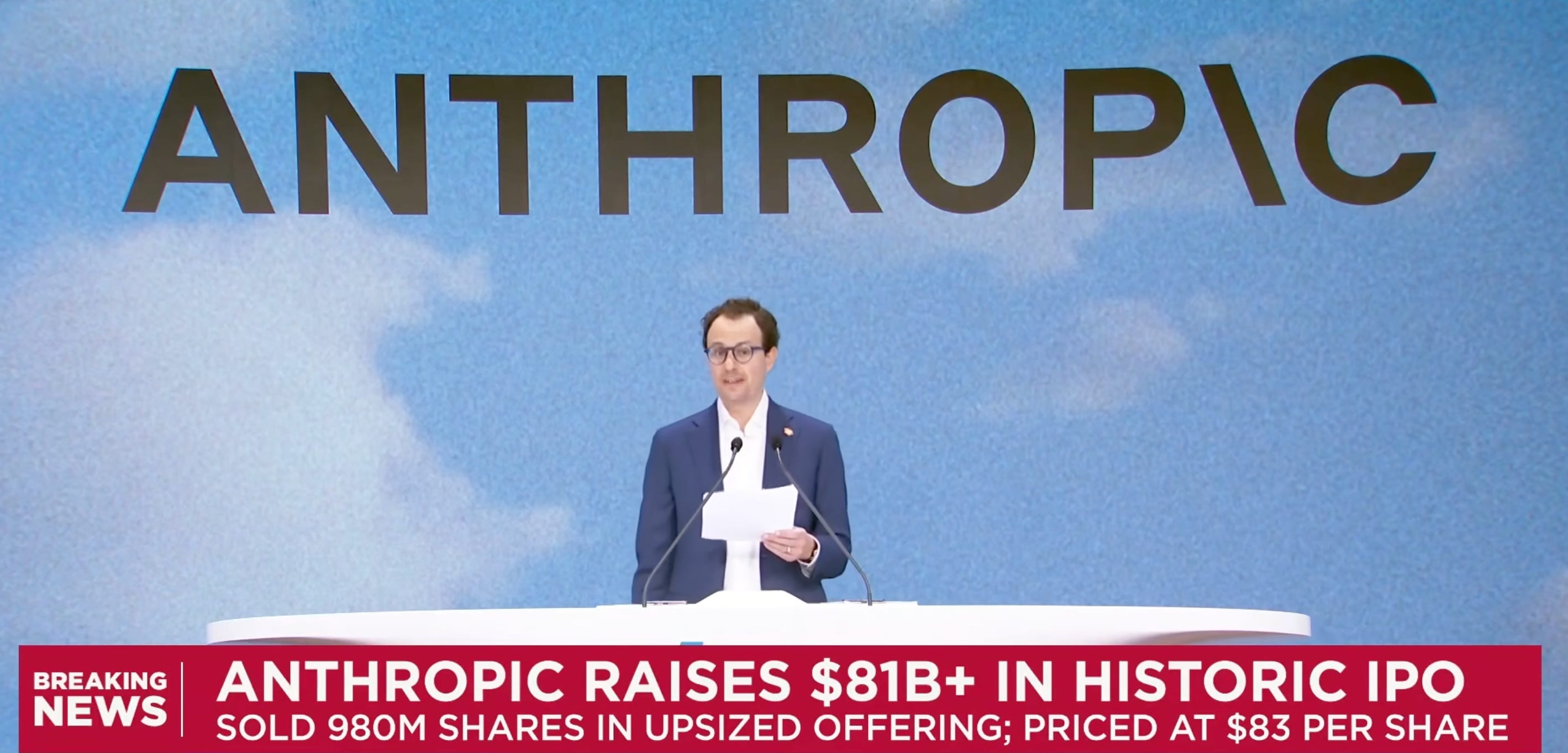
Anthropic, the AI company behind Claude, went public on Thursday. I have enjoyed reading the New York Times’ live updates about ANT—its Nasdaq ticker symbol—where multiple finance reporters have been tasked with updating us about stock going up, then stock going down. As of this writing, stock is up, but stock is down from the “pop” period after trading opened. I am furrowing my brow and twirling my mustache at these important economic developments.
Jokes aside, Anthropic’s IPO is a huge deal. Anthropic surpassed OpenAI and is the first dedicated frontier AI lab to go public. The company’s Form S-1 filing gave a little something for everyone: impressive revenues offset by unsustainable expenditures, and apocalyptic warnings that AI might cause the end of the world. Anthropic’s largest private investors reportedly include prominent Silicon Valley venture capital firms, plus Amazon, Google and Microsoft. Big Tech made its bet, and now…gaaaaah.
One of many post-IPO outcomes is that Anthropic now employs a bunch of newly minted billionaires and multimillionaires who are either out-and-out effective altruists, or are hiding in plain sight, or are at least EA-curious (EA is the broadly accepted acronym for effective altruism). I do not consider this to be a good thing.
The Centre for Effective Altruism defines EA as a philosophy “that encourages people to combine compassion and care with evidence and reason to find the most effective ways to help others.” I am giving you that definition to be fair to their side of things.
The Economist, which recently ran a cover story about effective altruism, correctly noted that “what began in the 2000s as a geeky way to make charitable giving more cost-effective has changed into a movement that subjects the world to complex, even bizarre, moral calculations.” This is especially pertinent for the AI industry. If you have ever heard an AI executive or researcher make an unsettling, hyperspecific prediction about AI superintelligence and the fate of societies, there is a pretty decent chance they are working off of an effective altruism framework. Many effective altruists are also longtermists—their beliefs and decisions are shaped by what they deem to be in the best long-term interest of humanity.
An extinction event caused by AI is a major fear of effective altruists. There’s lots of overlap between effective altruism, longtermism, and AI safety, as CNN broke down ahead of Anthropic’s IPO: “If catastrophic risk from AI is possible—as Anthropic has repeatedly claimed—then, the thinking goes, it is important for the ‘good guys’ to control the technology,” wrote senior reporter Allison Morrow.
The most infamous effective altruist is Sam Bankman-Fried, a convicted fraudster who demonstrated the excesses of the movement. Namely: that it emboldens a subset of offputting tech figures to rationalize their hubris and selfishness. EAs are smarter than the rest of society—they have a better grasp on what is happening now, and certainly what will happen in the future—and thus, know better than everyone else where their riches should go. Somehow, this is all supposed to be different from what other wealthy people do: stockpile and then sometimes contribute a slice of their net worth to their own philanthropic pet causes.
Dario and Daniela Amodei, two of Anthropic’s co-founders, have tried to distance themselves from effective altruism, and they’re smart to do so, given that SBF made the whole enterprise look like a sham. The Amodei siblings are full of it, though. A recent New York Times investigation traced Dario’s involvement in effective altruism back to 2008. He got involved with GiveWell, an EA-centric organization that recommends charities based on their potential impact. The Times spotted a 2010 blog post from Amodei that illustrates the thought process of an effective altruist; Amodei was debating whether to give $10,000 to a group that worked to prevent adult tuberculosis or a group that administered vaccines to African children. He originally leaned toward the tuberculosis group because “I think an adult death is perhaps 2 or 3 times worse than an infant’s death,” he wrote. According to the Times, he later changed his mind. For the record: I think assigning numerical value to human life for the purposes of a charitable exercise is unbecoming, alienating behavior.
As the Times reported, Dario Amodei became good friends with Holden Karnofsky, a co-founder of GiveWell. Then Daniela Amodei married Karnofsky. Their wedding site, from 2017, says that they are “both excited about effective altruism.” Other Anthropic co-founders reportedly showed a strong interest in effective altruism when they lived together in a San Francisco home.
Nevertheless, in a 2023 podcast interview with the Times, Dario said he didn’t consider himself an effective altruist—though he admitted he’s “very sympathetic to a lot of it.” In 2025, Daniela—who, again, is married to a pioneer of the effective altruist movement—said the following to Wired: “I’m not the expert on effective altruism. I don’t identify with that terminology. My impression is that it’s a bit of an outdated term.”
C’moooon. Anthropic explicitly encourages new hires to commit a portion of their equity to charities. It also announced a public benefit fund committing a portion of shares to charities and “specific populations.” After speaking to dozens of employees, Jasmine Sun wrote for the New York Times that “the most common form of I.P.O. talk involves discussions of where to allocate the newly liquid stock in their charitable donation accounts.” Other employees have reportedly suggested that their charitable donations will be portioned off to EA-oriented organizations.
On Nov. 15, an AI safety nonprofit called Palisade Research released an interview they conducted with a current Anthropic researcher named Tao Lin, who refers to himself as a longtermist and believes that “superhuman AI” will be achieved by the end of 2027. By that, Lin means AI is “as good as, or better than the best expert at almost every field. That includes programming. It includes making movies or politics or literally anything.” Lin fires off his estimates about AI destroying humanity (20%) and taking over the world (less than 50%). Later, he states, “The most predictable effect is everyone losing their current jobs, everyone needing to move to a different occupation briefly, and sometime after, being completely unemployable and needing to rely on the state to provide for them financially with no hope of finding employment ever again.”
At one point, the interviewers tell Lin that his predictions are going to anger people. “People should be angry at me and everyone else developing AI,” Lin responds. “It’s really not that bad to have people be angry at you, you know? We live in a bubble, I won’t meet those people.”
Lin isn’t representative of all of Anthropic, nor are the Amodeis representative of every worker at Anthropic. (We at Hard Reset remain very pro-tech worker!) But there are some undeniably troubling dynamics developing here. Post-IPO, the average Anthropic employee is now reportedly worth roughly $40 million. More than 400 employees are now worth more than $100 million. The co-founders’ net worths are now at least $20 billion each, according to the same CNBC report.
Some of the charitable donations of Anthropic’s newly minted billionaires and multimillionaires are going to annoy me. Fine. Nothing I can do about that. It’s the dead-eyed, dissociative, conceited philosophy underpinning these charitable donations that worries me much more. As a company, Anthropic seems to genuinely believe that it, and it alone, grasps the existential safety risks of AI. Its leaders can save us. Will save us. Or at least they’ll try. So long as they’re taking a utilitarian approach, they’re doing enough.
Forgive me for not being a longtermist, but: they are out of their minds. My near-term, in-this-lifetime concern is that Wall Street has given more capital and legitimacy to an AI company run by absolute weirdos. It was always trending this way, but now it’s harder to deny: Anthropic’s successes and failures are increasingly our successes and failures. What Anthropic characterizes as a success or failure is the scariest part of this entire experiment.
Here’s what else we’re reading this week:
Elon Musk said he’s not MAGA and doesn’t know what MAGA means. He is lying or deluded or (probably) both.
Vals, an independent AI evaluation startup, tested whether or not advanced frontier models would comply with commands to conduct autonomous drone attacks. The results from the research report are harrowing. The models “regularly misidentified civilians, ambulances, surrendering soldiers and a school in Iran as military targets,” according to a Bloomberg write-up. Anthropic’s models performed the worst during simulated scenarios.
Anduril CEO Palmer Luckey, a man who wears Hawaiian shirts and cargo shorts everywhere he goes, is claiming that his proposed seastead—a floating, libertarian hellscape where he gets to make up the laws—is somehow a high-minded and patriotic alternative to other seastead proposals, which are simply the unimaginative musings of Americans who want to “escape the US and smoke pot,” he wrote on X.
JD Vance last-minute canceled his DealBook Summit interview because, he says, he needed to attend very important meetings about a string of recent tech outages. I do not believe him.
On a Wednesday all-hands call, interim Nvidia CEO Colette Kress reportedly promised employees pay bumps and more equity. May that be a lesson to other tech workers: if your CEO becomes the most scrutinized man in the world and abruptly departs under a swirl of controversies that probably won’t resolve for years—and that creates a power vacuum at your company and instability across an entire industry—then your interim boss will likely offer you a raise. Nice!
Former Uber CEO Travis Kalanick went on TBPN—the No. 1 podcast for white guys whose tic is vigorously nodding their heads and saying “for sure”—and made the empirically incorrect assertion that “the majority of humanity” is “super pumped” at the idea of Jensen Huang returning to Nvidia. Kalanick, who resigned as CEO of Uber in 2017 because he ran the company like a horny teenager playing “The Sims,” has made Huang’s unlikely return to Nvidia a pet project of sorts. I’ll refer Kalanick to what he said in March of 2017, when he was caught on camera lambasting an Uber driver: “Some people don’t like to take responsibility for their own shit. ... They blame everything in their life on somebody else.” True!