

Early autumn has a well-deserved reputation for being a cruel time for markets. The Panic of 1873, the Great Crash of 1929, 1987’s Black Monday, and the most acute phase of the 2008 financial crisis all unfolded during the six weeks spanning the middle of September and the end of October. This October ended without anything quite so dramatic happening.
Or is October simply lasting longer than usual this year?
Markets have taken a pounding over the past several weeks, with stocks and bonds linked to the AI trade suffering the most. That matters because the AI industry plays an outsized role in both stock markets and debt markets. A sustained loss of confidence in Silicon Valley and Wall Street’s thesis of imminent AI transformation would put tens of trillions of dollars worth of stocks, bonds, and other assets under threat, raising the risk of a potentially devastating crash. That makes Anthropic’s planned initial public offering (IPO, essentially a stock market debut) later this month a pivotal event for the AI trade.
Given the likely consequences of an AI crash, it might be tempting to think that a successful Anthropic IPO is the least-bad outcome. But the planned IPO has taken on magnified importance precisely because the market is correctly losing confidence in both Anthropic and the AI industry as a whole. Plowing ahead with the IPO might restore the market’s confidence for a time, but it would not improve the fundamental weaknesses of either Anthropic or the AI industry. It would simply transfer risk from Silicon Valley and Wall Street to ordinary people.
A recent report that I co-authored with Maya Jenkins of Americans for Financial Reform argued that the AI ecosystem has three glaring points of fragility:
The three leading model developers, namely Anthropic, OpenAI, and SpaceX;
The “neoclouds,” the term of art for companies that focus on leasing access to AI chips to model developers; and
Oracle.
Ominously, but unsurprisingly, those three weak links were the first to show signs of strain this fall. That, in turn, exposed the broader and deeper-seated anxiety about the sustainability of the AI boom that has rocked markets for the past several weeks.
The first signs of trouble came from Oracle, which is spending almost as much on AI infrastructure as Amazon, Google, Meta, and Microsoft but lacks the monopoly revenues that its larger rivals enjoy. That has forced Larry Ellison’s company to take on an extraordinary amount of debt to keep pace, leaving Oracle with little margin for error as it races to bring new data centers online to sell AI chip access to model developers, especially OpenAI.
So investors were alarmed when, in late September, Oracle signaled that it would not be able to bring one of its flagship data centers online on time due to rising costs and uncertainty over how to power the facility. Oracle’s credit risk indicators soon hit new all-time highs, signaling deep anxiety among investors that Oracle might default on its debts.
At the same time, investors started to realize (however belatedly) that the finances of Anthropic and OpenAI were more opaque and tenuous than they had believed. First, news broke that OpenAI’s annualized revenues were significantly lower than previous reports had suggested. Then, analysis of Anthropic’s leaked Q3 revenues showed that the Claude developer’s revenues had slowed to a crawl over the summer.
Later in October, Anthropic filed its prospectus with the SEC ahead of its planned IPO. The prospectus’s financial disclosures earned bizarrely fawning headlines from the legacy media, but by far the most notable revelation in the document was that Anthropic has taken on nearly $900 billion in off-balance-sheet debt, an amount more than 25 times their annual revenues. Investors understandably started balking at Anthropic’s proposed valuation.

But it was the neoclouds that had, by far, the cruelest October. Firmus, an Australian neocloud whose co-founder was previously best-known for being convicted of insider trading (quite fitting for the circular-financing-driven AI industry), had been gearing up for an October stock market debut. It entered negotiations with investors at a proposed valuation of $30 billion — an absurd figure that was over 500 times the company’s $51 million in annual revenues. When investors blanched, the IPO fell apart.
That shook the market’s confidence in other neoclouds, particularly U.S.-based CoreWeave, a former cryptocurrency mining firm that has taken on a massive amount of debt, much of it at eye-popping interest rates. CoreWeave’s already-teetering bonds sank in the days following Firmus’s failure to launch, with indicators of credit risk suggesting that investors believed there was a 60% chance that CoreWeave would default on its debt within five years.
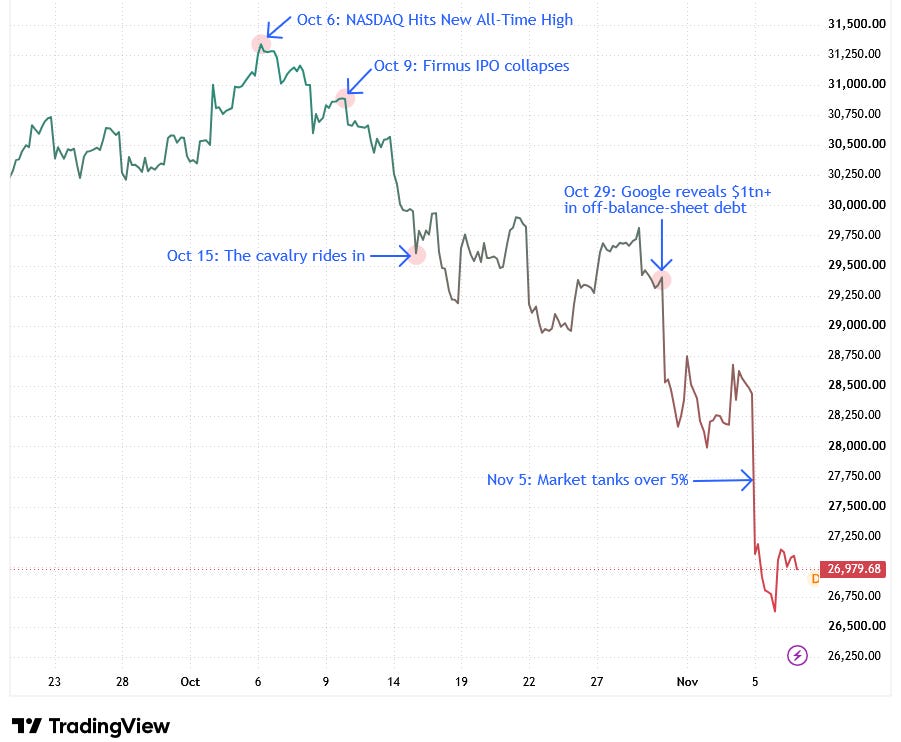
At this point, the AI boom’s cavalry — Silicon Valley and Wall Street titans — rode in to try to calm markets. Deutsche Bank, Goldman Sachs, and JPMorgan Chase each expressed confidence in CoreWeave’s ability to service its debts and encouraged investors to buy CoreWeave’s stock. Nvidia CEO Jensen Huang said that CoreWeave’s “strength is improving every day” despite its deteriorating stock and rising borrowing costs.
These are not exactly disinterested observers; CoreWeave owes money to all three banks while The Economist dubbed Nvidia “the central bank of AI” because of its extensive financial backing of smaller AI companies, including CoreWeave and Firmus. Nevertheless, these votes of confidence heartened investors intent on “buying the dip,” a strategy where investors take temporary falls in bull markets as an opportunity to buy more shares. The AI trade got a further boost from some well-timed solid earnings statements, particularly from several chipmakers, server-maker Super Micro, Microsoft, SpaceX, the latter of which saw a surge in revenue from renting access to its AI chips to Anthropic.
The combination of support from Silicon Valley and Wall Street elites, dip-buying, and strong earnings statements from AI infrastructure companies had been enough to sustain the AI trade through all its previous moments of anxiety. In October, it succeeded in slowing, but not reversing, the market’s slide.
The next big tremor came on October 29, when Google reported a staggering $1 trillion in AI-linked purchase commitments. The following morning, as the last trading day of the month opened, news broke that Anthropic might go into its IPO with a junk credit rating. Markets tanked again, and the NASDAQ closed out October down more than 5% on the month.
Markets initially rallied after the Democrats’ overwhelming victory in the midterms, but then fell sharply on Thursday after Wall Street apparently realized that that might mean an end to the complete lack of oversight the industry has enjoyed over the past two years.
While stocks ended the week on a high note this past Friday, the AI trade is now on perhaps its shakiest footing since the release of ChatGPT kicked the tech boom into high gear four years ago. The NASDAQ is down over 13% from its October 8 peak.
The numbers are far worse for the weaker corners of the AI industry. Oracle is down nearly 30% from early September.
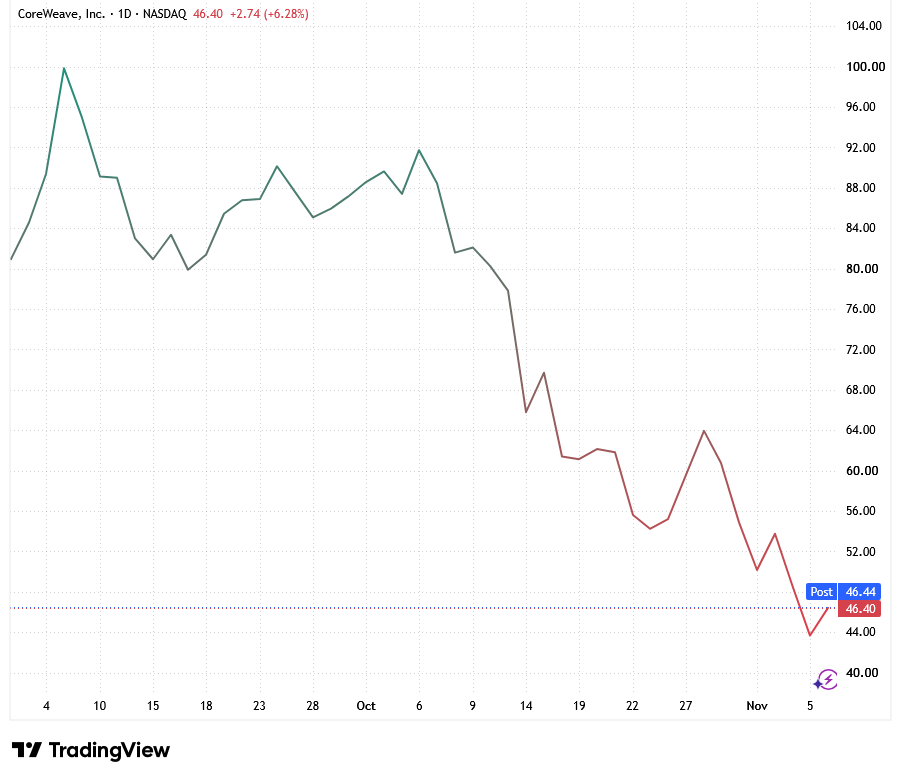
CoreWeave, despite the efforts of Nvidia and Wall Street to prop it up, is down 56%, and its bonds are yielding 17%, suggesting that the largest neocloud would have to pay credit-card-like interest rates if it needed to borrow more money. Another major neocloud, the UK-based Nscale, may have to cancel its planned IPO after Microsoft turned down a multibillion-dollar data center deal with the startup.
Does this mean the AI bubble has burst? Not necessarily. The AI boom has survived downturns of a similar magnitude before, including after the Trump “Liberation Day” tariffs last year. Chipmakers, cloud computing companies, and other companies at the center from the AI infrastructure build-out report are likely to continue to report bumper profits, as AMD did last week.
But at some point, one has to think Wall Street will wake up to the fact that those companies are selling shovels to gold miners. The gold rush only pays off if someone actually hits paydirt.
That brings us back to the importance of Anthropic’s IPO. Anthropic is stunningly unprofitable, but, having overtaken OpenAI as the biggest AI model developer by revenue, it is the closest thing the AI industry has to a successful gold miner. A hit Anthropic IPO would show that markets still believe the gold rush will eventually pay off. If, on the other hand, Anthropic’s stock market debut falls through or falls flat, markets’ current AI anxiety could turn to panic.
The odds of the latter outcome seem to be rising. Key investors, having already rejected Anthropic’s hoped-for valuation of $2 trillion, are now expressing discomfort even at $1.5 trillion, with buyers apparently thinking a valuation as low as $1.1 trillion would be more reasonable. Anthropic almost certainly won’t go public unless it can get a valuation a comfortably above the $965 billion figure it received in its last private funding round. That leaves little room for the IPO price to be negotiated down any further.
But even a successful IPO would, at most, earn Anthropic and the AI trade a reprieve. Anthropic’s slowing revenues and massive pile of non-cancelable lease and purchase commitments (which are, for all practical purposes, debt) show that its path to profitability is narrowing.
The same is true for the AI ecosystem as a whole. Collectively, tech companies are spending over $1 trillion this year on infrastructure for generative AI, but generative AI products and services are bringing in only a small fraction of that amount in sales. That gap has been widening rather than narrowing, and companies are planning to ramp up spending even more next year.
Even a wildly successful Anthropic IPO would do nothing to change those dynamics. The infusion of IPO cash would give Anthropic more cushion, but to pay its still-growing mountain of bills, the company would still need to quickly achieve and then sustain miraculous revenue growth. And, again, Anthropic’s revenue growth is currently slowing.
What the IPO would change is who pays the price if Anthropic falls short. Right now, Anthropic’s shares are overwhelmingly held by corporate insiders, Big Tech giants, and venture capitalists, meaning that Silicon Valley and Wall Street currently have the most to lose if Anthropic goes bust. After an IPO, ever-more of those risks would instead fall on workers, retirees, and retail investors whose retirement accounts and portfolios are already dangerously dependent on the teetering AI trade.
The SEC can and should stop that risk transfer from happening in light of Anthropic’s obfuscation and misleading statements regarding its finances. Perhaps the SEC is hesitating because regulators don’t want to further spook markets that are already nervous about the sustainability of the AI trade. But the whole point is that markets have good reason to be nervous. Allowing the Anthropic IPO to proceed might prop up the AI trade (if the IPO goes smoothly, anyway), but at the cost of further inflating the AI bubble and exposing ordinary people to greater losses when it inevitably bursts.
The SEC’s job is to protect Main Street, not Wall Street. If they bear that in mind, they will block Anthropic’s IPO. Otherwise, the economy will find itself in even more dire straits when Anthropic and its fellow AI gold miners run out of money for shovels.